Showing posts with label Walt Whitman. Show all posts

Thursday, 13 July 2017

U2 and Poetry: The Joshua Tree 2017 Tour


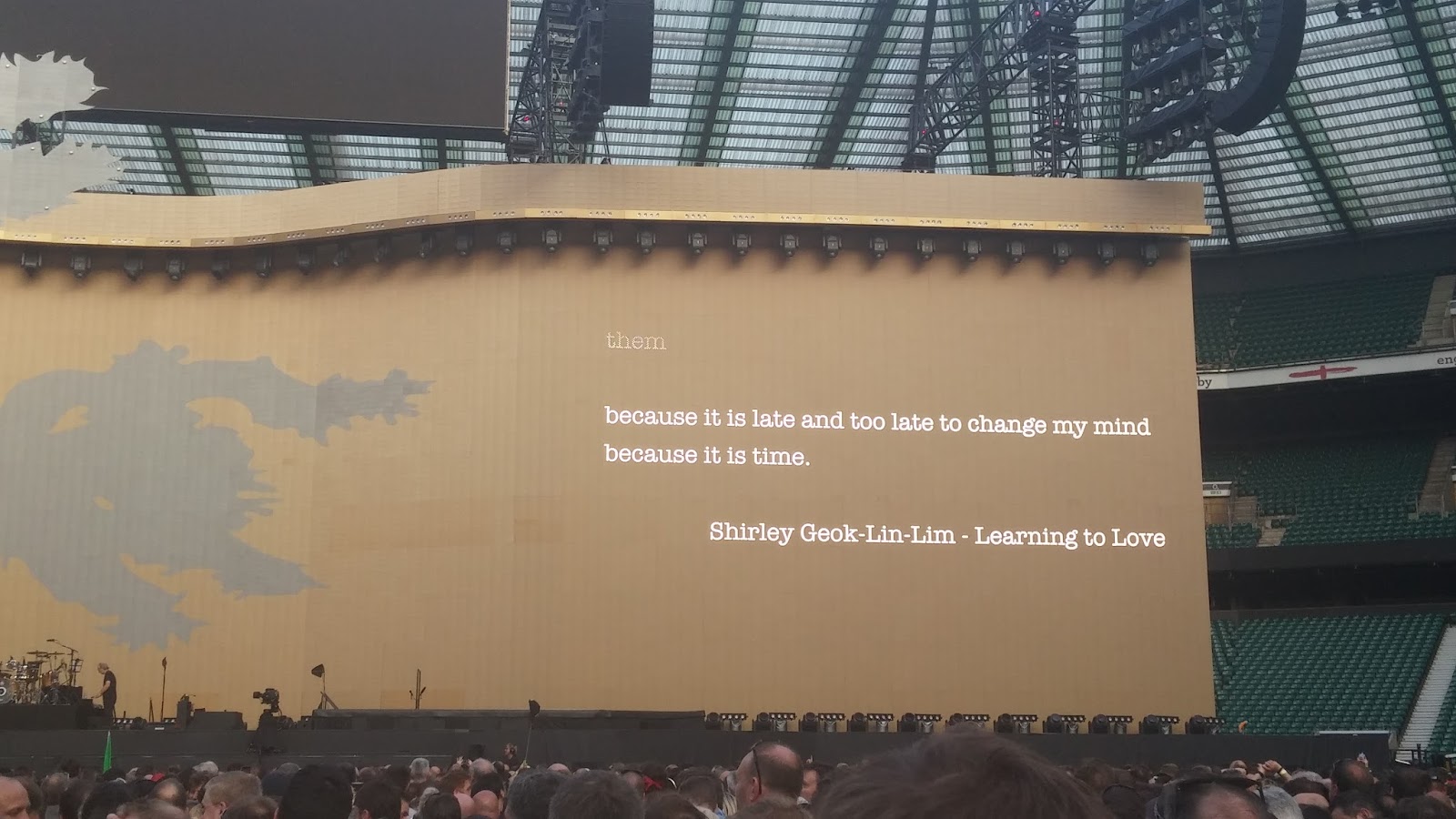
U2's current world tour is, unusually, not to promote a new album - it's for the 30th anniversary of The Joshua Tree and they are playing this album in its entirety, along with other songs before and after. I saw them last Sunday at Twickenham Stadium in London. It was a remarkable show for many reasons, not least of which was the screening of poems on the stage backdrop just before the show actually started.

I have a long history with U2, which sort of started close to 30 years ago when my brother bought The Joshua Tree. But it really started a few years later when I bought War, Under a Blood Red Sky, The Unforgettable Fire and later their other albums, when I was about 14. Those albums feature very prominently in my mental and emotional timeline from my early teens. I discovered those albums for myself, and the obsession was like falling in love. My relationship with The Joshua Tree is probably a bit harder to define, as I first encountered it through my brother and through the radio when I was younger. I was always impressed, but I also regarded the album with a slightly detached sense of awe which I've never quite shaken. I think it's their best record, but I'm not quite as closely bonded to it as I am to albums like War and Unforgettable Fire. I'm perhaps closer to its individual songs than I am to The Joshua Tree as a whole.

Before seeing U2 play on Sunday, I was already aware that they were scrolling poems on the big screen during the intermission between the opening act and the start of the main show. There was a fair amount of media coverage in Canada when one of the poems chosen was by Canadian poet laureate George Elliott Clarke. However, most (if not all) of the other poems chosen are by Americans, and it seems that different poems have been used at different shows. The poems that I saw were:

Elizabeth Alexander - 'Praise Song for the Day'. This poem was read at Barack Obama's inauguration.


Walt Whitman - a selection from Leaves of Grass


Sherman Alexie - 'The Powwow at the End of the World' 


Robinson Jeffers - 'Juan Higera Creek' 


James Dickey - 'The Strength of Fields'


Shirley Geok-lin Lim - 'Learning to Love America'  (this is actually the poem's full title, although it said 'Learning to Love' on the screen).


Pedro Pietri - 'Puerto Rican Obituary' (I didn't get a picture of this one, as the show was starting just as the poem finished...)

This U2 website has detailed more of the poems which were included on other shows (or perhaps I missed others when my friend and I were wandering around after the opening act.) Many of these poems will also be available to read online: http://www.u2songs.com/news/the_joshua_tree_tour_poetry

Personally, I was especially surprised and happy to see the Robinson Jeffers poem 'Juan Higera Creek'. Jeffers has been a bit of a well-kept secret for a long time, but in the current socio-political-environmental climate he seems to be enjoying something of a renaissance. I also love the James Dickey poem, 'The Strength of Fields'.

I don't know who was involved in selecting the poems, but to accompany (or precede) The Joshua Tree, they seemed to me exceptionally well chosen. In them, I saw the following which I also find in The Joshua Tree:

A variety of voices and experiences, including those of minorities and immigrants. The poems are by Native Americans, African Americans, Asian Americans and Hispanic Americans, among others. U2 composed The Joshua Tree in part because they'd fallen in love with America, and as Irish musicians they were well aware of their country's close links to America and of the huge numbers of Americans who are descended from Irish immigrants.

American landscapes. The landscapes of The Joshua Tree are dual (at least), as in poetry's landscapes. When U2 played 'Where the Streets Have No Name' ("I'll show you a place high on a desert plain, where the streets have no name"), the huge backdrop screen sent us flying along an American desert highway. The song was also partly inspired by Bono's humanitarian work in Ethiopia and by the divisions in Northern Ireland when he was growing up; finally, it seems to be about the speaker's spiritual quest (continued in 'I Still Haven't Found What I'm Looking For'. There seems to be something of this in 'The Strength of Fields'.) But the imagery of the album's lyrics often evoke idealised American landscapes, especially in the song 'In God's Country'. These poems also travel all over a real and figurative America.

Stories of oppression. 'Puerto Rican Obituary' came out of Pedro Pietri's experiences in advocating for civil rights along with fellow Puerto Ricans in America, and it tells a series of tragic stories. The songs 'Bullet the Blue Sky' and 'Mothers of the Disappeared', in particular, are about US military intervention in Latin America and about los desaparecidos in countries such as Argentina, Chile and El Salvador. There is a strong duality in The Joshua Tree between a mythical America and a violent one, whether internationally or closer to home (the song 'Exit' is about gun violence, and apparently the line "The hands that build can also pull down" also comments on the dual nature of US interference abroad).

The language of the poems may at times be prosaic, but the impression is often prophetic and spiritual, even shamanistic. This is also very reminiscent of U2's (Bono's) lyrical approach. Bono often includes literary references in his songs, and this was definitely a factor in my affection for U2, especially given that I was falling in love with U2 and with the poetry of WB Yeats at the same time in my early teens. Here are some of the notable poetry references in U2 songs:


  • "Into the half-light" - from 'Bad' (The Unforgettable Fire), also a reference to 'He Wishes for the Cloths of Heaven' by Yeats
  • 'A Sort of Homecoming' (The Unforgettable Fire). The title of one of my favourite U2 songs is taken from the quotation "Poetry is a sort of homecoming" from Paul Celan's 'Meridian' speech. When I learned that Bono had been influenced by Celan's writings in this song, I went to find Celan in the library, meaning that U2 are directly responsible for introducing me to his work. Also in 'A Sort of Homecoming', Bono sings 'O come away, o come away' which is a likely reference to 'The Stolen Child' by Yeats.
  • "In the world a heart of darkness, a fire zone/where poets speak their heart then bleed for it/Jara sang his song, a weapon in the hands of love/You know his blood still cries from the ground" - from 'One Tree Hill' (The Joshua Tree). Victor Jara was a Chilean songwriter, poet and political activist who was murdered under the rule of Pinochet. His last lyric was 'Estadio Chile' and it was written just before his violent death in the Chile Stadium (which has been renamed after him.)
  • "See the stone set in your eyes" - from 'With Or Without You' (The Joshua Tree). This reminds me of "The stone's in the midst of all", from Yeats's 'Easter 1916', but I admit this may be a long shot on my part.
  • "In dreams begin responsibilities" - from 'Acrobat' (Achtung Baby). This is adapted from the epigraph to the Yeats collection Responsibilities.
  • "Hope and history don't rhyme" - from 'Peace on Earth' (All That You Can't Leave Behind), a song partly based on the Omagh bombing of 1998 by the so-called Real IRA. This line is adapted from a famous quotation in Seamus Heaney's The Cure at Troy, a version of Philoctetes by Sophocles. Bono spoke here of his love for Heaney's work: https://www.theguardian.com/books/2013/sep/01/bono-seamus-heaney-tribute-poetry  

There are plenty of other literary references in U2, but I suppose it comes down to this: Sunday's concert was one of the best of my life (the fact that we had hard-to-come-by standing tickets helped a lot), and The Joshua Tree has more than stood the test of time. It was lovely to see some great poetry projected on the screen for all to read, and to reflect on how both poetry and U2 have accompanied me, and often intersected, for a very long time. 


Photos: The Joshua Tree Tour - Twickenham, July 9, 2017. Taken by Clarissa Aykroyd

Monday, 9 March 2015

Emily Carr at Dulwich Gallery: "A Continual Miracle"


Emily Carr, Big Eagle, Skidegate, B.C. c. 1930, Watercolour on paper, 76.2 x 56.7 cm, 1980.034.001, Art Gallery of Greater Victoria, Donated in memory of Dorothy Plaunt Dyde


I finally went to Dulwich Picture Gallery's exhibition of Emily Carr, the artist from British Columbia who for me is local. For most of her life, her home was in Victoria, which is also my hometown. Her house is a museum which is a stone's throw from where some of my friends live and not far from my childhood home. Her grave is in Ross Bay Cemetery, one of the oldest graveyards in Canada and just down the road from my house.

It was strange to see Emily Carr's works in a London gallery, especially when a few of the paintings and sketches depicted places I grew up with and saw almost daily, such as Clover Point and Ross Bay. In part, this exhibition followed on from the Group of Seven exhibition a few years ago, which was an enormous success. Carr was associated with the Group of Seven, but their works mostly represent other parts of Canada, especially Ontario. Emily Carr was a pure West Coaster and her works depicting areas such as Haida Gwaii and the Skeena River are iconic. I admit that part of the interest of these exhibitions is the feeling of moving through like a shadow and watching the mostly British art lovers look at paintings and descriptions of places I know, or at least places close to home, with the interest and bewilderment of those confronted by something quite exotic. The exhibition also featured artifacts of First Nations tribes from the Pacific Northwest such as the Haida, Gitxsan and Tsimshian, which helped to put the places she went to and depicted in context.

I was surprised at how richly the paintings struck me, after never being terribly interested as a child, and forgetting many except the most famous pieces. The deep forest paintings featured a rich, hallucinogenic green and shapes both rounded and geometric. In lighter, more open woods and her more impressionistic period, the trees seem to be swirling in a wind on the canvas, drawing the eye upwards. Other paintings and sketches show First Nations buildings, canoes and totem poles in vivid, documentary-style detail.

Emily Carr, Tree (spiralling upward), 1932-1933, oil on paper, 87.5 x 58.0 cm, Collection of the Vancouver Art Gallery, Emily Carr Trust, VAG 42.3.63, Photo: Trevor Mills, Vancouver Art Gallery


 Emily Carr, Indian Church, 1929, oil on canvas, Overall: 108.6 x 68.9 cm. ART GALLERY OF ONTARIO, Bequest of Charles S. Band, Toronto, 1970, 69/118


An extremely independent and adventurous woman, especially for her time period, Carr was also a writer - mostly of prose, but she loved and appreciated the poetry of Walt Whitman and the British Romantics. This Whitman poem, 'Miracles', was a particular favourite of Carr's, especially the last two stanzas.


MIRACLES (Walt Whitman)


Why, who makes much of a miracle?
As to me I know of nothing else but miracles,
Whether I walk the streets of Manhattan,
Or dart my sight over the roofs of houses toward the sky,
Or wade with naked feet along the beach just in the edge of the water,  
Or stand under trees in the woods,
Or talk by day with any one I love, or sleep in the bed at night with any one I love,
Or sit at table at dinner with the rest,
Or look at strangers opposite me riding in the car,    
Or watch honey-bees busy around the hive of a summer forenoon,
Or animals feeding in the fields,
Or birds, or the wonderfulness of insects in the air,
Or the wonderfulness of the sundown, or of stars shining so quiet and bright,
Or the exquisite delicate thin curve of the new moon in spring;
These with the rest, one and all, are to me miracles,
The whole referring, yet each distinct and in its place.

To me every hour of the light and dark is a miracle,
Every cubic inch of space is a miracle,
Every square yard of the surface of the earth is spread with the same,
Every foot of the interior swarms with the same.

To me the sea is a continual miracle,
The fishes that swim - the rocks - the motion of the waves - the ships with men in them,
What stranger miracles are there?     

Tuesday, 4 November 2014

A Long Weekend of Paris and Poetry


Ten days ago I went to Paris for a long weekend. I think it was my sixth visit (between the age of seven and, er, now), but my first in a few years, and Paris is never not worth visiting. I was with a friend from London and we also met up with one of my good friends who lives in the south of France, and one of her Parisian friends. Over the course of four days there was much amazing food, speaking French, wandering and taking photos, a wonderful visit to the Louvre, bookshops, a ramble round the base of the Eiffel Tower (the queue was too long to go up), and more.

There were, of course, poetic moments. I had thought to make a Paul Celan pilgrimage to his grave (in the outskirts of Paris) and maybe his last address on Avenue Emile Zola, and the Pont Mirabeau, but in the end I just wasn't in the mood for the sadness - and I would have been reluctant to drag my friend along. The Celanian pilgrimage is still on my list to do another time, though. But as always, there were the bookshops in St-Michel, especially my favourite, Gibert Jeune. Their 'livres poche' section is to die for. I bought poetry collections by Paul Eluard, René Char and André Breton (after my recent post about liking Spanish poetry more than French poetry...I felt this was a good time to act). I could easily have gone crazy in their poetry section, and I slightly wish I had, but honestly I have more than enough French poetry at home to keep going for a while.

We also went to the lovely Shakespeare & Company, where a pianist played jazz upstairs and we squeezed through the narrow aisles packed with books. I was a little unnerved to see A Cypress Walk, the correspondence between Alun Lewis and Freda Aykroyd (my great-aunt), displayed in the war poetry section. (I still haven't read it....) 


 And there was Walt Whitman, in French, outside the shop...


In the Île de la Cité, I came across Edmond Fleg, who I didn't know. All I have learned so far is that he was a Jewish French writer who wrote much work, including poetry, closely based on the Bible and his Jewish beliefs. I'd like to learn more.


We were staying in Montparnasse, for which my mother had given me a few tips from her student days in the '60s. The hotel was pleasant and there was an amazing crêperie where we feasted a couple of times. Also notable, of course, was the Montparnasse cemetery, across the road from our hotel. We walked through shortly before collecting our bags on the last day to go to Gare du Nord, and I wanted to see Baudelaire's grave. As I craned my neck to find the exact spot, having only a rough idea from the cemetery map, a middle-aged man walked by smoking a little cigar, smiled, and wordlessly gestured at the grave of the Baudelaire family.


And of course, there were many other places and moments with their own poetry. I love Paris. It is a city that wears the darkness lightly.


 Photos © Clarissa Aykroyd, 2014


Wednesday, 13 August 2014

Robin Williams and Walt Whitman: 'O Me! O Life!'


Robin Williams in Canada, 2004. Photo by Darsie. Used under Creative Commons license


O ME! O LIFE! (Walt Whitman)


Oh me! Oh life! of the questions of these recurring,
Of the endless trains of the faithless, of cities fill'd with the foolish,
Of myself forever reproaching myself, (for who more foolish than I, and who more faithless?)
Of eyes that vainly crave the light, of the objects mean, of the struggle ever renew'd,
Of the poor results of all, of the plodding and sordid crowds I see around me,
Of the empty and useless years of the rest, with the rest me intertwined,
The question, O me! so sad, recurring - What good amid these, O me, O life?


                                       Answer.
That you are here - that life exists and identity,
That the powerful play goes on, and you may contribute a verse.


By now everyone has heard about the tragic death of actor Robin Williams a couple of days ago. Comic actors are not usually my favourite actors, but nearly everyone loved Robin Williams, and for my generation he was an inevitable part of our lives. The fact that he took his own life feels particularly sad and hard to come to terms with.

In Dead Poets Society, Williams' character John Keating quotes Whitman's 'O Me! O Life!' in part. He prefaces it with one of my favourite quotations about poetry, by anyone: "We don't read and write poetry because it's cute. We read and write poetry because we are members of the human race. And the human race is filled with passion."

I first saw Dead Poets Society when I was 13 or 14 (a few years after it first came out) and it made a deep impression. I loved its passion and drama and I feel sure that it sent me at least a small step of the way along the road to becoming a poetry lover. I watched it again recently for the first time in years and I still enjoyed it. Dead Poets Society is often criticised for mixed messages and for a facile view of the humanities, even for being manipulative. The fact is, though, that all art is manipulative in some way, and the messages I got from Dead Poets Society were: love poetry, live life to the full, be an inspiring teacher if that's your vocation. Not bad things.

I like Whitman's poem because anyone can find common ground in it. Regardless of our choices in life, our beliefs, and so on, most of us find life challenging and often sad, most of us are often disappointed in ourselves. Here Whitman says - keep trying, contribute a verse. They are beautiful and helpful words. Many people will be thinking of them this week and wishing that Robin Williams could have found a way.