Showing posts with label Paul Celan. Show all posts

Saturday, 28 November 2020

Remembering Paul Celan, 1920-1970


November 2020 is the centenary of Paul Celan's birth, and in 2020 it is also 50 years since he died. I have often written about him in this blog, but it has been lovely to see him widely commemorated this year and especially in this past month, even if many events had to be moved online due to the pandemic. And this has its advantages - in the past couple of weeks I attended a couple of excellent Celan events from Deutsches Haus in New York, despite living in the UK. 

While Celan's poetry is often considered difficult, he has managed to gain legions of readers who haven't been put off by this discouraging label and who often (like myself) can't read him in German, the language in which he wrote most of his poetry. Sometimes if I'm looking at Twitter late at night (a bad habit) I find myself searching to see who's tweeting about Celan all over the world (a good habit, or at least a better habit). English is by no means the dominant language, and I'm not sure German is either - he seems particularly popular in Spanish and Turkish. 

Celan's identity is very difficult to pin down in any way. He was Jewish, but that isn't necessary the dominant influence on his work (although it is massive). He was German-speaking but not German. He was Romanian, but his hometown of Chernivtsi is now in Ukraine. His greatest poetic work came from years in Paris, and he worked as a translator with many languages. All of this has probably succeeded in making him more universal. His poems are like radio transmissions directly from his mind and heart, in an new language, untranslated, somehow and mysteriously unmediated in a way that is different from most other poetry. The silences, gaps and elisions in his poems are also like the moments when the radio waves break up - but they are entirely deliberate, an essential part of the work of art, at times the most essential.

My love for Celan's work has sometimes puzzled me. He is not particularly like any other poet or writer that I love. The fact is, though, that he is simply not much like any other poet or writer at all. While his work evidently poses many extreme difficulties for translators, there is no question that the emotions carry across and pierce through. Celan's poems can seem surreal or abstract but they often refer to very specific people, places, events. To know him fully, perhaps these need to be unpicked to a level most of us never will reach. And yet Celan himself said that his work could be understand if readers would simply engage and read the poems again and again. At one of the events I attended, the author Paul Auster said that Celan's intellectual prowess was immense but that the defining factor and what has made his work so loved was the spirit, the emotion that burns from him onto the page. The Celan expert Christine Ivanovic said that even when you engage deeply with Celan and read him again and again, there will be texts that you don't understand, but you still live with the words. This has been entirely my experience. I have lived with Celan since my late teens (which seems to have been a crucial moment at which many enthusiasts and experts encountered him.) I love and admire translations by dedicated translators such as Pierre Joris and John Felstiner, but in English Celan truly lives in me through the work of translator and poet Michael Hamburger, because that was the encounter from which everything else followed. There is always an encounter with Celan - there are many encounters and they persist and can last for a lifetime. He once wrote "I see no difference between a handshake and a poem," and this despite the extraordinarily personal and often mysterious nature of his work. 

In some way I think about Paul Celan and his words every day. I feel as though a small, dedicated area of my mind (or perhaps more accurately, my heart) is occupied with his poetry all the time, even if I may not have read him for a while. He influences my own poetry and beyond that, he takes me to a Celanworld of such unique specificity and beauty that it hurts. His words are a place where no one else had ever gone and where we can all go now, across the threshold. "Louder whirring. Nearer glow. This world and the other." (from 'Under a Picture', translated by Michael Hamburger)

Here are a few of his poems to read if you haven't before or if you wish to revisit him.


Image: Paul Celan's passport photo, 1938. Author unknown. 

Wednesday, 29 January 2020

Alice Oswald's Nobody at Kings Place, and Anselm Kiefer at White Cube


In the past couple of weeks I went to two events which were either poetry, or poetry-adjacent ("adjacent" is my current overused word) and wanted to write a little about them here.

Alice Oswald, who is definitely "the great Alice Oswald" and is also now the first woman Oxford Professor of Poetry (though not the first to be elected - that was Ruth Padel), performed at Kings Place on 17 January with live music by Ansuman Biswas. Oswald does specifically "perform" rather than "recite" or "read" - even her more conventional appearances involve her almost chanting her poems off by heart, unforgettable performances unlike anyone else's. I have written about seeing her a couple of times before, and this was one of the less conventional appearances. It started with a "sound calendar" or seascape by Chris Watson, and the actual performance was mostly in total darkness, although there was partial lighting for sections of it.

Oswald was performing Nobody, her most recent book, based on stories of water, humans and gods from Greek mythology. I'm only superficially knowledgeable about the Odyssey and related works, so I appreciated Nobody more from a sea-perspective, but the tales that washed in and out sometimes had an odd familiarity. Ansuman Biswas performed on the aquaphone, which reminded me of sea sounds washing into a cave, and also an enormous gong, which was overwhelming to the point of being almost distressing at certain points. The whole performance was mesmerising, thrilling and absolutely haunting.

Last weekend I went to Anselm Kiefer's new exhibition Superstrings, Runes, The Norns, Gordian Knot at White Cube in Bermondsey. I got in just under the wire - the exhibition had been on for a few months but was in its final hours when I went. I was very glad that I did make it, as I've found that Anselm Kiefer is one of the very few contemporary artists who I really connect with. I've written about him on this blog before, as my way into his work was through the poetry of Paul Celan, one of his greatest inspirations (and mine...)

The tangled, broken, cascading canvases and masses of wires weren't quite as enthralling to me as Kiefer's exhibition Walhalla, also at White Cube a few years ago, or the retrospective at the Royal Academy which introduced me to his work - although this was still excellent. This exhibition also seemed a little less poetry-influenced. But poetry was still there: one canvas took inspiration from Georg Trakl, another from the Kalevala, a work which brings together traditional poetry about Finnish mythology. In one of the books accompanying the exhibition, Kiefer referred to Ingeborg Bachmann's poem 'Bohemia Lies By the Sea'.

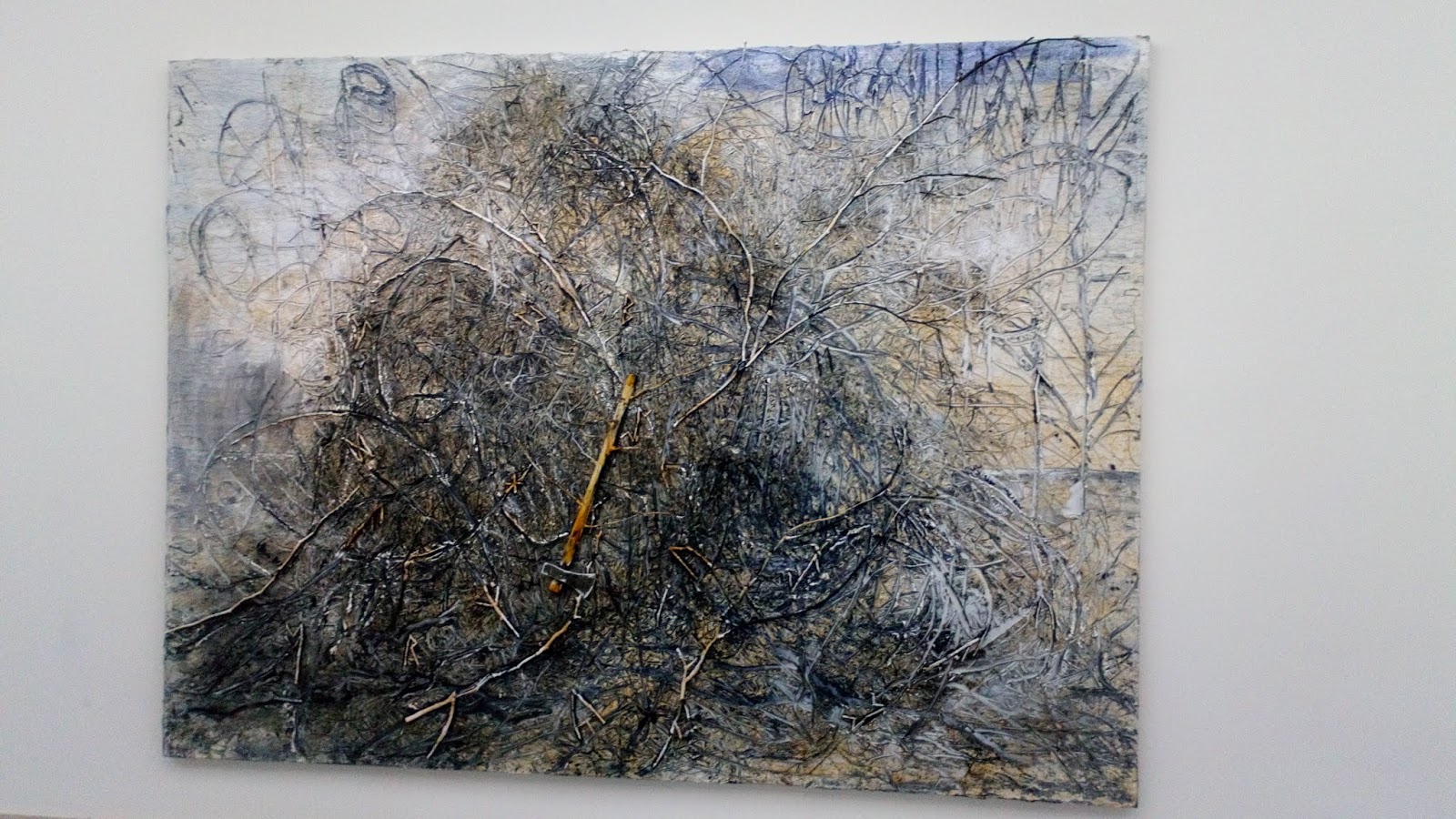
The painting below, one of the Gordian Knot series which featured axes, seemed slightly more optimistic than most of the other works in the exhibition (which probably tells you something about how "optimistic" it was overall: Kiefer is pretty shattering, almost literally.) I don't quite know what it was - perhaps the colours. I just knew that I felt a slight lifting of the heart. But it also reminded me of Paul Celan's poem 'I hear the axe has flowered'. You can read this poem in full, along with a few others, in translation by Ian Fairley on this link: https://www.guernicamag.com/four_new_translations_of_paul/


Tuesday, 8 October 2019

New Poem Published for National Poetry Day, & Sherlock Holmes Essay


I never feel as though I end up fully participating in National Poetry Day, because if I'm in London I'm working (it's the first Thursday in October) and if I'm off work, it's typically because I am out of town. I am currently in Canada, which also meant an eight-hour time difference. However, "participating fully" isn't really the point: enjoying and promoting poetry is, and there's always a way to do that at least a little.

The theme of National Poetry Day this year was Truth. I was delighted that the wonderful Ink Sweat & Tears chose my poem 'Speaks true who speaks shadow' as one of fifteen poems in total that they published across five days, on and around National Poetry Day. You can read the poem here: http://www.inksweatandtears.co.uk/pages/?p=20142&fbclid=IwAR2vfh2nSOp8A9r8M19eIc_C3pxSr6ILZgHb4tknfDDplzvvUVsWut58PuQ

The title of the poem is taken from Paul Celan's poem 'Speak you too' (the translation by John Felstiner), and my poem is dedicated to Alexander Litvinenko, who was assassinated in London in 2006. I have always been fascinated and saddened by Litvinenko's story, and I recently saw the play A Very Expensive Poison at the Old Vic, which is about his life and death, so it has all been on my mind.

On another subject, and really not poetry but I'm going to mention it anyway, I've published another essay about Sherlock Holmes in the new collection Sherlock Holmes is Everywhere!, published by Belanger Books. The essay is essentially about how I find Sherlock Holmes in London, and it's just one of a huge variety of essays which locate Holmes anywhere and everywhere. The Belanger Books website is here, but you will find that it takes you to Amazon to purchase the book, so you can also search for it there.

Saturday, 13 July 2019

Review: David Howard - The Ones Who Keep Quiet


New Zealand poet David Howard, who lives in the South Island city of Dunedin, has held residencies as close to home as the University of Otago and as far away as Prague; his next residency will be in Ulyanovsk, Russia. His most recent collection, The Ones Who Keep Quiet (2017, Otago University Press), is equally connected to New Zealand, the South Pacific and cities of the Northern Hemisphere, through the shifting figures of Auckland businessmen, alleged spies, and others.

It's an ambitious comparison, but The Ones Who Keep Quiet has something in common with TS Eliot's Four Quartets in that its poems are typically grounded in real-world places, with an almost overwhelming level of historical detail (a couple of the poems have end notes to rival Eliot's The Waste Land), but they feel internal, intellectual, mystical. If anything, they seem to depict the movement of the human mind, with its blend of the abstract and the concrete, and often under great pressure. In some cases, the pressure takes the most final form, death.

The first piece in the book is a long poem written in sestains. 'The Ghost of James Williamson 1814-2014' is about the Belfast businessman's youth on his father's ships and his eventual existence in New Zealand - both before and after his death on 22 March 1888. Appropriately, the sestains flow down the page in shapes suggesting waves, or brainwaves. There are also the tides of belief, their ebb and flow:

    ...Our fall into Paradise shows
             God is an ironist
             who gives the knife another twist -
    pointed refusal to disclose
proof He's the first cause.

There is, perhaps, also an echo of the famous ship appearing at Clonmacnoise in Seamus Heaney's 'Lightenings' (viii), when "stunned under the Gothic/arch of a monstrous swell", James Williamson declares: "the unreal becomes our last port of call". As with most poems in The Ones Who Keep Quiet, the writing is very dense and allusive, with occasional leaps which seem almost random but are carefully calculated. This poem concludes on a very odd and ironic note of "sex, drugs and rock'n'roll", which at first seemed entirely incongruous to me based on its protagonist's life in the 19th century: however, it succeeds in giving the impression that the ghost is floating freely in time, but also trapped.

Throughout, and with rare exceptions, I was more enthralled by the collection's long poems than by the shorter lyrics, as Howard's work seems to excel when it has more leisure to establish a voice and to sink into a story or a train of thought. 'The Speak House' is another centrepiece of the book, a dive into the mind of Robert Louis Stevenson in the last few hours of his life. The poem is full of very specific references to Stevenson's life and work and had a slightly overwhelming level of end notes, but the most rewarding moments are often those of sudden clarity: "Starlight strikes the dead and the living/with equal intensity, flesh being what it always was" and "breathless/running after my shadow: that is what writing is." After the demands of 'The Speak House' I turned with some relief to one of the best shorter poems (well, two pages), 'The Vanishing Line', a self-scrutinizing poem with an unfolding/enfolding structure and echoes of Paul Celan: "Between, that is where the poem grows/between the visible, the invisible."

Howard touches on family history, on love, and dedicates a beautiful poem ('L'Histoire du Soldat') to Russian poet Tatiana Shcherbina. Particularly intriguing, though, is the long poem 'Prague Casebook' which, as Howard says in the end notes, "circles the character of the New Zealander and alleged spy Ian Milner (1911-1991)". A Rhodes scholar and friend of Miroslav Holub, Milner was eventually identified as a spy who passed information to the Soviets while working for the Australian Department of External Affairs in the Post-Hostilities Division during the 1940s. He defected to Czechoslovakia, but denied having been a spy. Milner's case is still controversial. His voice in 'Prague Casebook' is ironic and elusive, sliding away, providing excuses or perhaps simple facts: "Poetry's half a meal. Don't go hungry." Milner seeks kinship with Russian poets Mayakovsky and Mandelstam - "Sing/Vladimir, sing Osip, to show we are still men among men", but no doubt also recalls their troubled or fatal relationships with the Soviet authorities. Addressing God in the closing lines of the poem, Milner could be admitting to guilt, or defining himself as a victim, or both: "Your paradise was a short ride in a fast car, I got out/on the wrong side, that's clear as ice on the highway at first light."

The Ones Who Keep Quiet isn't a perfect collection: I found that its self-consciousness could occasionally be stifling, and Howard succeeds noticeably better with male voices and characters than with female perspectives. However, it is an exceptionally skilled and ambitious work which will reward rereading, as it offers so many layers to explore. Readers who appreciate psychology, flair and challenge in their poetry will enjoy The Ones Who Keep Quiet.


Review copy courtesy of Otago University Press 

Saturday, 20 April 2019

Michael Hamburger Event and Questions of Translation


A couple of days ago I went to an event at the British Library, 'Poet in the Archives: Michael Hamburger', with discussions between Karen Leeder, Jen Calleja and Iain Galbraith.

I will immediately admit that my interest in Michael Hamburger is (so far) almost entirely related to his translations of Paul Celan's poems: in fact, for me, he is the voice of Paul Celan in English. I have also been impressed by others' translations (Felstiner, Joris, etc) but I first encountered Celan through the English words of Michael Hamburger when I was only about 18 years old, and that was inevitably a more powerful experience than I was even able to comprehend at the time. In a way, it was good that this event didn't involve a lot of discussion of the Celan translations - it was more about his own poetry, his criticism, his correspondence, and his general approaches to translation (he also worked on Rilke and Hölderin among others), and so it broadened my horizons.

Karen Leeder said: "He wrote his criticism with the voice of a poet" and that Hamburger was interested in translation as a mirror image rather than as an imitation - "he only translated what he felt he could understand." There was discussion of the peculiar musicality of his translations, and his love of letter-writing - he sometimes kept up intense correspondences with people he'd only met once or who had simply written to him with a question or observation. Iain Galbraith, who had known him personally, quoted Hamburger as having said "The poems that don't embarrass me are the ones that surprise me." Jen Calleja, who had been working on Hamburger's material in the British Library archives, read poems based on this exploration, some of them wittily based on subjects like disgruntled readers' corrections of his English equivalents.

On a different but related note, I have just read this Asymptote article by Jen Calleja and Sophie Collins about translation: https://www.asymptotejournal.com/special-feature/jen-calleja-sophie-collins-she-knows-too-much/

I wanted to share it because I have occasionally thought of writing something along the same lines on this blog, but this is much more informed and thorough than anything I could have written. In essence, while there's an obviously growing interest in poetry translation and that's fundamentally a good thing, it's also quite obvious that some potential or even tangible problems have arisen, along the lines of poets who are only fluent in English superseding the actual translators in collaborative translation, and related issues. This article is essential reading for anyone interested in current developments in the translation of international poetry into English.


Friday, 12 October 2018

New Poems Published in The Interpreter's House and Ink Sweat & Tears


I think that poem publications are much like buses in that often there are none for ages and then there are a few at once. Or at least two.

This week, my poem 'Healer' appeared in Ink Sweat & Tears, as part of their National Poetry Day feature (which they have a tradition of turning into National Poetry Week). The next day, my poem 'In Paris' was published in The Interpreter's House, which has just moved to a new online format.

I wrote 'Healer' a couple of years ago when I did a residency with the Poetry School and London Parks & Gardens Trust, in Cleary Garden, a historic public garden in the City of London. Although it was named after Fred Cleary, who campaigned for public spaces in the City, Cleary Garden was originally founded by Joseph Brandis, the subject of the poem. There aren't a lot of details about Brandis (that I'm aware of) but he was a member of the Cordwainers Company, and he did such a good job of transforming that particular bomb site into a garden that the Queen visited in 1949. The theme of this year's National Poetry Day was 'Change', so the poem was perfect for the Ink Sweat & Tears feature.

'In Paris' was written last year, after my last visit to Paris (a weekend meet-up with my brother). I've now been reading Paul Celan for over 20 years, and his importance in my writing and reading life can hardly be over-estimated. I've written a few poems more or less inspired by or dedicated to him, but this is definitely the one I'm happiest with. I always think of Celan in Paris, although, as the poem says, I've never gone as far as Pont Mirabeau (he lived nearby and is presumed to have jumped to his death from that bridge).


Photo: Cleary Garden, London. Taken by Clarissa Aykroyd

Monday, 31 July 2017

The Benjamin Fondane Update


In case you thought this was just a lot of big talk, I actually did pick up Benjamin Fondane's Le mal des fantômes in Paris a few months ago and I've now translated a few of his poems. I'm looking at translating a few more and seeing if I can find a suitable home for them somewhere. (I feel more trepidation over sending out translations than over sending out original work, but that's another story.) 

In the meantime, I thought I'd share this interesting excerpt from a 1985 interview with EM Cioran, who knew both Fondane and Paul Celan. It confirmed my readings of their respective work. (The interview was with Leonard Schwartz and appears in the recent selection of Fondane's work in English translation, Cinepoems and Others, published by New York Review Books, 2016).


Leonard Schwartz: Do you see any sort of connection between Paul Celan and Fondane?

EM Cioran: I knew both Fondane and Paul Celan well, and I suppose it is true that they had something in common. They came from almost the same geographic area in Romania: Bukovina and Moldavia are provinces that border on each other. Both were Jewish poets and both had an intellectual curiosity which is not absolutely normal in a poet. But they were very different as men. Fondane had an immense presence; all became enlivened around him; we were very pleased to hear him speak. Around Celan one felt a kind of uneasiness. As I've told you before, Celan was so susceptible, so vulnerable: Everything hurt him... With Celan one always had to be on guard. He was a wounded man, in the metaphysical and psychological sense of the word, and that was why one felt so uneasy. Whereas Fondane was the contrary: You felt you didn't have to supervise yourself.


Thursday, 13 July 2017

U2 and Poetry: The Joshua Tree 2017 Tour


U2's current world tour is, unusually, not to promote a new album - it's for the 30th anniversary of The Joshua Tree and they are playing this album in its entirety, along with other songs before and after. I saw them last Sunday at Twickenham Stadium in London. It was a remarkable show for many reasons, not least of which was the screening of poems on the stage backdrop just before the show actually started.

I have a long history with U2, which sort of started close to 30 years ago when my brother bought The Joshua Tree. But it really started a few years later when I bought War, Under a Blood Red Sky, The Unforgettable Fire and later their other albums, when I was about 14. Those albums feature very prominently in my mental and emotional timeline from my early teens. I discovered those albums for myself, and the obsession was like falling in love. My relationship with The Joshua Tree is probably a bit harder to define, as I first encountered it through my brother and through the radio when I was younger. I was always impressed, but I also regarded the album with a slightly detached sense of awe which I've never quite shaken. I think it's their best record, but I'm not quite as closely bonded to it as I am to albums like War and Unforgettable Fire. I'm perhaps closer to its individual songs than I am to The Joshua Tree as a whole.

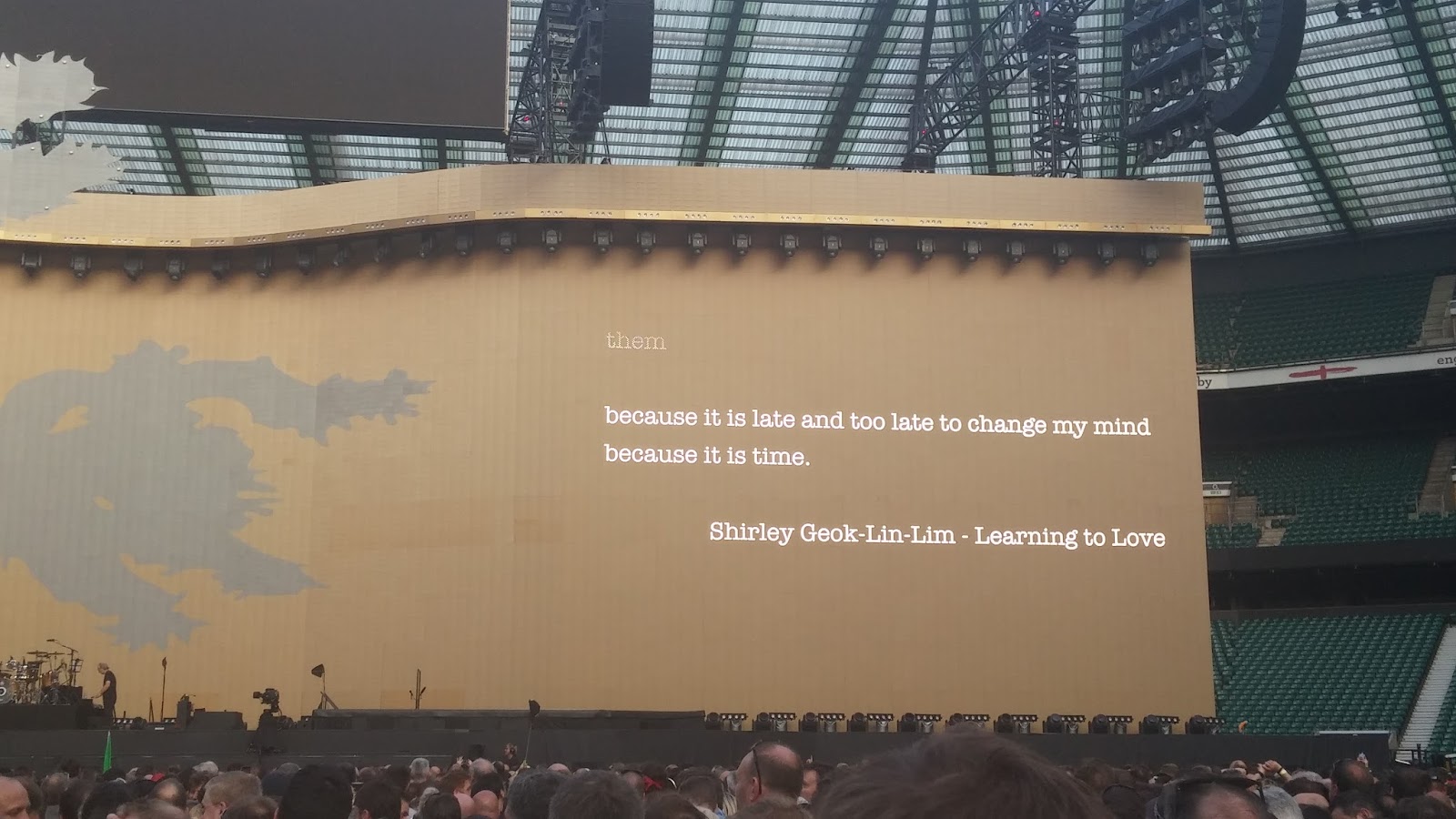
Before seeing U2 play on Sunday, I was already aware that they were scrolling poems on the big screen during the intermission between the opening act and the start of the main show. There was a fair amount of media coverage in Canada when one of the poems chosen was by Canadian poet laureate George Elliott Clarke. However, most (if not all) of the other poems chosen are by Americans, and it seems that different poems have been used at different shows. The poems that I saw were:

Elizabeth Alexander - 'Praise Song for the Day'. This poem was read at Barack Obama's inauguration.


Walt Whitman - a selection from Leaves of Grass


Sherman Alexie - 'The Powwow at the End of the World' 


Robinson Jeffers - 'Juan Higera Creek' 


James Dickey - 'The Strength of Fields'


Shirley Geok-lin Lim - 'Learning to Love America'  (this is actually the poem's full title, although it said 'Learning to Love' on the screen).


Pedro Pietri - 'Puerto Rican Obituary' (I didn't get a picture of this one, as the show was starting just as the poem finished...)

This U2 website has detailed more of the poems which were included on other shows (or perhaps I missed others when my friend and I were wandering around after the opening act.) Many of these poems will also be available to read online: http://www.u2songs.com/news/the_joshua_tree_tour_poetry

Personally, I was especially surprised and happy to see the Robinson Jeffers poem 'Juan Higera Creek'. Jeffers has been a bit of a well-kept secret for a long time, but in the current socio-political-environmental climate he seems to be enjoying something of a renaissance. I also love the James Dickey poem, 'The Strength of Fields'.

I don't know who was involved in selecting the poems, but to accompany (or precede) The Joshua Tree, they seemed to me exceptionally well chosen. In them, I saw the following which I also find in The Joshua Tree:

A variety of voices and experiences, including those of minorities and immigrants. The poems are by Native Americans, African Americans, Asian Americans and Hispanic Americans, among others. U2 composed The Joshua Tree in part because they'd fallen in love with America, and as Irish musicians they were well aware of their country's close links to America and of the huge numbers of Americans who are descended from Irish immigrants.

American landscapes. The landscapes of The Joshua Tree are dual (at least), as in poetry's landscapes. When U2 played 'Where the Streets Have No Name' ("I'll show you a place high on a desert plain, where the streets have no name"), the huge backdrop screen sent us flying along an American desert highway. The song was also partly inspired by Bono's humanitarian work in Ethiopia and by the divisions in Northern Ireland when he was growing up; finally, it seems to be about the speaker's spiritual quest (continued in 'I Still Haven't Found What I'm Looking For'. There seems to be something of this in 'The Strength of Fields'.) But the imagery of the album's lyrics often evoke idealised American landscapes, especially in the song 'In God's Country'. These poems also travel all over a real and figurative America.

Stories of oppression. 'Puerto Rican Obituary' came out of Pedro Pietri's experiences in advocating for civil rights along with fellow Puerto Ricans in America, and it tells a series of tragic stories. The songs 'Bullet the Blue Sky' and 'Mothers of the Disappeared', in particular, are about US military intervention in Latin America and about los desaparecidos in countries such as Argentina, Chile and El Salvador. There is a strong duality in The Joshua Tree between a mythical America and a violent one, whether internationally or closer to home (the song 'Exit' is about gun violence, and apparently the line "The hands that build can also pull down" also comments on the dual nature of US interference abroad).

The language of the poems may at times be prosaic, but the impression is often prophetic and spiritual, even shamanistic. This is also very reminiscent of U2's (Bono's) lyrical approach. Bono often includes literary references in his songs, and this was definitely a factor in my affection for U2, especially given that I was falling in love with U2 and with the poetry of WB Yeats at the same time in my early teens. Here are some of the notable poetry references in U2 songs:


  • "Into the half-light" - from 'Bad' (The Unforgettable Fire), also a reference to 'He Wishes for the Cloths of Heaven' by Yeats
  • 'A Sort of Homecoming' (The Unforgettable Fire). The title of one of my favourite U2 songs is taken from the quotation "Poetry is a sort of homecoming" from Paul Celan's 'Meridian' speech. When I learned that Bono had been influenced by Celan's writings in this song, I went to find Celan in the library, meaning that U2 are directly responsible for introducing me to his work. Also in 'A Sort of Homecoming', Bono sings 'O come away, o come away' which is a likely reference to 'The Stolen Child' by Yeats.
  • "In the world a heart of darkness, a fire zone/where poets speak their heart then bleed for it/Jara sang his song, a weapon in the hands of love/You know his blood still cries from the ground" - from 'One Tree Hill' (The Joshua Tree). Victor Jara was a Chilean songwriter, poet and political activist who was murdered under the rule of Pinochet. His last lyric was 'Estadio Chile' and it was written just before his violent death in the Chile Stadium (which has been renamed after him.)
  • "See the stone set in your eyes" - from 'With Or Without You' (The Joshua Tree). This reminds me of "The stone's in the midst of all", from Yeats's 'Easter 1916', but I admit this may be a long shot on my part.
  • "In dreams begin responsibilities" - from 'Acrobat' (Achtung Baby). This is adapted from the epigraph to the Yeats collection Responsibilities.
  • "Hope and history don't rhyme" - from 'Peace on Earth' (All That You Can't Leave Behind), a song partly based on the Omagh bombing of 1998 by the so-called Real IRA. This line is adapted from a famous quotation in Seamus Heaney's The Cure at Troy, a version of Philoctetes by Sophocles. Bono spoke here of his love for Heaney's work: https://www.theguardian.com/books/2013/sep/01/bono-seamus-heaney-tribute-poetry  

There are plenty of other literary references in U2, but I suppose it comes down to this: Sunday's concert was one of the best of my life (the fact that we had hard-to-come-by standing tickets helped a lot), and The Joshua Tree has more than stood the test of time. It was lovely to see some great poetry projected on the screen for all to read, and to reflect on how both poetry and U2 have accompanied me, and often intersected, for a very long time. 


Photos: The Joshua Tree Tour - Twickenham, July 9, 2017. Taken by Clarissa Aykroyd

Sunday, 28 May 2017

In Paris with Paul Celan (and the usual suspects)


A couple of weeks ago - only a few days after returning from a three-week visit to Canada - I went to Paris for the weekend. This year the IIHF World Championship (ie. ice hockey) was in Paris and Cologne, and I was there to meet up with my brother Lucas, who writes articles for the IIHF website.

Paris is one of my adored cities, and every visit there is different. It was strange to be going to a couple of hockey games while there (this time I got to see Slovenia-Belarus and Canada-Switzerland. Canada managed to lose to Switzerland!). At the same time, there always seem to be some common threads, often involving food, art and books. It is Paris, after all.

Besides spending time with my brother, my mission on this particular trip was to go to the Gibert Jeune bookshop on Place St-Michel and to find a few French poetry books. I was looking for Benjamin Fondane's Le mal des fantômes in particular, and possibly something by Yves Bonnefoy and Guy Goffette. This mission was accomplished in a matter of minutes when I found all of the above, but then I also ended up buying a French Sherlock Holmes pastiche (Einstein et Sherlock Holmes) by Alexis Lecaye. These things happen.

On the Sunday, my brother and were walking in the Marais (and, incidentally, avoiding the passation de pouvoir of the new president Emmanuel Macron, which would no doubt have been interesting to see but all the security was a bit off-putting.) On Rue Rambuteau, we stopped in at Les Cahiers de Colette (Colette's Notebooks), a lovely and distinctly intellectual bookshop. I'd say intellectual even by French standards - I find that in France there tends to be an underlying assumption of a certain intellectual level, which is perhaps one reason why some publishers tend not to include blurbs on their books. Editions Gallimard, who published a couple of my poetry purchases, is one of these. They just know you want to buy Yves Bonnefoy and Guy Goffette.

Anyway, in Les Cahiers de Colette I also saw these:


The second photo shows a reproduction of one of Paul Celan's letters. In the montage of faces, his jumped out at me right away. (Of course I recognised Beckett and Kafka, and found that Paul Eluard and André Breton were there too. There are others I feel sure I should know - feel free to identify them!)

I always feel close to Celan, somehow, even when I'm not actively reading him. It is about 20 years since I first read his work, and the writers I encountered in my teenage years have tended to have a particularly strong effect on me. I started reading him more actively about seven years ago, when I was also undergoing some particularly intense moments, so I think that Celan was really sealed into my life. But in Paris, I feel a little closer to him. As well as the knowledge that he walked those streets, there's a feeling that he is more remembered there.

Saturday, 21 January 2017

The Dreamed Ones: Filming the Celan-Bachmann Letters


Anja Plaschg, Laurence Rupp
© Ruth Beckermann 
Filmproduktion


Last week I went to see The Dreamed Ones (2016, directed by Ruth Beckermann) at Institut Français in South Kensington. I walked for over half an hour in a sleetstorm to get there - it's only been showing for a few nights here and there in the UK, so I was determined to see it.

The Ingeborg Bachmann-Paul Celan letters were first published in German in 2008, and a few years later in English translation. Prior to the publication of the letters, not much was known about the relationship between two of the greatest German-language poets of the 20th century (Bachmann was Austrian and Celan was a Romanian/Bukovinian German-speaking Jew. He is the very definition of 'hard to label'.) Celan and Bachmann met in Vienna in 1948 when he was 27 and she was 21. He wrote the poem 'In Egypt' for her 22nd birthday. They had an on-off affair/friendship, and correspondence, for 20 years, during most of which time they didn't see each other or only occasionally. Celan was married to artist Gisèle Lestrange when the affair resumed in the 1950s.

The Dreamed Ones (in German, with English subtitles) dramatises the letters by placing the audience in a studio with the young Austrian actors Anja Plaschg and Laurence Rupp, as they make a sound recording of the correspondence. That's all that happens. We see them recording some of the letters and bits of poetry; in between takes, they smoke, chat, flirt, and discuss the events and emotions behind the letters (for instance, why Bachmann chose not to send certain letters.) 

That's all that happens, but the film was beautiful. The letters themselves are almost indescribable; passionate, tender, thoughtful, wistful, paranoid, hurt... 

In mid-August I will be in Paris for just a few days. Don't ask me why or what for, but be there for me, for one evening, or two or three... Take me to the Seine, let us gaze into it until we become little fishes and recognise each other again. (Ingeborg Bachmann to Paul Celan)

How far away or close are you, Ingeborg? Tell me, so that I know whether your eyes will be closed if I kiss you now. (Paul Celan to Ingeborg Bachmann)

It does seem as though the passion and the darkness of the letters could be spilling over into the interactions between the actors, although this isn't explored too far. The playfulness and the silences between them illustrate something about how flesh-and-blood people interact or even fall in love, beyond the words. But this film is really about the words. There is something about the studio, and the faces (especially the eyes) of the actors, which create a space in which these letters can really breathe and live. I don't know how better to put it than that. The letters, beyond the pain and misunderstandings and imperfection, and the paranoia that Celan especially fell into, seem to achieve a spiritual-sensual level that I can't imagine many correspondences reaching, especially today. I just know that nothing really happened in this film but I didn't want it to end.


Saturday, 7 January 2017

Anselm Kiefer's Walhalla and Paul Celan Encounters


A few weeks ago I went to the Anselm Kiefer exhibition at White Cube Bermondsey, near London Bridge. This new exhibition, called Walhalla, runs until 12 February and it's free.

Anselm Kiefer, the German artist who was born just as World War II ended, produces art which is in a continual dialogue with Germany's history, with poets and philosophers, and with the times of rupture that we are living through. I went to his retrospective exhibition at the Royal Academy a couple of years ago and was blown away - which is a rare occurrence for me with contemporary art. You can read my thoughts about that exhibition here.

Kiefer's work feels shocking in the way that visiting the site of a concentration camp shocks. It's not so much what you see before your eyes as what seems to be in the air. It's a feeling of living in aftermath. The first thing I saw at White Cube was a long, dark hallway of hospital beds dressed with lead sheets. There was a warning not to touch the installations, as the lead could be dangerous.

Huge paintings of burning, crumbling towers - a spiral staircase draped with robes - a library-cum-apothecary bleeding film reels and pages... I found, as with the previous exhibition, that I was having an almost physical reaction to Kiefer's work. It seemed as though the world around me was going in and out of focus in a very unsettling way.

I went to that 2014 exhibition at the Royal Academy mainly because I had read that Kiefer was strongly influenced by Paul Celan. I wasn't disappointed, because there were works specifically inspired by Celan's poems. In Walhalla, the influence wasn't signalled quite so clearly. But then, in the cluttered room of giant drawers and film reels, I saw this:


Mohn und Gedächtnis (written on the bottom drawer) means Poppy and Memory, and it is the title of Celan's second book of poetry. In an installation which reminded me very much of some crazed, broken apothecary, and in an artist's work which continually tries to deal with the worst of memory, it seemed very appropriate.

Later, on another work, I saw this:


I had an eerie feeling when I saw this piece of writing. I don't actually speak German, but I was sure I recognised the words. I was sure I knew the poem and the exact lines it referred to. And when I checked later, I found I was right:

bone-Hebrew
ground into sperm
ran through the hourglass
through which we swam, two dreams now, chiming
against time, in the squares.

(from 'In Prague', translated by Michael Hamburger)

This happens to be one of my favourite poems by Celan, and the shock of recognising lines from it on the side of a work of art, in the original German, was considerable. I have to read his poems in translation, but usually I do so with the original on the facing page, and I do try to read and compare both. I was of course looking out for references to poetry and particularly to Celan, but it was a moment which brought home to me the intensity of my relationship with Celan's work.

You can read another review of Walhalla and find some good photos here: https://www.theguardian.com/artanddesign/2016/nov/21/anselm-kiefer-review-walhalla-white-cube-bermondsey


Friday, 18 November 2016

The Open Eye: Five Years in Blogland


Photo by Clarissa Aykroyd, October 2016


Open one eye only - 
the horizon is in the closed eye.

-Nikola Madzirov


As of October, I have been blogging fairly regularly for over five years. It feels like longer, which may or may not be a good thing. This blog has, at various times, been a release, an obligation, a handshake, and a door. Here you can read my first blog post ever, which may give some indication as to why I chose the quote above. (Although it's only a partial indication, because the quote came to mind when I took the photo above - a piece of found art.)

I can see from early blog posts that I had a slightly more rigid approach in mind; or not rigid, exactly, but more of a template. Discuss a poem and then open it up to touch aspects of my life; or pick something in my life, write about it and then draw it down to a poem. This works quite well, and at times I still use this template, more or less. Perhaps I should use it more often - in terms of close reading, there are other blogs out there that put mine to shame.

But over the course of a few years, one of the things I have discovered in myself is a general interest in poetry as a concept - what it touches and what is touched by it - in other words, everything. I am quite capable of finding a particular poet's work, or a particular school of work (tellingly, I saw this referred to as 'factions' on Twitter today) uninteresting or unlikeable in a personal, aesthetic or moral sense. In terms of the part that this work or idea plays in poetry, however, it is always interesting - the breadth of poetry as a concept, and what it can come into contact with. And in this sense, the metaphor of the eye is especially important. Poetry is everywhere, so I have to keep my eyes open for it - except it doesn't just happen through the eye; it's every way in which we experience our self, other people and the world, every way in which we come into contact with the things within ourselves and the things outside of ourselves.

It has also been fascinating to see how my tastes have developed and which poets or poems I write about. Poets such as Yeats, Celan, MacNeice, Eliot and Keith Douglas come and go, except they never really go because even if I were never to read another word of their work, at this point they can never leave me. (As for Celan, I don't get tired of him - I just get tired.) But in this regard, the most essential thing is the fact that I have embraced poetry in translation. Poetry-wise, if one thing over the past five years has influenced not only my reading choices and my own writing, but my life in general - this is it. In the early stages of this blog, I was still very hesitant about reading poetry in translation. In this aspect and the progress I have made, I also owe a lot to Paul Celan, because he was there right at the beginning.

And then, over five years I have also come a long way with my own poetry, met some amazing people, and discovered a lot about what I love about the poetry world, and what I don't love. But that is another story and shall be told another time, as Michael Ende wrote in The Neverending Story.

If you are a reader, and especially if you are a regular reader, thank you so much for coming with me. When I started blogging, I wasn't sure if I even needed readers - but as it turns out, I really do.


Thursday, 28 July 2016

Alice Oswald: Falling Awake


Leaf by daBinsi. Used under Creative Commons license


A couple of weeks ago I went to the launch of Alice Oswald's new collection, Falling Awake, at Southbank. A collection of mostly nature poems, it is also a book of high-level anxiety, with a tick tick tick of paranoia throughout. "It's as if the whole book is a kind of parking meter," said Oswald, noting that all of the poems are in some way about time. The reading, as always with her appearances, was not actually a reading, but a hypnotised/hypnotic recital.

Nature poetry can be really dull - well, this applies to any subject for poetry, but perhaps it has been my misfortune to read a lot of really dull nature poetry. Alice Oswald is never dull, not just because of the paranoia (which I have also noticed in her earlier work), but because her work partakes of a kind of super-perception. In April I went to an event celebrating Christopher Logue's War Music, a version of Homer's Iliad. Along with classicist Bettany Hughes, Alice Oswald was one of the speakers, on the basis of her own Memorial, which is another groundbreaking version of the Iliad. In the course of the discussion, Oswald mentioned that when she read the Iliad in the original ancient Greek, there was a sense that she was not just reading a powerful description of a river, or a battle, or a leaf - but that she was actually seeing these things directly, through a kind of periscope into another time and another mode of perception. I would describe her own work in a similar way; this super-perception makes me think of the title of Wallace Stevens' poem 'Not Ideas About the Thing but the Thing Itself.' It is also like the moment when out of the corner of your eye, you see a face in the crowd of someone you thought you had lost - in a way which is more than imagination, a physical shock strikes you, and then you realise it wasn't them, after all.

Reaching this level of intensity through the power of the written word is unusual even in poetry - amongst the poets I love who succeed, I would name Oswald, Paul Celan and Vasko Popa, and the latter two I can read only in translation. There are others, but even with the greatest of writers, I think this is rare. I think it helps enormously to be a writer who can recall the extraordinary intensity of childhood experience (not all writers can), and through a combination of effort and unconscious reach, perceive adult experience in this way, as well.

Here are a few poems from Falling Awake:

BODY
FLIES
ASIDE


Friday, 1 July 2016

Geoffrey Hill, 1932-2016


Shadows, Severn Valley by Kumweni. Used under Creative Commons license


We learned today that the English poet Geoffrey Hill died yesterday, on 30 June 2016.

Many will have something more insightful to say about Geoffrey Hill today or in the days to come. I am a long way from being an expert on his work, though I have read some of it. It always seemed to me that his work would demand the same level of engagement as, say, Paul Celan's (one of Hill's influences.) But I haven't gone there yet.

In a quiet way, Geoffrey Hill bestrode the literary world like a colossus. It was like being alive at the same time as TS Eliot. From reading other tributes today, I would say that it is a little difficult to talk about his death without sounding superstitious. This may have something to do with the times we live in, and the questions about the United Kingdom and about identity that many are asking themselves. It also has something to do with the fact that hearing of his death is like turning around and noticing that Stonehenge has vanished without trace.

There is a sort of Geoffrey Hill thing that happens, at times. It is a feeling like being watched, then realising that an enormous mountain is looming over you. It could also be the feeling just before the avalanche hits you.

Here are a few poems to read today.

from MERCIAN HYMNS

OVID IN THE THIRD REICH

TENEBRAE


Monday, 23 November 2015

Paul Celan: Sounds and Visions at Kings Place


Edmund de Waal, Karen Leeder, Grete Tartler and Isobel Colchester at Paul Celan: The Romanian Context (Kings Place, London, November 2015). Photo by Clarissa Aykroyd


On Thursday 12 November I went to a Paul Celan event hosted by Poet in the City, at Kings Place (a great arts venue near London's Kings Cross station).

It was actually a dual event, the first part of which was 'Paul Celan: the Romanian Context' and featured Edmund de Waal (author of The Hare With Amber Eyes - I finally read it and it's wonderful), Karen Leeder (Professor of Modern German Literature at Oxford, and translator) and Romanian poet Grete Tartler in conversation about Celan. Grete Tartler's opening talk on Celan was wonderful. She drew attention to his various roots - German (language), Romanian (geography and his Bucharest period), Viennese (surrealist context), French (Paris for much of his life) and of course Jewish. Apparently "all Romanians are born poets" is a saying in Romania (I can imagine), but because of his background as a German-speaking Jew, when he went to Bucharest people there were amazed by the quality of his Romanian. (He wrote early poetry, much less known, in the Romanian language). Two beautiful phrases which emerged from this part of the evening described his poetry as "a music of suggestions" and "symphony of origins". Celan had a collection whose title is usually translated as Poppy and Memory, but Tartler called it Moonflower and Memory, which I found equally wonderful.

In the subsequent discussion with Karen Leeder, Edmund de Waal talked about discovering Celan at 17, through a tribute poem by Geoffrey Hill - a mysterious reminder of my own discovery of Celan, at almost exactly the same age, through a song by U2 called A Sort of Homecoming. (Never, ever disdain the origins of your passions. I still love the song.) De Waal, as well as an author, is a potter, and talked passionately about the "texture" and "granular" quality of Celan, a wonderful sidelight for someone like me who has pretty much zero grasp of the world of pottery.

The second part of the evening, 'Paul Celan: Sounds and Visions' was the main event of the evening. Karen Leeder spoke about his life and poems, and Edmund de Waal spoke again about crossover and the inspiration provided by Celan for visual artists. We saw photos of some of his Celan-inspired works, with names such as Black Milk and Lightduress, and the number of pots echoing the number of syllables in a poem - and especially the spaces and silences. "He brings breath and white to the foreground," said de Waal. Celan also wrote about home and homecoming a good deal, but we were acutely reminded that this had resonances of loss and horror for Celan: when he came home one night in 1942, his parents were gone and he never saw them again - the key moment in his life which created a trauma he could never recover from.

There was music by Webern, Berg, Harrison Birtwistle and finally a premiere, Psalm by Martin Suckling (who was sitting two seats away from me), a tribute to Celan's own devastating 'Psalm'. The music was, I admit, avant-garde for my rather conservative tastes, but I was impressed by how Psalm, performed by players from the Aurora Orchestra, created a sort of echo chamber of reaching and loss (there were three quartets placed around the auditorium). Very unfortunately, for me, the real downside to the evening was the reading of Celan's poems. The selection was excellent - many of my favourites, including 'Homecoming', 'Etched away', 'Think of it' and others. However, the readings by actor Henry Goodman went way too far into 'actor' territory, and not in a good way (working for LAMDA, I know well that actors can perform poems superbly). Poems shouldn't be an opportunity for an actor to overact, and the power of Celan's words is such that just love, respect and restraint are needed (that goes for most poetry, actually). Sadly, he injected obvious sarcasm into every pronunciation of "Lord" in 'Tenebrae', and "over the top" doesn't even describe what happened to 'Death Fugue' (shouting in a fake German accent? Really?). I hope some of those who were less familiar with Celan in the audience look for the recordings available online of him reading his own poems, in the original German, in a tentative, trancelike voice.

Paul Celan was born 95 years ago today. It is sad to contemplate the fact that he committed suicide and that he could possibly still have been alive today. It's good, though, to see that a lot of people still love him, or that they're interested at least. I spoke with Grete Tartler afterwards and at the end of our conversation I said "I just really love him. I'm very sentimental about him, actually." She said "Yes, yes! You must be sentimental about him." She certainly understood. I am not quite sure whether she meant that my sentimentality about Paul was obvious, or whether it was a necessary approach for any reader, but certainly in my case, both apply.


Sunday, 15 November 2015

New Poems Published - The Island Review


Vancouver Island, British Columbia, Canada. Photo by Clarissa Aykroyd, 2014.


The Island Review recently published three of my poems. As this lovely journal publishes only work by islanders and/or in some way related to islands, it won't come as a surprise that all three poems are about Vancouver Island (where I grew up). You can read them here: http://www.theislandreview.com/poetry-clarissa-aykroyd/

'The Provincial Museum' has actually been called the Royal BC Museum for many years, but it was the Provincial Museum in my childhood and so that name has stayed, for me. 'An Eye, Open' is in some ways a little tribute to Paul Celan. I stole the title from the title of one of his poems, and you can read it here if you're interested: http://www.poetryfoundation.org/poetrymagazine/browse/119/3#!/20595433


Tuesday, 27 January 2015

Poems for International Holocaust Remembrance Day


Auschwitz - Camp after liberation (www.auschwitz.org)


27 January is International Holocaust Remembrance Day. It is 70 years today since the liberation of Auschwitz.

Commemoration events planned this year are particularly extensive, as 70 years is one of the last major anniversaries when a significant number of survivors may still be alive. I think that this may also be considered a potentially dangerous tipping point, when the events of the war become a really distant memory and newer generations may be less and less interested or aware. World events would seem to indicate that in some respects the tipping point has already been reached.

I just wanted to share a few poems and past blog posts which tie into International Holocaust Remembrance Day. 

Two poets particularly close to my heart are Paul Celan and Miklós Radnóti. Paul Celan, a German-speaking Jew from Bukovina, lost his parents in the Holocaust and was also interned in a labour camp. He died by suicide in 1970, never able to leave the trauma of his experiences behind. I wrote about Celan's poem 'With a Variable Key', and some reflections on my visit to Auschwitz, here.

Miklós Radnóti was a Hungarian Jew who died on a forced march in 1944. I wrote here about his life and his beautiful poem 'Letter to my wife', published after his death.

Szilárd Borbély, a Hungarian poet who died in 2014, was also the author of The Dispossessed. I was thinking of his poem 'The Matyó Embroidery'. This is a very powerful and distressing poem. The first time I read it, I must say that I started to feel a sense of panic about halfway through when I realised where it was going. I suppose that it should have been obvious where it was going, but the poem's carefully constructed narrative shape makes the whole experience of reading it especially overwhelming.

Finally, Geoffrey Hill's 'September Song' is a short and very sad poem about a child victim of the Holocaust.


Thursday, 11 December 2014

Anselm Kiefer and Paul Celan at the Royal Academy


In recent weeks I've been reading Paul Celan again. I move in and out of the Celanian moments in my life (when I say "moments", these can last for weeks or months). I don't find it possible to read Celan all the time - I get tired and sad if I go on for too long, though his work can also be very clarifying in the right proportion. I have never been able to forget the comment by Michael Hamburger, one of Celan's most dedicated translators: "From the first my engagement with the work of Celan had been difficult and sporadic. Had it become a full-time occupation and specialisation, it could have driven me into suicide, as it did his friend and interpreter Peter Szondi."

Anyway, I have been reading John Felstiner's wonderful translations, and I have also finally started reading Felstiner's biography Paul Celan: Poet, Survivor, Jew. I'm also about to dip (or dive) into Pierre Joris's new translations of Celan's later works, Breathturn into Timestead. But I came back to Celan this time most notably through the Anselm Kiefer exhibition currently showing at the Royal Academy in London, which will end in a few days.

For someone (me) who is mostly drawn to art created one hundred years ago or more, Kiefer's work seemed a bit alien and intimidating. In a post-World War II Germany he created controversial works touching provocatively on Nazi symbolism, and has otherwise explored the threads of German history, its influences, and its own influence on the world. Many of his works are massive in size, overwhelming. My way in, and my main reason for going to the exhibition, was the influence of Paul Celan's works.

Kiefer has many artworks directly inspired by Celan's poems and several of them were in the exhibition. The paintings Margarete and Sulamith, directly inspired by 'Deathfugue', appeared side by side. Next to them, on the wall, was John Felstiner's translation in full of 'Deathfugue' - this translation is particularly famous for how it daringly and effectively weaves lines of the original German in with the English translation. I was glad to see other people reading the poem attentively.


Black milk of daybreak we drink you at night
we drink you at midday and morning we drink you at evening
we drink and we drink
a man lives in the house your goldenes Haar Margareta
your aschenes Haar Shulamith he plays with his vipers


I really loved For Paul Celan: Stalks of the Night, among others. One of the "lead book" works, Black Flakes, I also found especially striking:


Anselm Kiefer, Black Flakes. Private collection, c/o Museum Kuppersmuhle fur Moderne Kunst. Photo Privatbesitz Famille Grothe/copyright Anselm Kiefer


This painting is embedded with an enormous lead book and it features lines from the poem 'Black Flakes', a particularly heart-wrenching poem Celan wrote after the loss of his mother, from which he never recovered.


Autumn bled all away, Mother, snow burned me through:
I sought out my heart so it might weep, I found - oh the summer's breath,
it was like you.
Then came my tears. I wove the shawl.

(translation by John Felstiner)


I find it difficult to write about visual art, and you will find far more thorough reviews of the exhibition elsewhere. But there were a couple of things I thought particularly worth noting.

The size of many of these works is such that it has a very immersive effect. With works such as Black Flakes, I had a feeling that Kiefer had directly transferred the broken, scratchy, beautiful images in his mind directly onto the canvas. I find it very interesting to think about the pictures in others' minds, and I have sometimes asked people to describe how they "see" their consciousness, the mind's eye, the film inside your head, however you want to describe it. Mine is a mix of constant palimpsest film-reels, often with music or with words faintly (or clearly) heard, sometimes with the written words themselves. Perhaps nothing unusual, but I have a feeling that this is different for everyone. These works were so enveloping that I seemed to be seeing behind the artist's eyes. This was an especially fascinating impression because of my feeling that Celan's poems are transferring the images in his mind directly onto the page, in a way that few other poems achieve.

The other thing is that some of Kiefer's works produced a strange aural impression on me. The gallery wasn't empty and it was far from silent in there, but when I looked at some of the canvases, including the Celan works, I seemed to hear a rustling. I don't know why and I wouldn't say it necessarily represented anything, but it is very unusual for me to have aural impressions when I look at works of art. I had a confused feeling that the rustling I "heard" was something to do with the sounds of silence.

Tuesday, 4 November 2014

A Long Weekend of Paris and Poetry


Ten days ago I went to Paris for a long weekend. I think it was my sixth visit (between the age of seven and, er, now), but my first in a few years, and Paris is never not worth visiting. I was with a friend from London and we also met up with one of my good friends who lives in the south of France, and one of her Parisian friends. Over the course of four days there was much amazing food, speaking French, wandering and taking photos, a wonderful visit to the Louvre, bookshops, a ramble round the base of the Eiffel Tower (the queue was too long to go up), and more.

There were, of course, poetic moments. I had thought to make a Paul Celan pilgrimage to his grave (in the outskirts of Paris) and maybe his last address on Avenue Emile Zola, and the Pont Mirabeau, but in the end I just wasn't in the mood for the sadness - and I would have been reluctant to drag my friend along. The Celanian pilgrimage is still on my list to do another time, though. But as always, there were the bookshops in St-Michel, especially my favourite, Gibert Jeune. Their 'livres poche' section is to die for. I bought poetry collections by Paul Eluard, René Char and André Breton (after my recent post about liking Spanish poetry more than French poetry...I felt this was a good time to act). I could easily have gone crazy in their poetry section, and I slightly wish I had, but honestly I have more than enough French poetry at home to keep going for a while.

We also went to the lovely Shakespeare & Company, where a pianist played jazz upstairs and we squeezed through the narrow aisles packed with books. I was a little unnerved to see A Cypress Walk, the correspondence between Alun Lewis and Freda Aykroyd (my great-aunt), displayed in the war poetry section. (I still haven't read it....) 


 And there was Walt Whitman, in French, outside the shop...


In the Île de la Cité, I came across Edmond Fleg, who I didn't know. All I have learned so far is that he was a Jewish French writer who wrote much work, including poetry, closely based on the Bible and his Jewish beliefs. I'd like to learn more.


We were staying in Montparnasse, for which my mother had given me a few tips from her student days in the '60s. The hotel was pleasant and there was an amazing crêperie where we feasted a couple of times. Also notable, of course, was the Montparnasse cemetery, across the road from our hotel. We walked through shortly before collecting our bags on the last day to go to Gare du Nord, and I wanted to see Baudelaire's grave. As I craned my neck to find the exact spot, having only a rough idea from the cemetery map, a middle-aged man walked by smoking a little cigar, smiled, and wordlessly gestured at the grave of the Baudelaire family.


And of course, there were many other places and moments with their own poetry. I love Paris. It is a city that wears the darkness lightly.


 Photos © Clarissa Aykroyd, 2014


Saturday, 24 May 2014

Joan Miró: "Colours Like Words That Shape Poems"


Fundació Joan Miró, Barcelona


I just spent a few days in Barcelona, the city beloved of artistic types, party animals and those in search of the Catalan soul. It was my first time in this city, and I enjoyed the spectacular Gaudí buildings, the seaside and lovely seafood, the winding streets of the Barri Gòtic, the relaxed atmosphere and catching up with friends and family who were there at the same time. I think it is time for me to re-read George Orwell's Homage to Catalonia: as in any European city, darker histories lie behind the pleasant touristy reality you see on a brief visit.

On the last day, my friend flew out earlier than I did so I had a few hours left to visit the Fundació Joan Miró on Montjuïc. I knew Miró's work, of course, but this art gallery visit was a revelation - I didn't realise previously how much I liked his art. I think there is a ubiquity to Miró which means it is easy to take him for granted. His bright colours and gently geometric human and animal figures have been incredibly influential. It was wonderful, though, how this gallery displayed the range of his work and its development, the influence of Surrealism, of the Spanish Civil War and World War II, and his fascination with public art. I found the works very psychological. They exerted a gentle pressure on the mind which was very emotionally cleansing. Miró's almost comical depictions of people seemed to me to show humans as they are, full of oddities, of over- or under-developed qualities, and curious leftovers from childhood (as in the sculpture which showed a baby's foot emerging from the back of a small human figure).

What was totally new to me was the extent to which Miró was influenced by and collaborated with poets and poetry. Early on, he read Apollinaire and Pierre Reverdy, and during World War II he was influenced by Spanish mystic poets. Miró said that the purpose of painting was to produce poetry, and some of his works are called 'Poem-Paintings'. He also wrote some poetry of his own, which mainly served as notes and ideas leading on to visual artworks. In Paris, he associated with Surrealist poets, and his paintings are a visual expression of this genre of writing. He was friends with the poets André Breton and Robert Desnos, among others. Miró's Constellations are a particularly beautiful series of paintings which represented the artist's desire to escape the nightmare of World War II. They strongly feature images of stars, birds and women, and while dreamy, their bright accents of colour occasionally seem like stabs of pain. Breton later wrote a series of poems which not only illustrate but carry on a dialogue with the Constellations. Miró also made plans to collaborate with Robert Desnos, but was only able to illustrate some of Desnos' work decades after the poet's tragic death in a Nazi concentration camp.

It could be that the sense of wonder which overtook me in this gallery was related to Miró's poetic approach. I don't generally consider myself a fan of Surrealist art or poetry, but sometimes I wonder if it's just that I haven't found the key yet. Maybe I have found it now. I did think of Paul Celan, which admittedly I often do. He wasn't precisely a Surrealist, except maybe in his earliest works (including some of his Romanian poems, as opposed to his more famous German poems) but he was influenced by their work and approach. I have also seen some of the work of Celan's artist wife, Gisèle Lestrange, which is well suited to accompany his poems. It's not very similar to Miró, but perhaps there is some emotional commonality, or at least in the way that the art and the words seem to work off, illustrate and engage in dialogue with each other. Another poet recently said to me in a discussion about Celan that it seems as though he used language to bypass language. Celan's work uses surreal images to go directly to a place of emotion and reaction which reminds me, disturbingly, of the electro-shock treatment he underwent in the last years of his life. Although I found Miró much gentler, even in his darker moments, similar metaphors come to mind to illustrate how I reacted to his work.

I'm not sure whether these two poems by Breton and Desnos (below) have any direct connection with Miró, but they seem to have certain things in common with the great painter's work and to illustrate the approach he had in common with the Surrealist poets. "I try to apply colours like words that shape poems, like notes that shape music," Miró said. He certainly succeeded. 

CHOOSE LIFE (André Breton)

IDENTITY OF IMAGES (Robert Desnos)