"Poetry searches for radiance, poetry is the kingly road that leads us farthest" (Adam Zagajewski)
Showing posts with label Canada. Show all posts
Saturday, 21 March 2020
The silence of AM Klein: an essay by Carmine Starnino
Carmine Starnino has written a fascinating essay on the important Canadian poet AM Klein, for The New Criterion, which you can read here: https://newcriterion.com/issues/2020/4/the-silence-of-a-m-klein
The essay is also extremely interesting for its exploration of the role of a poet in society and how this affected Klein and his work. Also, I must admit I was delighted to learn that Klein authored a spy thriller (apparently called That Walks Like a Man, about the Gouzenko affair in Ottawa which helped to start the Cold War) but saddened that it was never published.
AM Klein (1909-1972) was one of the Montreal Group of modernist writers whose literary innovations created radical change in Canadian literature from the 1920s on. He was an associate of poets such as FR Scott and PK Page. (My Montreal grandparents had some connections to FR Scott, while PK Page is one of my most important influences all the way back to my teenage years. She lived in Sidney, BC, near where I grew up in Victoria, and I was privileged to go to one of her readings and meet her some years before she died. I like to think that these slight connections give me a cool "degrees of separation" angle on AM Klein...)
More significant than those degrees of separation was the Canadian poetry class I took at UVic at the end of the 1990s, taught by another Canadian poet, Doug Beardsley. I have mentioned this class before on the blog; I took it rather reluctantly with much eye-rolling over a Canadian literature requirement. It turned out to be absolutely life-altering for me in a literary sense, particularly (but not only) in my discovery of PK Page. The great Al Purdy also came to speak and read to us, once. I loved AM Klein's poetry too.
You can read some of Klein's poetry here: https://canpoetry.library.utoronto.ca/klein/index.htm
Photo: AM Klein in the 1940s. Library and Archives Canada. Public domain
Sunday, 16 June 2019
New Poem in Black Bough Poetry, & Alison Brackenbury Review in Magma
Recently, my poem 'Canada' appeared in the new Wales-based micropoem publication Black Bough Poetry (publishing poems of up to 10 lines). You can download the whole publication as a PDF here (it's Issue 1, Summer 2019): https://smithmatt1.wixsite.com/blackbough/publications
There's a fine variety of poems, by new and more established poets, in the first issue of Black Bough Poetry, and I recommend having a good browse through.
'Canada' is, in part, a poem about imagining how other people imagine. Being Canadian and having spent the first 23 years of my life there, I have a particularly intimate connection to the concept of Canada, and I know that often when others ask me about my country, they're picturing something quite different from what I see in my mind, and feel. I have to say that the poem is also partly about how big Canada is geographically, and how that adds to its "bigness" as a concept. I think it's too big to be understood, in a way that is different from most other countries. (I probably would think that, being Canadian...) So of course, I wrote a very short poem about it. The poem is also partly about night flying - something I find nerve-wracking, but sometimes beautiful in an elemental way. How this all came together, I am really not sure.
My other recent publication came a few days ago - a review of Gallop by Alison Brackenbury, for Magma Poetry. It's an excellent new collection (a Selected Poems from her whole career, actually) and I highly recommend it. You can read the review here: https://magmapoetry.com/review-clarissa-ackroyd-reviews-gallop-by-alison-brackenbury/
Photo by Robert Nelson. Used under Creative Commons license
Friday, 28 July 2017
Recent (Sherlock Holmes) Poem Publications
I still write poems on other subjects (I promise) but my recent poetry publications have been of the Sherlock Holmes variety.
In late June my poem 'Beekeeper' (which first appeared in The Ofi Press Magazine) was reprinted in Canadian Holmes. This is the journal of the Bootmakers of Toronto, one of Canada's pre-eminent Sherlockian societies. I was a member for several years, during which time I published several reviews and essays in Canadian Holmes - including an essay written when I was in junior high and attempting to prove that Sherlock Holmes was a Canadian. Canadian Holmes also printed a poem I wrote in tribute to Jeremy Brett (my favourite Sherlock Holmes actor, and probably my favourite actor full stop) after his death in 1995. I was 16 and it was either my first poetry publication or one of the first. This was my first publication in Canadian Holmes for something like 15 years, so it's nice to be back.
In early July, Ink Sweat & Tears published my poem 'Watson on Dartmoor', which strictly speaking is a Watson poem rather than a Holmes poem. Watson, a romantic soul, seems quite overwhelmed by the eerie atmosphere of Dartmoor in The Hound of the Baskervilles. But if I'm honest, this poem is mainly me being Watson. I visited Dartmoor a few years ago - it was December, and it was just like the descriptions in the Hound, but more so. It truly feels like a world part of but separate from our own, and so it can never be fully captured.
Image: I Looked Out Across the Melancholy Downs (Sidney Paget, from The Hound of the Baskervilles, 1902)
Monday, 22 May 2017
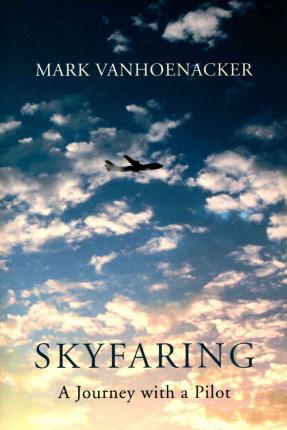
Skyfaring by Mark Vanhoenacker: Poetry Takes Flight
There are times when I'm not reading a great deal of poetry (or, less than at some other times) but it still finds its way into my life. (It always does that.) A recent example was when I read the book Skyfaring: A Journey With a Pilot by Mark Vanhoenacker.
Flying isn't particularly my favourite subject to read about. I fly at least a couple of times a year, usually more, but have struggled with it for years to the extent that each flight is anywhere from uncomfortable to a major ordeal. Oddly enough, this was partly what impelled me to read Skyfaring. The description attracted me: an experienced pilot evokes the perspective shifts, the emotional challenges and rewards, the friendships and unusual messages, and the pure beauty of flying.
I really wasn't disappointed with the book and I would certainly recommend it for a nervous flyer, at least one who can bear the thought of reading about the experience they dread. There is such an air of wonder and serenity about it that it had a noticeably calming effect on me (and yes, I did read parts of it on long plane flights a few weeks ago, between London and the west coast of Canada.) The writing is exquisite. I particularly enjoyed some of Vanhoenacker's descriptions of night flying (not my favourite time to be flying, due to a weird psychological cocktail of reasons.) Such as this:
In the high night...are many phenomena we cannot see so clearly, if we see them at all, when the sun is up. There are nameless ships of cloud that seem to sail best under a bright moon. There are vast lobes of lightning, flashbulbing out from deep within the grey matter of distant equatorial thunderstorms, while on the windowpanes St Elmo's fire, a kind of static that appears in startling bursts of flat blue veins, flickers like Prufrock's 'nerves in patterns on a screen'.
And...there's the other reason why I enjoyed Skyfaring. It opens with, as epigraph, the latter half of one of the poems in Derek Walcott's Midsummer sequence, a poem that actually is about flying (and landing):
It comes too fast, this shelving sense of home -
canes rushing the wing, a fence; a world that stands still as
the trundling tires keep shaking and shaking the heart.
Vanhoenacker obviously has a rich appreciation for literature: as well as Walcott and TS Eliot, Philip Levine, Robert Frost, 'Dark Night of the Soul' by St John of the Cross, all appear along with other poems and poets. A book well worth reading, then; but it did make me think that to enjoy flying, you really have to be a pilot - or at least sitting in business class.
Sunday, 3 July 2016
My Translation of Emile Nelligan's 'The Ship of Gold' ('Le Vaisseau d'or')
I recently translated the French-Canadian poet Emile Nelligan's 'Le Vaisseau d'or' ('The Ship of Gold'), and here it is. The original French poem is below the translation.
You can read my translation of Nelligan's 'Soir d'hiver' ('Winter Night') here, and some more details about his life. I find him quite difficult to translate. His poems tend to have a sort of high-strung edge which is hard to convey without going over the top. I did try, but the rhyme scheme also eluded me - or it would have involved contortions I was unwilling to enter into.
The final line of this poem has haunted me for a long time.
THE SHIP OF GOLD (Emile Nelligan, translated from the French by Clarissa Aykroyd)
It was a great Ship, of solid gold,
Its masts reached up from sea to sky.
Love's Venus, wild-haired and bare-skinned,
Sprawled on the prow, in the heady sun.
But then came a night when it struck a reef
In the trickster Sea, where sirens sing.
And fiercely wrecked, its tilted hull
Drowned in the Gulf's unrelenting grave.
It was a Ship of Gold, whose melting sides
Showed treasures that the cruel sailors,
Disgust, Hate and Madness, ripped apart.
What is left after the brief storm?
What of my heart, the deserted ship?
Alas! It foundered in the Dream's abyss!
LE VAISSEAU D'OR
Ce fut un grand Vaisseau taillé dans l’or massif :
Ses mats touchaient l’azur, sur des mers inconnues ;
La Cyprine d’amour, cheveux épars, chairs nues,
S’étalait à sa proue, au soleil excessif.
Mais il vint une nuit frapper le grand écueil
Dans l’Océan trompeur où chantait la Sirène,
Et le naufrage horrible inclina sa carène
Aux profondeurs du Gouffre, immuable cercueil.
Ce fut un Vaisseau d’Or, dont les flancs diaphanes
Révélaient des trésors que les marins profanes,
Dégoût, Haine et Névrose, entre eux ont disputés.
Que reste-t-il de lui dans la tempête brève ?
Qu’est devenu mon coeur, navire déserté ?
Hélas ! Il a sombré dans l’abîme du Rêve !
Translation © Clarissa Aykroyd, 2016
Saturday, 13 February 2016
Gwendolyn MacEwen and the "Poem": 'Let Me Make This Perfectly Clear'
Dark & Stormy Night 2 by Ken McMillan.Used under Creative Commons license.
One of Canada's great poets, Gwendolyn MacEwen was associated with other key Canadian literary figures such as Northrop Frye and Margaret Atwood. She died at the age of 46 but left her incisive, mysterious, beautifully written poems.
'Let Me Make This Perfectly Clear' is a favourite of mine, and it goes out to anyone who doubts the motives of artists, or indeed anyone who writes just because they want to be a "Poet". It's not about a title or an act, says MacEwen - it's something much bigger.
I love the humorous-angry tone of the poem which gives way, in the final lines, to the unfathomable darkness which is both the source and the conclusion of art. The ending of the poem stops me in my tracks.
Sunday, 15 November 2015
New Poems Published - The Island Review
Vancouver Island, British Columbia, Canada. Photo by Clarissa Aykroyd, 2014.
The Island Review recently published three of my poems. As this lovely journal publishes only work by islanders and/or in some way related to islands, it won't come as a surprise that all three poems are about Vancouver Island (where I grew up). You can read them here: http://www.theislandreview.com/poetry-clarissa-aykroyd/
'The Provincial Museum' has actually been called the Royal BC Museum for many years, but it was the Provincial Museum in my childhood and so that name has stayed, for me. 'An Eye, Open' is in some ways a little tribute to Paul Celan. I stole the title from the title of one of his poems, and you can read it here if you're interested: http://www.poetryfoundation.org/poetrymagazine/browse/119/3#!/20595433
Saturday, 6 June 2015
New Poem Published: 'Qualicum Beach'
Qualicum Beach, 2014. Photo by Clarissa Aykroyd
Shot Glass Journal, who have published some of my short poems in previous issues, have just published my poem 'Qualicum Beach' in their latest issue.
I wrote this poem last year after visiting Vancouver Island's Qualicum Beach, a small town a few hours from where I grew up. Like much of the Island scenery, Qualicum Beach and the surrounding areas are stunningly beautiful. And the ocean does indeed bring a very special type of solace.
Monday, 9 March 2015
Emily Carr at Dulwich Gallery: "A Continual Miracle"
Emily Carr, Big Eagle, Skidegate, B.C. c. 1930, Watercolour on paper, 76.2 x 56.7 cm, 1980.034.001, Art Gallery of Greater Victoria, Donated in memory of Dorothy Plaunt Dyde
I finally went to Dulwich Picture Gallery's exhibition of Emily Carr, the artist from British Columbia who for me is local. For most of her life, her home was in Victoria, which is also my hometown. Her house is a museum which is a stone's throw from where some of my friends live and not far from my childhood home. Her grave is in Ross Bay Cemetery, one of the oldest graveyards in Canada and just down the road from my house.
It was strange to see Emily Carr's works in a London gallery, especially when a few of the paintings and sketches depicted places I grew up with and saw almost daily, such as Clover Point and Ross Bay. In part, this exhibition followed on from the Group of Seven exhibition a few years ago, which was an enormous success. Carr was associated with the Group of Seven, but their works mostly represent other parts of Canada, especially Ontario. Emily Carr was a pure West Coaster and her works depicting areas such as Haida Gwaii and the Skeena River are iconic. I admit that part of the interest of these exhibitions is the feeling of moving through like a shadow and watching the mostly British art lovers look at paintings and descriptions of places I know, or at least places close to home, with the interest and bewilderment of those confronted by something quite exotic. The exhibition also featured artifacts of First Nations tribes from the Pacific Northwest such as the Haida, Gitxsan and Tsimshian, which helped to put the places she went to and depicted in context.
I was surprised at how richly the paintings struck me, after never being terribly interested as a child, and forgetting many except the most famous pieces. The deep forest paintings featured a rich, hallucinogenic green and shapes both rounded and geometric. In lighter, more open woods and her more impressionistic period, the trees seem to be swirling in a wind on the canvas, drawing the eye upwards. Other paintings and sketches show First Nations buildings, canoes and totem poles in vivid, documentary-style detail.
Emily Carr, Tree (spiralling upward), 1932-1933, oil on paper, 87.5 x 58.0 cm, Collection of the Vancouver Art Gallery, Emily Carr Trust, VAG 42.3.63, Photo: Trevor Mills, Vancouver Art Gallery
Emily Carr, Indian Church, 1929, oil on canvas, Overall: 108.6 x 68.9 cm. ART GALLERY OF ONTARIO, Bequest of Charles S. Band, Toronto, 1970, 69/118
An extremely independent and adventurous woman, especially for her time period, Carr was also a writer - mostly of prose, but she loved and appreciated the poetry of Walt Whitman and the British Romantics. This Whitman poem, 'Miracles', was a particular favourite of Carr's, especially the last two stanzas.
MIRACLES (Walt Whitman)
Why, who makes much of a miracle?
As to me I know of nothing else but miracles,
Whether I walk the streets of Manhattan,
Or dart my sight over the roofs of houses toward the sky,
Or wade with naked feet along the beach just in the edge of the water,
Or stand under trees in the woods,
Or talk by day with any one I love, or sleep in the bed at night with any one I love,
Or sit at table at dinner with the rest,
Or look at strangers opposite me riding in the car,
Or watch honey-bees busy around the hive of a summer forenoon,
Or animals feeding in the fields,
Or birds, or the wonderfulness of insects in the air,
Or the wonderfulness of the sundown, or of stars shining so quiet and bright,
Or the exquisite delicate thin curve of the new moon in spring;
These with the rest, one and all, are to me miracles,
The whole referring, yet each distinct and in its place.
To me every hour of the light and dark is a miracle,
Every cubic inch of space is a miracle,
Every square yard of the surface of the earth is spread with the same,
Every foot of the interior swarms with the same.
To me the sea is a continual miracle,
The fishes that swim - the rocks - the motion of the waves - the ships with men in them,
What stranger miracles are there?
Sunday, 27 July 2014
Poetry Jazz Café, Toronto
When I was in Toronto for a few days last month, my friend and I paid a visit to the Poetry Jazz Café in the eclectic Kensington Market neighbourhood. My friend is a Londoner too (a real one, unlike me) but she lived in Toronto for a while as a student and knows the city very well.
The Poetry Jazz Café is, I think, more jazz than poetry, but they also have spoken word/slam poetry events and a cool bar. For hungry poets, the day's menu featured this:
We very much enjoyed the ambiance, our cocktails and the music, as below. The band was Cruzao, playing jazz with a Cuban twist.
You can read about the inspiration behind the name here. "Poetry comes from sorrow and to be a poet one must be able to feel."
Photos © Clarissa Aykroyd, 2014.
Wednesday, 9 July 2014
Poetic Encounters in Victoria, BC
While back for a few weeks' visit to my hometown of Victoria, BC, I stopped in at Russell Books, which is an amazing and iconic used bookstore. It also happens to be where I had one of my first jobs after university, which was pretty good for a book lover without much work experience at the time.
I was searching the poetry section and decided to buy a small bilingual collection of Émile Nelligan's poems, partly because I am planning to try some more translations of his work. (You can read my translation of his 'Soir d'hiver', and some information about Nelligan's sad life, here.) Much to my surprise, when I looked inside the book, I found an inscription by Doug Beardsley. It was inscribed "Montreal, Quebec, at the Hotel Nelligan", and signed with dates both in 2006 and 2009, which added a little to the mystery. He had also made a few notes in the Preface. Doug Beardsley is a Victoria poet who was also an instructor at the University of Victoria until 2006 - and he taught the Canadian Poetry course which proved to be somewhat life-altering for me (both in introducing me to extraordinary Canadian poets, and in helping to open up modern and contemporary poetry to me.) Finding a book inscribed by him at my old workplace was sort of strange and wonderful.
I also bought Karen Solie's Short Haul Engine, one of her older collections which she wrote while living in Victoria. I've browsed through it but am really looking forward to reading it more in-depth, especially in the light of her brilliant recent work.
Finally, I came across a tidbit in a local Victoria magazine regarding poet Rudyard Kipling. He visited Victoria in 1907 and commented to a reporter for the Times Colonist (which I think was called the Colonist or British Colonist then): "I am going to take a motor drive to see the beauties of the place. But I really don't see why I should move away from here. In Victoria, it is a waste of time to look for beauty. It is always with you."
Saturday, 14 June 2014
The Great Canadian Identity Crisis: Karen Solie's 'All That Is Certain Is Night Lasts Longer Than the Day'
The South Saskatchewan River at Empress, Alberta. Photo by Emdx
My impending visit home to Canada seems to have brought on one of my bouts of Canadian identity crisis and questioning why exactly I left at all. Canadian identity crises (or simply, THE GREAT CANADIAN IDENTITY CRISIS) are quite complicated. If you are Canadian you will know what I mean, and if you aren't, you won't. But you could try looking up "western alienation" and "the two solitudes", for starters. Those are just two aspects of The Great Canadian Identity Crisis, but they will give you some clues.
Karen Solie is becoming a key Canadian poet at high speed, it seems. Her new Selected Poems, The Living Option, which has been published by Bloodaxe Books specifically for the UK/international market, has been extremely well reviewed. Writing in the London Review of Books, Michael Hofmann said: "Introducing Karen Solie, I would adapt what Joseph Brodsky said some thirty years ago of the great Les Murray: 'It would be as myopic to regard Mr Murray as an Australian poet as to call Yeats an Irishman. He is, quite simply, the one by whom the language lives.' Solie is Canadian [...] and, yes, she is the one by whom the language lives." Not bad at all. I seriously regret not seeing her at Poetry Parnassus, but maybe I'll catch her somewhere else someday.
Solie was recently interviewed for The Poetry Trust's Poetry Paper, along with other poets, about how landscapes and places affect their writing. She is from Saskatchewan and now lives in Ontario. "I've grown to love Toronto," she said. "It's a vibrant, crazy and often very warm city." However, she also lived for a time in my hometown of Victoria, BC, and said: "I had been living in Victoria, on Vancouver Island, writing my English PhD dissertation, when my resources ran out. Despite its beguiling and temperate Pacific character, Victoria requires an iron will from its residents and I did not have it." I have heard all sorts of things said about Victoria, both positive and negative (and I have said some of them myself), but this was a new one on me. I am still so intrigued by it that I sincerely I hope I can ask Solie what she meant, some day.
I have particularly enjoyed this poem of Solie's, 'All That Is Certain Is Night Lasts Longer Than the Day'.
ALL THAT IS CERTAIN IS NIGHT LASTS LONGER THAN THE DAY (Karen Solie)
As a description of changing identity over a lifetime, this poem could hardly be better. Mysteriously, I also feel as though it is about Canada. (Is that "In time you've learned that to behave badly isn't/necessarily to behave out of character"?) This is the self as place and journey, which feels very appropriate for Canadians. I read it and I think about trying to avoid regrets, which is valuable in itself. And the final lines are beautiful:
A mist not unlike it walks the morning streets, comments on
the distinction of Ottawa from Hull, Buda
from Pest, what used to be Estuary from what used to be
Empress and the ferry that once ran between them.
Ottawa is separated from Hull only by a conjunction of rivers, but Ottawa is the country's capital city, in Ontario, and Hull is part of the French-speaking province of Quebec. As for Estuary, it is a ghost town in Saskatchewan close to the tiny village of Empress, Alberta, and the two are also separated by rivers. Understanding the geographical nature of identity: this is really Canadian.
Friday, 20 December 2013
Translating Emile Nelligan's 'Winter Night' (Soir d'hiver)
Emile Nelligan photo: Laprés & Lavergne
This is my translation from French of 'Soir d'hiver' by Emile Nelligan (1879-1941), one of Quebec's great poets. You can also find the original poem below.
The story of Emile Nelligan is tragic in the extreme. The son of an Irishman and a Quebecois woman, he was influenced by the Symbolist poets such as Verlaine and Baudelaire, and published some of his poems in Montreal when he was only 16. He had already produced a considerable and impressive body of work by the time he was 19, when the sensitive poet suffered a massive mental breakdown from which he never recovered. Nelligan lived into his sixties, but was never able to write any more new poetry. Despite this, he is considered a great French-Canadian poet and romantic figure.
I found this poem quite challenging: that said, it's probably one of Nelligan's most straightforward and accessible poems, and certainly one of the most famous. I attempted to preserve a similar rhyme scheme, but I admit that in places it is a loose or free translation, in terms of wording. I hope I captured some of the spirit of the poem, at least.
(I have titled my translation 'Winter Night', though it may be that 'Winter Evening' is actually more accurate. The imagery is just so dark...)
WINTER NIGHT (Emile Nelligan, translated from the French by Clarissa Aykroyd)
It has snowed, oh, how it has snowed!
My window's blooming, a garden of frost.
It has snowed and it has snowed...
The spur of life seems all but lost
To this agony in me, in me...
Every lake is gripped by ice. Where am I,
And which way, through my soul's black night?
All my hopes are cold, bled dry:
I am the new North, the Arctic heights
From which the midnight sun has fled.
Weep, birds of winter,
For the deadly chill through all.
Wail, February birds -
Tears must fall like roses fall
Through the sharp juniper branches.
It has snowed, oh, how it has snowed!
My window's blooming, a garden of frost.
It has snowed and it has snowed...
The stab of life seems almost lost
To all the dread in me, in me...
SOIR D'HIVER (Emile Nelligan)
Ah ! comme la neige a neigé !
Ma vitre est un jardin de givre.
Ah ! comme la neige a neigé !
Qu’est-ce que le spasme de vivre
A la douleur que j’ai, que j’ai !
Tous les étangs gisent gelés,
Mon âme est noire : Où vis-je ? où vais-je ?
Tous ses espoirs gisent gelés;
Je suis la nouvelle Norvège
D’où les blonds ciels s’en sont allés.
Pleurez, oiseaux de février,
Au sinistre frisson des choses,
Pleurez, oiseaux de février,
Pleurez mes pleurs, pleurez mes roses,
Aux branches du genévrier.
Ah ! comme la neige a neigé !
Ma vitre est un jardin de givre.
Ah ! comme la neige a neigé !
Qu’est-ce que le spasme de vivre
A tout l’ennui que j’ai, que j’ai !...
Translation © Clarissa Aykroyd, 2013.
Thursday, 14 November 2013
Elizabeth Bishop's 'The Moose': Nature, Childhood and Memory
Cow Moose Drinking From Pond, Alaska. Used under Creative Commons license
By most reckonings, Elizabeth Bishop was an American poet (and a great one), but she spent some of her early childhood in New Scotia and described her ancestry as "three-quarters Canadian and one quarter New Englander". The influence of such early memories can be enormous. This poem, 'The Moose', seems to me an especially strong evocation of Canada and the natural world, and of certain aspects of childhood.
THE MOOSE (Elizabeth Bishop)
I have never been to Canada's Maritime provinces, including those described in this poem, Nova Scotia and New Brunswick. The farthest east I have been is, I think, the town of Montmagny in Quebec, on the Saint Lawrence River east of Quebec City. Strangely, some of the poem's initial details seem more reminiscent of the Nordic countries, to me: the herring, the "clapboard farmhouses" and "twin silver birches". The "impenetrable wood" of New Brunswick is more familiar - there's a lot of that, all over Canada.
The coach-trip nature of the poem is quintessentially North American. The lines are quite short and there is a flick/flick/flick effect to many of the images:
One stop at Bass
River.
Then the Economies— Lower, Middle, Upper;
Five Islands, Five Houses,
where a woman shakes a tablecloth
out after supper.
I have remembered, since childhood, catching glimpses of certain people and places on car, bus or train journeys and thinking: what is their life like, what is that place like? That person who I've just flicked past has a life and thoughts as full and complex as mine. These thoughts have always been a bit overwhelming, and usually not to be clung to for too long.
There is a blurring of place here which is both reassuring and disorienting. The child overhears her grandparents "talking the way they talked/in the old featherbed", which has a lulling effect (she doesn't fully understand the seriousness of the conversation, so it remains reassuring): she could be back at home, not on the bus. But the sudden appearance of the moose, while beautiful, is also jarring.
The moose is a reminder that nature will intrude anywhere it wants to; so far, the passengers have been cocooned in the bus, observing the natural world but not participating it, even able to imagine, half-asleep, that they're at home. The moose is enormous, ugly and beautiful at the same time, and it stops the bus. This poem is certainly a tribute to the animal world and to the Maritime provinces, but it seems to me that the moose could also represent the anarchic nature of artistic inspiration - or more broadly, it is the kind of event which is uncontrollable and which sets more things in motion than are evident at the time.
Bishop reportedly said that it took her 20 years to finish this poem. Childhood memories can sometimes be incomprehensibly enormous - like the moose. You never know what you will remember, and what you will forget. I have memories from the age of five, at least, which are extremely vivid, and it is not unusual for them to involve animals and the natural world. Other memories - which, when reminded of, I think I should have remembered - seem to have gotten lost, or at least buried.
In an unrelated-yet-related way, I realised the other day that I still remembered the Finnish word for moose - hirvi. Why I should remember this, when I either never knew or have long forgotten other (probably more useful) words, is beyond me. It's certainly true that a lot of my meager Finnish is child-Finnish - a lot of animal words, and food words. There's more there than I give credit for, I suppose.
The moose/hirvi thought may have been triggered by looking at some photos of the animal sculptures of Jussi Mäntynen, which for some other inexplicable reason I was doing recently. They are as beautiful and touching as I remembered. The art gallery in Turku features a small room containing many of his pieces. There was always something magical about it, for me. It was like an animal treasure house.
Thursday, 17 October 2013
Karen Solie's 'Migration': "Snow Is Falling..."
Snow at Lake Oesa, J E H MacDonald, c .1930Canadian literature has been much in the news these last several days, because Alice Munro won the Nobel Prize. I actually let out a tiny shriek of joy when I saw the news, which is probably a Nobel first for me. She's been a favourite writer of mine for quite a few years, probably my favourite short story writer of all time, and a lot of us thought she deserved it but would probably never actually get it. The fact that she's a Canadian woman (both uncommon factors in a Nobel Literature win) is a bonus. She has spent some of her life in my hometown of Victoria, BC, and in Comox, also on Vancouver Island, and was actually in Victoria when the news was announced. Years ago I applied to work at Munro's Books, which she founded with her ex-husband Jim Munro, and I met Mr Munro himself, which is cool in a six-degrees-of-separation way. Apparently they get along quite well these days, and obviously Munro's has had a lot of good days since the award was announced.
Speaking of Canadian literature, I have been enjoying the work of poet Karen Solie, who is originally from Saskatchewan and now lives in Ontario. Her deceptively conversational poetry often focuses on industrial wastelands and peculiarly Canadian details. I wish I'd seen her at Poetry Parnassus last year, but there was too much going on and I really missed a lot (though I also experienced a lot). My parents brought me a copy of her collection Pigeon when they visited me in London recently. It includes this poem, 'Migration'.
MIGRATION (Karen Solie)
I think that 'Migration' is one of my favourite contemporary poems that I have read in the last few years. It shifts from wry but nostalgic details - the idling cars, the old-fashioned neighbourhoods, the "tax collector" - to elegy and a kind of agnosticism about life, with great elegance. What I really love about it, though, is the expansiveness and the sense of distance and space. Sometimes I really can't figure out if I'm Canadian or not; a Vancouver Islander is surely a bit different. I occasionally doubt whether I have ever really lived in Canada, because I never lived in places where the temperature goes to 20 or 30 below every winter. In Victoria, much as in London, residents freak out when there is an inch of snow. (They brag unreasonably about the climate, though, which a Londoner would never do.)
But one indication of my Canadian-ness - I think - is the fact that I understand how big the country is. It is really, really big, and Europeans just don't get this, unless they are among those who have not only been to North America but also travelled some distance around it. (In a similar way, a lot of North Americans don't get how close most things are in Europe, and how you can be in Paris in a few hours.) The opening lines of 'Migration' seem like a vast weather map; snow falling all over the country, the lightning over Lake Ontario, a giddy zoom in to "debt accumulating along baseboards/like hair", the "frozen fields and wheels/of wind" on the Prairies, the northern frost. The Arctic tern, too, flying bravely on to Antarctica, brings us back to the vast distances, even while the speaker stays earthbound in bewilderment. It's a fantastic poem.
Wednesday, 24 October 2012
"Archetypal Dreams": Anne Wilkinson's 'TV Hockey' and the Canadian Obsession
I took this picture in 2009, at the World Hockey Championships in Bern, Switzerland. It was during the gold medal game between Canada and Russia, one of the most classic rivalries in hockey history. Canada lost, but it was still a great game (said the Canadian, graciously.)
It is not really possible to describe to people of most nationalities - except for the Finns, the Swedes, the Russians, the Czechs, and a handful of other nations - what hockey represents to Canadians. For one thing, in most countries you have to call it "ice hockey", and if you're Canadian, that just doesn't seem right. What the English call "hockey" is not hockey, for one thing - it is grass hockey or field hockey.
Most of the teams of the NHL (the confusingly named National Hockey League, the world's number one professional ice hockey league) are now in the United States, with a relatively small number left in Canada, but most Canadians are of the opinion that Americans just do not get it. Some years ago, American TV channels trialled a way to get the tiny black puck to show up better: every time a player shot it at speed down the ice, it left a little fiery trail on the screen, like a miniature comet. It was absolutely ridiculous and Canadians were amused no end. But I've been told by the English as well that they find the play (and the puck) very hard to follow. I was completely bewildered by this when I first heard it. I think that the eye muscles of a Canadian simply develop in such a way that you have no problem following play in the average game, although occasionally the action moves so fast that you don't quite know what is happening - but that's all part of the excitement.
I believe that every single Canadian grows up with hockey at least to a certain extent and it seeps into your personality whether you are aware of it or not. I have very early memories of our old black and white TV, with a rotary channel dial that had to be held in place by (appropriately) black hockey stick tape. The jumpy, joyous theme music for Hockey Night In Canada sometimes races through my head unbidden - I must have heard it played thousands of times. My brother, Lucas Aykroyd, played hockey for several years like most Canadian boys do. He didn't go on to become a hockey player, but he is now a sports journalist and a leading world expert on hockey. Something like it was bound to happen.
I realised after I moved away that I was more Canadian than I previously thought. Given that I have one European parent and grew up going to Europe regularly - and also perhaps because I was the kind of child who doubted her own ability to "fit in" - I always felt at least semi-European while growing up. Having now lived in England and previously Ireland for many years (well, it's sort of Europe...) I feel more Canadian than I did before. I suppose this is all inevitable. But I certainly have a rosy nostalgia around hockey that I never thought I would have. I love the rare opportunities I get to watch the game, especially when my brother has given me tickets to see the Worlds. I thrilled to the gold medal game from the Vancouver 2010 Olympics, where a lightning-fast goal from the Canadian star Sidney Crosby sealed the game in overtime against the Americans. (Apparently the entire country exploded at that moment, particularly in Vancouver.) Perceptively, an English commentator said: "To understand what this game means to Canadians, you have to imagine the World Cup final, with England as one of the teams, at Wembley Stadium." I don't think he could have put it much better.
Hockey poetry seems like an unlikely concept, but it is out there and some of it is quite good. In his poem 'Hockey Players', the great Canadian poet Al Purdy called it 'this combination of ballet and murder'. Michael Ondaatje and other poets have also explored the area.
TV HOCKEY (Anne Wilkinson)
I wasn't too familiar with Anne Wilkinson, although her name is ranked alongside that of Dorothy Livesay and P K Page, both Canadian legends. However, this poem really captured me. I realised that there was something about its sensory details and the shape of its movements that struck very deep. This is what I mean about hockey seeping into the personality of every Canadian; it's there even if you hardly think of it. The players do indeed "brood in boxes" and "stumble from their cages", and then they become birds - it is one of the fastest team sports in the world and I find football (soccer!) slow and hard to watch in comparison.
This poem, with its multitude of natural images including the "little black moon" of the puck, seems to invoke a primal spiritual ceremony or the movements of animals in the wild. And yet, if you are familiar with the sport, it is very recognizably about hockey. I love the way that it is familiar, but still casts a new and strange light on something that we Canadians think we know so well.
Sunday, 5 August 2012
P K Page's 'Stories of Snow': "Where Silent, Unrefractive Whiteness Lies"
A non-definitive list of the ten poems which have been particularly significant in inviting me into the world of modern, almost-modern, post-modern and contemporary poetry would likely include the following:
Byzantium (W B Yeats)
The Waste Land (T S Eliot)
Foal (Vernon Watkins)
The Convergence of the Twain (Thomas Hardy)
Homecoming (Paul Celan)
At the Quinte Hotel (Al Purdy)
The Tollund Man (Seamus Heaney)
Bagpipe Music (Louis MacNeice)
The Shadow of Cain (Edith Sitwell)
Stories of Snow (P K Page)
I've written about some of these before, and they could probably all be an essay in themselves. To use one of my favourite over-used words, it is a pretty random list. Poems discovered by chance, poems studied in high school or university, poems which I wasn't sure I liked at the time but which ultimately took on greater meaning, poems I heard read by the poet themself (T S Eliot, I wish! In this case, Al Purdy), poems which led me on to poems I preferred by the same poet...and so on.
I've written before about the modern Canadian poetry class which I took in university and which turned out to be very pivotal in my literary life. Among other significant moments, I discovered P K Page in this class, and that was hugely important for me. 'Stories of Snow' can lay claim to being one of the greatest Canadian poems of all time, and simply a great poem, and you can read it here. (Due to the way the poem is reproduced, be prepared to page over a couple of times - it's a long-ish poem.)
STORIES OF SNOW (P K Page)
The Canadian landscape, the landscape of the West Coast rainforest I grew up in, the tropics, Northern Europe - all of these are invoked. More than this, these are emotional and metaphoric landscapes, snowy and blossoming worlds of poetry.
In that forwards/backwards/memory/premonition way which I've come to recognise, it seems as though this poem ties in with my Antarctic fascination (although that came a little later than my first reading of this poem). In the end, the reader is invited to "unlock/the colour with its complement and go/through to the area behind the eyes/where silent, unrefractive whiteness lies." P K Page was also a talented artist, and her poems are often powerfully visual, so there is an element of artistic curiosity and exploration here.
I feel, though, that these are mainly emotional landscapes and that this has something to do with my metaphoric/semi-realistic desire to escape the twittering and the human difficulty of the modern world and to go to Antarctica - somewhere more peaceful, where access to what is truly important becomes more direct and less encumbered. "Souvenir of some never nether land": this could be ancestral memory, too, or something that I'd pass on if I ever had descendants; again, forwards/backwards/memory/premonition. I'm just waiting to find out that I had an ancestor who went to Antarctica, though I would likely have heard about it by now.
The painting is by Akseli Gallen-Kallela, the magnificent Finnish artist.
Sunday, 17 June 2012
Earle Birney's 'Vancouver Lights': "A Spark Beleaguered By Darkness"
Photo of Vancouver by keepitsurreal. Used under Creative Commons license
The following link will take you to 'Vancouver Lights' by Earle Birney, as well as other poems and biographical information, on the University of Toronto Canadian Poetry website:
VANCOUVER LIGHTS (Earle Birney)
I returned from my holiday on the West Coast of Canada a few days ago (and so far have failed pretty miserably with the jet lag). Most of my time was spent in Victoria, on Vancouver Island, a few hours by ferry and car from Vancouver. My parents live in Victoria, where I grew up, and I spent time with them and catching up with some friends. My brother lives in Vancouver, so I usually spend at least a day there as well.
Although I didn't take the above picture - which vividly captures Vancouver by night - I have seen this view or very similar views. I particularly remember my cousin's wedding reception on Grouse Mountain. I have never skiied Grouse, but it is reckoned to have perhaps the best night skiing in the world, and I can believe it. Even just standing on the deck of that restaurant, looking out over the city, I felt as though the eternal dream of flight was not far away. Skiing down towards that "winking/outpost" - yes, that would be flight. Perhaps I will try it some day yet.
I bought Earle Birney's Selected Poems (One Muddy Hand) at the wonderful Munro's Books in Victoria, and I've already loved what I've browsed. I had not yet read many of his poems, although he is one of Canada's most significant poets and an influence on the likes of Al Purdy. His poems tend to run in long loose lines, but still with a sense of tautness and structure. He wrote love poems, poems about Japan and South America, and great poems about Canada. 'Vancouver Lights' is one of his best-known works.
I've seen that throbbing glow of cities by night, and Vancouver surely is "this twinkle we make in a corner of emptiness", relatively speaking. It is far away from most of the rest of the world. I now live in a city at the centre of the world (also relatively speaking), and so I'm acutely conscious of how far away the place I grew up is. Not by the standards of Australia or New Zealand, perhaps, but the Pacific Rim towns and cities certainly have an edge-of-the-world vibe. On the flip side of this poem's darkness, there is a Pacific light that is like nothing else. I saw it in Japan, too, where I was frequently and sharply reminded of where I grew up. Architecture and Asian culture, yes; but also the light.
In this poem, Birney primarily conjures the light of humanity. "These rays were ours/we made and unmade them". I love the West Coast for its natural beauty and laid-backness, for the mountains, and for the sea, perhaps above all in terms of nature. The older I get, though, it seems that people have grown more and more important to me, in all their complexity. In moments of extreme complexity I wish I could free myself from this, but I can't, and wouldn't really want to. The lights of this poem remind me of the people I'm so far away from and love so much.
Sunday, 29 January 2012
Al Purdy, Tom Thomson, the Group of Seven, and Canada: "A Country That No Man Can Comprehend"
Preface and Last Poem, HER GATES BOTH EAST AND WEST (Al Purdy)
The above link will take you through to a page on the website of Harbour Publishing, Al Purdy's publishers. It contains the preface to his Collected Poems and a 'last poem', 'Her Gates Both East And West'.
The painting is The Jack Pine by Tom Thomson, a great Canadian painter. It was completed in 1917, not long before Thomson's death. He died under mysterious circumstances in Algonquin Park, Ontario - his canoe was found floating empty and his body discovered over a week later. Thomson was the principal inspiration for the Group of Seven, who are remembered alongside his name and art. Along with Thomson, these seven - Franklin Carmichael, Lawren Harris, A Y Jackson, Franz Johnston, Arthur Lismer, J E H Macdonald, and Frederick Varley - left an extraordinary legacy to Canadian art. They celebrated the country's grandiose, cutting mountainscapes, its astonishing colours and contrasts, and its vastness. While they were principally based in Ontario, they also travelled and found inspiration from British Columbia to Nova Scotia, and even in the Arctic.
At the end of 2011, the Dulwich Picture Gallery in London hosted a wonderful exhibition of Tom Thomson and the Group of Seven. Of course, every Canadian art lover in town headed down to see it, including myself; but it was great to see so many Londoners curious about what Canadian art had to offer. I suspect a lot were thinking "not much". It was amazing to see so many of these great paintings together, though I was struck by homesickness and also had the inevitable "The rest of the world doesn't know what they're missing, eh?" conversation with another ex-pat. The exhibition was very well reviewed by the media and was a success. But the comment I was happiest to hear was overheard from a surprised-sounding art lover in the Lawren Harris room. Surrounded by monolithic, glowing, semi-deified icebergs and lakes, she said: "I've never seen anything like this before." Coming from hard-to-impress Londoners, that kind of comment is quite something.
I think that Tom Thomson and the Group of Seven go well with Al Purdy's poems. In so many respects, Purdy is the great voice of modern Canadian poetry. His poems are funny, irreverent and a bit rude; they celebrate Canada's vastness and beauty and tell us not to worry about that silly quest for national identity we're so hung up on. This is Canada - massive, diverse, harsh, lovely, self-celebrating but self-deprecating.
I heard Al Purdy read twice and met him once, probably in the space of about a year - maybe two years before he died in 2000. He came to read and chat with my modern Canadian poetry class. He was very tall and had a foghorn voice and an enormous personality. I was obviously being a bolshie 18 (19?)-year-old intellectual that day because I asked him how he could explain placing D H Lawrence's poetry ahead of Yeats's - he cited both of them as massive influences but loved Lawrence the most. (At the time, I was a total Yeats devotee.) He boomed "I'd have a hell of a time explaining it!" and then, as I recall, fixed his piercing eyes on me and recited a bit of Lawrence. There wasn't much I could say in response to that. Some months later, I went to one of Purdy's readings at the university. I remember he had an auditorium-full of students and others howling with laughter as he read some of his best-loved poems:
Now I am a sensitive man
so I say to him mildly as hell
"You shouldn'ta knocked over that good beer
with them beautiful flowers in it"
(from 'At the Quinte Hotel')
Purdy is funny on the page, but hearing him read was unforgettable. It's such a loss that he is no longer around to read his own poems, as they're not quite the same coming from anyone else.
Purdy lived and travelled all over Canada, though his later years were spent in Sidney, BC, just outside of my hometown of Victoria. Much of his inspiration seems to have come from Ontario, and from the Arctic, but it appears that he touched down almost everywhere. He hears the same voice everywhere, something which holds the country together:
Listen:
you can hear soft wind blowing
among tall fir trees on Vancouver Island
it is the same wind we knew
whispering along Côte des Neiges
on the island of Montreal
when we were lovers and had no money
(from 'A Handful of Earth')
I love the range and sweep of 'Her Gates Both East and West'. Purdy calls Canada "a country that no man can comprehend", and I think I know what he means. It's too big, it's too empty, its people are diverse but distinctly Canadian; it boggles the mind as much as it seduces. People in Europe sometimes ask why I've only been to Toronto a couple of times, given that it's the country's major city. I explain that I grew up almost a five-hour plane flight away. Then they understand a little more, but unless they have been to Canada (or at least North America) they don't really understand. From the UK, five hours would take you beyond Turkey. Flying that far and still being in the same country is hard to understand if you come from a small nation. I still can't help laughing when I overhear comments like "France and Germany are SO BIG!". Er, really?
I've travelled in Canada; fairly large parts of British Columbia, quite a lot of Alberta, bits of Ontario and Quebec. Is that really all? A lot of it was a very long time ago, too. It still takes in a lot of sights and memories. I think of the west coast of Vancouver Island, endless sand and ocean at Long Beach, world's end. The Rocky Mountains, lakes a blue you can't believe, postcard scenes beyond anything the human mind could imagine. The top of the CN Tower at night in November - COLD. Seeing the house where my father grew up in Westmount, Montreal. Flying home from Europe for a visit, watching hours and hours of rock and ice and snow unfolding beneath me and marvelling at it. The ferry between the mainland and Vancouver Island - the islands, the calm, the beautiful horizons. Road trips where you fall asleep and wake up hours later and the landscape has hardly changed, because it's just so big, and so far.
Unsurprisingly, I probably didn't really appreciate Canada until I left. People tell me how fortunate I was to grow up there, how beautiful it is, and wonder how I could have left. I tell them there was a big wide world waiting out there, and I love London, and I love Europe. But Canada was a special place to grow up. It is unusual to grow up in a city and still feel so close to nature, and in Canada you can easily do that, especially somewhere like Victoria or Vancouver. I miss the familiar mountains, their shapes and names, their changeable yet constant nature, colours shifting from day to day, sometimes disappearing behind cloudcover. I miss the sea and I miss knowing that not far away are lakes and forests. I miss knowing that I could be in a car for hours and there would be just an endless pour of dark green trees past my window and it would hardly change for hours. When I was younger, I found that a bit boring. I now know how wrong I was. Constant and exciting and magnificent, Canada is - not boring.
Wednesday, 19 October 2011
"A Size Larger Than Seeing": P K Page and West Coast Memories
AFTER RAIN (P K Page)
The above link will take you to P K Page's 'After Rain', a few of her other poems and some biographical information, from the University of Toronto Libraries website's section on Canadian poetry (http://www.library.utoronto.ca/canpoetry/index.htm).
Victoria, on Vancouver Island, was a beautiful place to grow up. I didn't fully realise it until I left, and probably not even for a few years then. I regularly get people telling me that I'm crazy because I left British Columbia, and especially the Island, to live in London. Well - Londoners tell me I'm crazy; Islanders, when I go back home, remind me incessantly that it's the most beautiful place on earth and tell me how much I must miss it. I do miss it, of course; I miss fresh air, the ever-present ocean, the parks and flowers, some of the most striking scenery in the world (the Olympic Mountains painted across the horizon on the Strait of Juan de Fuca) - the list goes on. Also "of course", I had to leave eventually, and I am not sorry that I ended up in London. But I wish that I could go back more often, most importantly to see my family and friends. I took the above picture on a visit home this summer (June 2011).
Reading P K Page's poems brings back a flood of memories from Canada. I discovered her in a summer Canadian poetry class at university, and simultaneously discovered that contemporary poetry was quite a wonderful world. I remember doing a presentation on 'Cook's Mountains', a brilliant description of how language and names alter our perception: "instantly they altered to become/the sum of shape and name." I somewhat irrelevantly raised the point that images in the poem reminded me very much of a scene in Watership Down, but Doug Beardsley, the instructor and a poet in his own right, seemed to like it. And I remember being captivated by 'Stories of Snow', one of the greatest Canadian poems. Page was born in England but moved to Canada as a small child and lived there for most of her life, so she was certainly Canadian. However, she also lived with her diplomat husband in other countries including Australia and Brazil. 'Stories of Snow' beautifully describes how people with one set of experiences, or in one environment - in this case, the tropics - fill in their emotional landscape by dreaming of places that are very different. Although I'm not sure where Page lived when she wrote that poem, a friend pointed out to me that there was something very West Coast about these lines:
And stories of this kind are often told
in countries where great flowers bar the roads
with reds and blues which seal the route to snow...
Smug West Coasters do love it when the cherry blossoms, tulips and daffodils flower magnificently in the spring, and they can call their relatives out East, who are still snowbound.
I believe it was in 2000 when I went one evening to Victoria's James Bay Inn to hear P K Page read. My mother, also a fan, came with me. Page was a beautiful and stately lady - she would then have been about 85. I was one of a queue of people who politely lined up to ask her if she could read a particular poem. I told her how much my Canadian poetry class had loved 'Stories of Snow' and asked if she could read it, but sadly she didn't have a copy with her. I had also loved 'After Rain', so asked her if she could read that instead. When she got up to read her poems, she graciously but laughingly told us that she'd had to significantly rearrange her program because she'd had so many requests. I remember that she read 'Poor Bird', and the relish with which she delivered the line "Poor bird, he is obsessed!". And she did read 'After Rain'. I remember so vividly the turn of her head and the brightness of her eyes as she read: "O choir him, birds, and let him come to rest/within this beauty as one rests in love". Page died last year at the age of 93. I wish that she had made it to 100, as so many senior citizens living in Victoria do.
'After Rain' also reminds me of the West Coast simply on its own: a garden drowned in chlorophyll, and Page delighting in the lacy creations of the snails all over her cabbages. It is a wet climate, and the outdoors can drip seemingly for days after a day or six of heavy downpours. The poem's sharp but delicate imagery, its ornate but pure tone, are typical of Page's best work. The lines "Keep my heart a size/larger than seeing" have echoed in my mind for many years now.
------------------------------------------
I realised that I didn't quite say what I wanted to say about Celan in my last entry, but I will probably have to return to him. It occurred to me that his abstract but extraordinarily precise images are somehow like electrodes placed on the reader's emotional centres, to stimulate wonder and fear and grief. Then, when I was tracing some more information about Celan, I found out that he underwent electroshock therapy for his severe depression. That was quite unsettling.
I also learned that Celan and P K Page were both born on November 23; Page in 1916, and Celan in 1920. It is strange to think that had he lived, I could potentially have met Celan, as I did Page. I am not sure if Celan influenced Page (more likely than the other way around, given his much greater fame), but I have thought that if his life had been less ravaged by tragedy, there might have been some more similarities between their work. There is something that seems to link them for me, as well as the coincidence of their birthdays; something in the images that they choose. They were certainly both in love with flowers, and birds, and images of minerals, and broken glass, and the changing perspective of the eye.
Subscribe to:
Posts (Atom)