Showing posts with label Robinson Jeffers. Show all posts

Thursday, 13 July 2017

U2 and Poetry: The Joshua Tree 2017 Tour


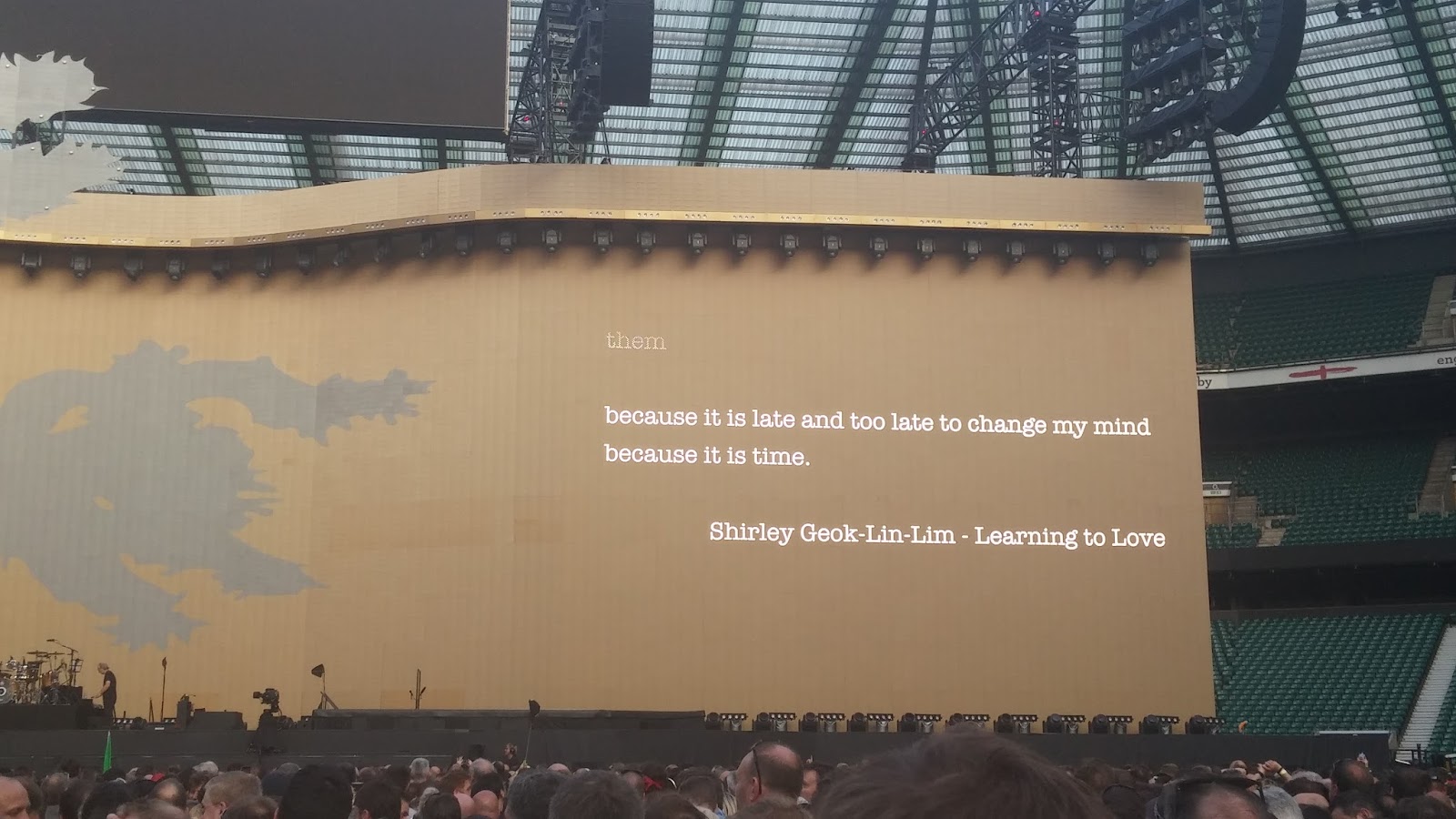
U2's current world tour is, unusually, not to promote a new album - it's for the 30th anniversary of The Joshua Tree and they are playing this album in its entirety, along with other songs before and after. I saw them last Sunday at Twickenham Stadium in London. It was a remarkable show for many reasons, not least of which was the screening of poems on the stage backdrop just before the show actually started.

I have a long history with U2, which sort of started close to 30 years ago when my brother bought The Joshua Tree. But it really started a few years later when I bought War, Under a Blood Red Sky, The Unforgettable Fire and later their other albums, when I was about 14. Those albums feature very prominently in my mental and emotional timeline from my early teens. I discovered those albums for myself, and the obsession was like falling in love. My relationship with The Joshua Tree is probably a bit harder to define, as I first encountered it through my brother and through the radio when I was younger. I was always impressed, but I also regarded the album with a slightly detached sense of awe which I've never quite shaken. I think it's their best record, but I'm not quite as closely bonded to it as I am to albums like War and Unforgettable Fire. I'm perhaps closer to its individual songs than I am to The Joshua Tree as a whole.

Before seeing U2 play on Sunday, I was already aware that they were scrolling poems on the big screen during the intermission between the opening act and the start of the main show. There was a fair amount of media coverage in Canada when one of the poems chosen was by Canadian poet laureate George Elliott Clarke. However, most (if not all) of the other poems chosen are by Americans, and it seems that different poems have been used at different shows. The poems that I saw were:

Elizabeth Alexander - 'Praise Song for the Day'. This poem was read at Barack Obama's inauguration.


Walt Whitman - a selection from Leaves of Grass


Sherman Alexie - 'The Powwow at the End of the World' 


Robinson Jeffers - 'Juan Higera Creek' 


James Dickey - 'The Strength of Fields'


Shirley Geok-lin Lim - 'Learning to Love America'  (this is actually the poem's full title, although it said 'Learning to Love' on the screen).


Pedro Pietri - 'Puerto Rican Obituary' (I didn't get a picture of this one, as the show was starting just as the poem finished...)

This U2 website has detailed more of the poems which were included on other shows (or perhaps I missed others when my friend and I were wandering around after the opening act.) Many of these poems will also be available to read online: http://www.u2songs.com/news/the_joshua_tree_tour_poetry

Personally, I was especially surprised and happy to see the Robinson Jeffers poem 'Juan Higera Creek'. Jeffers has been a bit of a well-kept secret for a long time, but in the current socio-political-environmental climate he seems to be enjoying something of a renaissance. I also love the James Dickey poem, 'The Strength of Fields'.

I don't know who was involved in selecting the poems, but to accompany (or precede) The Joshua Tree, they seemed to me exceptionally well chosen. In them, I saw the following which I also find in The Joshua Tree:

A variety of voices and experiences, including those of minorities and immigrants. The poems are by Native Americans, African Americans, Asian Americans and Hispanic Americans, among others. U2 composed The Joshua Tree in part because they'd fallen in love with America, and as Irish musicians they were well aware of their country's close links to America and of the huge numbers of Americans who are descended from Irish immigrants.

American landscapes. The landscapes of The Joshua Tree are dual (at least), as in poetry's landscapes. When U2 played 'Where the Streets Have No Name' ("I'll show you a place high on a desert plain, where the streets have no name"), the huge backdrop screen sent us flying along an American desert highway. The song was also partly inspired by Bono's humanitarian work in Ethiopia and by the divisions in Northern Ireland when he was growing up; finally, it seems to be about the speaker's spiritual quest (continued in 'I Still Haven't Found What I'm Looking For'. There seems to be something of this in 'The Strength of Fields'.) But the imagery of the album's lyrics often evoke idealised American landscapes, especially in the song 'In God's Country'. These poems also travel all over a real and figurative America.

Stories of oppression. 'Puerto Rican Obituary' came out of Pedro Pietri's experiences in advocating for civil rights along with fellow Puerto Ricans in America, and it tells a series of tragic stories. The songs 'Bullet the Blue Sky' and 'Mothers of the Disappeared', in particular, are about US military intervention in Latin America and about los desaparecidos in countries such as Argentina, Chile and El Salvador. There is a strong duality in The Joshua Tree between a mythical America and a violent one, whether internationally or closer to home (the song 'Exit' is about gun violence, and apparently the line "The hands that build can also pull down" also comments on the dual nature of US interference abroad).

The language of the poems may at times be prosaic, but the impression is often prophetic and spiritual, even shamanistic. This is also very reminiscent of U2's (Bono's) lyrical approach. Bono often includes literary references in his songs, and this was definitely a factor in my affection for U2, especially given that I was falling in love with U2 and with the poetry of WB Yeats at the same time in my early teens. Here are some of the notable poetry references in U2 songs:


  • "Into the half-light" - from 'Bad' (The Unforgettable Fire), also a reference to 'He Wishes for the Cloths of Heaven' by Yeats
  • 'A Sort of Homecoming' (The Unforgettable Fire). The title of one of my favourite U2 songs is taken from the quotation "Poetry is a sort of homecoming" from Paul Celan's 'Meridian' speech. When I learned that Bono had been influenced by Celan's writings in this song, I went to find Celan in the library, meaning that U2 are directly responsible for introducing me to his work. Also in 'A Sort of Homecoming', Bono sings 'O come away, o come away' which is a likely reference to 'The Stolen Child' by Yeats.
  • "In the world a heart of darkness, a fire zone/where poets speak their heart then bleed for it/Jara sang his song, a weapon in the hands of love/You know his blood still cries from the ground" - from 'One Tree Hill' (The Joshua Tree). Victor Jara was a Chilean songwriter, poet and political activist who was murdered under the rule of Pinochet. His last lyric was 'Estadio Chile' and it was written just before his violent death in the Chile Stadium (which has been renamed after him.)
  • "See the stone set in your eyes" - from 'With Or Without You' (The Joshua Tree). This reminds me of "The stone's in the midst of all", from Yeats's 'Easter 1916', but I admit this may be a long shot on my part.
  • "In dreams begin responsibilities" - from 'Acrobat' (Achtung Baby). This is adapted from the epigraph to the Yeats collection Responsibilities.
  • "Hope and history don't rhyme" - from 'Peace on Earth' (All That You Can't Leave Behind), a song partly based on the Omagh bombing of 1998 by the so-called Real IRA. This line is adapted from a famous quotation in Seamus Heaney's The Cure at Troy, a version of Philoctetes by Sophocles. Bono spoke here of his love for Heaney's work: https://www.theguardian.com/books/2013/sep/01/bono-seamus-heaney-tribute-poetry  

There are plenty of other literary references in U2, but I suppose it comes down to this: Sunday's concert was one of the best of my life (the fact that we had hard-to-come-by standing tickets helped a lot), and The Joshua Tree has more than stood the test of time. It was lovely to see some great poetry projected on the screen for all to read, and to reflect on how both poetry and U2 have accompanied me, and often intersected, for a very long time. 


Photos: The Joshua Tree Tour - Twickenham, July 9, 2017. Taken by Clarissa Aykroyd

Thursday, 29 December 2016

Richard Adams and the Rabbit World of Literature


Richard Adams, the author of Watership Down and other novels for children and adults, died on 24 December. He was 96 years old.

In a year where celebrity deaths seemed nonstop, his passing was overshadowed moments after it was announced, by the death of actress Carrie Fisher, who sadly was only 60. But it was particularly hard to hear that Richard Adams was gone, given the importance of Watership Down in my life.

As a child I loved talking-animal books, a genre which seems to have gone thoroughly out of fashion (for anyone older than picture book age, at least). It was inevitable that I would read Watership Down. My first attempt was when I was seven or eight and I didn't get very far. I found the style a bit heavy and the action a little too frightening, and abandoned it. When I picked it up again I think I was ten or eleven, and I was hopelessly lost in the best possible way. I followed Hazel, Fiver and their friends out of the Sandleford warren and never looked back.

Many books have moved me, but I think there are only a few (another important one being The Lord of the Rings) which on repeated readings have proved so emotionally overwhelming that they leave me physically drained. I read and re-read Watership Down with cold shivers, with the complete disappearance of the world around me, in tears. Again and again I seemed to find myself physically in the midst of scenes - 'racing through the ochre light' of a thunderstorm ahead of a murderous gang of thugs, trying to save my friend from the deadly snare, staring awestruck at the enormous, silent movement of clouds over the downs. I have finished it and started it again immediately. I have read it several times in a year, although not for quite a few years, I admit. Despite that, its words and images are always within me. My visualisations of the book play through my head sometimes, or I hear the words, or read them behind my eyes.

Watership Down can be read as a really great adventure story blending the fantasy of anthropomorphic animals and their society with accurate details about the natural life of the rabbits and the English countryside they move through. It also has elements of allegory, particularly about the dangers of totalitarian rule. I have, however, read many beautifully written adventure stories, or allegories about fascism (I was even younger when I read Orwell's Animal Farm). What makes Watership Down unique is the way it subtly draws the reader into a literary world. It contains so many literary references that reading it is a remarkable education.

The book is famous for its epigraphs at the start of each chapter, which range from Xenophon to the Bible to Joseph Campbell to Jane Austen to Dostoevsky to WH Auden - and many others. In subsequent years, every time I have come across one of these quotations within the work of literature it was taken from, I feel a kind of time-shock and I am in Watership Down again. I discovered the World War II poet Sidney Keyes through one of these epigraphs, and he has become one of my favourites. Robinson Jeffers' poem 'Hurt Hawks' also came to me in this way. But the epigraphs are far from being the only references. Within the text itself, Richard Adams compares the adventures of the rabbits to those of Odysseus. The poem recited by Silverweed, the eerie rabbit-poet who appears in one of the book's most sinister passages, contains the phrase 'the heart of light, the silence', which is a quotation from TS Eliot's The Waste Land. (The blunt Bigwig refers to Silverweed as 'that lop-eared nitwit of a poet'.) There are glancing references to Sherlock Holmes and Robin Hood, to 'Everyone Sang' by Siegfried Sassoon, to the Psalms, and more.

Watership Down has thus been a kind of slow-release of literature into my bloodstream throughout my life. I have finally realised that this, more than anything else, has made it so important to me. It has created echoes everywhere and has accustomed me to walking through a world where I see and hear literature in everything. It seems that this is how Richard Adams saw the world, or at least how he wanted his readers to see it. I am used to carrying quotations and stories and references and poems with me wherever I go, seeing and hearing them everywhere. And because of this book, I know that it's ok to do so. Some of us see the world in this way, and it enriches us. It makes life a little easier and a little more beautiful. It helps us to understand the interconnectedness of things, to see cause and effect, and to act with compassion and understanding. It shows me that understanding my connections to literature is a way of understanding connections to the world around me.

I don't think Watership Down, which first appeared in 1972, would be published now. If it were, it would be in a massively butchered form. The style would not pass an editorial team today. It would be viewed as too dense and difficult, too prescriptive of the pantheon of literature, too paternalistic. Most books aimed at adults today don't have a tenth of the complexity and beauty of Watership Down. But despite that complexity, it is also far less didactic than many books published now, which tend to hit the reader over the head with a dumbed-down style and a painfully obvious worldview. Richard Adams wrote this book at a time when authors still allowed their convictions and principles to imbue their writing, but not to overwhelm it. This is rare today, but it's good to know that so many people still love his work.

Goodbye and thank you, Richard Adams.


Monday, 21 May 2012

'Hurt Hawks': Robinson Jeffers By Way of Watership Down


Hawk eye photo by Jurvetson (flickr)


Over the years, and especially from about ages 7 to 20, there have been certain authors, works and characters which have been especially formative in my life. One of these was Watership Down, which I have already mentioned here and there in this blog. I think I was ten or eleven when I first read it, though I remember an abortive attempt a few years earlier, when I was really a bit too young and I think my mother had brought it home from the library for my older brother to read.

Watership Down was significant for me in a good many ways. It reinforced my love for nature, animals and talking animal books (a genre which seems to have gone significantly out of fashion - but for some years it was almost the only kind of book I wanted to read). It is one of the most English of books - if I remember correctly, Richard Adams based the characters partly on his friends during his time in the military - and it increased my fascination with all things English. It was also just an exciting, moving, funny, passionately written book which inevitably appealed to a sensitive child with a vivid imagination.

The book also features an epigraph at the start of every chapter, taken from world literature, and giving just a hint of what is to come in that chapter. These vary widely - from Shakespeare, the Bible, Jane Austen, Greek and Roman classics, Joseph Campbell's The Hero With a Thousand Faces, The Wind In the Willows, and so on. It is in no way an exaggeration to say that I discovered a few writers that I really admire from these epigraphs. Sidney Keyes, one of the great World War II poets, is quoted at the start of one chapter, from his 'Four Postures of Death', and in recent years he has become a very significant poet for me. These phrases, like passages from the novel itself, have become a part of me and echo through me at many and various times in my life.

One of the epigraphs featured a quotation from 'Hurt Hawks' by American poet Robinson Jeffers:


HURT HAWKS (Robinson Jeffers)


It was in the chapter where Kehaar, the crazy gull, is found wounded and adopted by the Watership Down rabbits. (I'm honestly not sure if his accent was supposed to be Jamaican, or Polish, or what, but it wasn't all that politically correct.) The few lines of the poem made a deep impression on me. I don't even like birds that much, but I could just see everything in this poem. I could see the fearsome, pained glare of the wounded bird, the sense that death is encroaching.


He is strong and pain is worse to the strong, incapacity is worse.
The curs of the day come and torment him
At distance, no one but death the redeemer will humble that head,
The intrepid readiness, the terrible eyes.


I've now also read some of Robinson Jeffers' other poems. I think he is a bit out of fashion these days and in all honesty I do not see him becoming one of my favourite poets. He became most notorious for writing a long poem about incest, 'Tamar', and for a mode of thought called inhumanism. As far as I can tell, this posited that human beings are too indifferent to the beauty of the natural world and that their disappearance wouldn't be a great loss. (I admit that I may not have this quite right, but that's more or less how I understood it.) The great Polish poet Czesław Miłosz, who was a believer, wrote a very interesting poem, 'To Robinson Jeffers', in which he rejected Jeffers' inhumanism and deplored the "nakedness of elements" in a godless world, or at least a world in which God and humans could not have anything to do with each other.


Thin-lipped, blue-eyed, without grace or hope,
before God the Terrible, body of the world.
Prayers are not heard. Basalt and granite.
Above them, a bird of prey. The only beauty.


I'm not sure about Jeffers' beliefs - I have seen it suggested that he was a pantheist, but in any case, it seems pretty certain that he did not believe in a personal God. His vision of nature is indifferent to humanity, beautiful, stark and annihilating. In 'Hurt Hawks', the man does give release to the wounded hawk by killing him, but the bird's incandescent life force is still greater even as he dies:


[...] I gave him the lead gift in the twilight. What fell was relaxed,
Owl-downy, soft feminine feathers; but what
Soared: the fierce rush: the night-herons by the flooded river cried fear at its rising
Before it was quite unsheathed from reality.