Showing posts with label U2. Show all posts

Wednesday, 18 December 2019

Seamus Heaney Reminds Me of Everything


A month ago I went to a Seamus Heaney tribute event at Kings Place which featured discussions and readings by Glenn Patterson (director of the Seamus Heaney Centre), Irish historian Roy Foster, poet Vona Groarke and actor Bríd Brennan.

The poems read included 'Two Lorries', among others, and there were discussions about Heaney's views on Britain and Ireland, how these contextualised his work and assured his importance - as well as his detailed and intimate observations about family life, rural living and so forth. To be honest, I wish I had taken notes, because I don't remember a lot of detail from the evening. I arrived a little late, and had in any case been feeling very stressed for several days. The most noteworthy thing of all was that the moment I started listening to Heaney's words, my stomach unknotted and my stress seemed to evaporate. It was this, more than anything else, that made me think about the place of Heaney's poetry in my life.

During the evening, photos of Heaney at different ages appeared on the large screen over the stage. His face filled me with affection and sadness, but sometimes the backgrounds were even more evocative; for example, the poet standing on a beach that was likely Dublin, bleak and beautiful with the shallow pools and flotsam of low tide. U2, one of my most important bands, admired and even referred to Heaney in their work, and that particular photo reminded me a little humorously of some of their more awkward photo shoots from their younger years. And then I started to think of the heady cocktail of Yeats and U2 that fuelled my earliest obsession with Ireland and, in part, led me to live there for three years.

As much as I love Heaney, I'm not sure I've ever obsessed over him the way I did over Yeats and U2. They're more responsible for my few years in Ireland, before London. But he's been around in my life for a long, long time. The shock and amazement of reading poems like 'The Tollund Man' and 'Punishment', at a young age (probably junior high), was considerable and has never quite left me. I had not known that poetry could be like that, especially the way he doubled past and present and folded them over each other. His collection District and Circle was released in 2006, shortly after I moved from Dublin to London, and it is entwined with that early time in London; my (then) romantic obsession with the Underground, the possible echoes of the 7/7 terrorist attack (only a couple of weeks before I moved to the city) in "blasted weeping rock-walls. Flicker-lit." 'Out of Shot' and 'Höfn' appeared in the Guardian back when we still all bought papers: I cut them out and stuck them up on my bedroom door. I actually saw Heaney read a few times in the few years before he died, one of those occasions being at Poetry Parnassus in 2012, which was a particularly significant event for me in terms of learning about international poetry. And it goes on.

There's art that we recall as, or that calls up, moments in time. Other authors, bands, books, poems seem to remind us of everything. Some can do both, and perhaps they are the most special of all. Seamus Heaney is in that category, for me.


Photo: Seamus Heaney by Burns Library, Boston College.  Photo used under CC BY-NC-ND 2.0 license

Thursday, 13 July 2017

U2 and Poetry: The Joshua Tree 2017 Tour


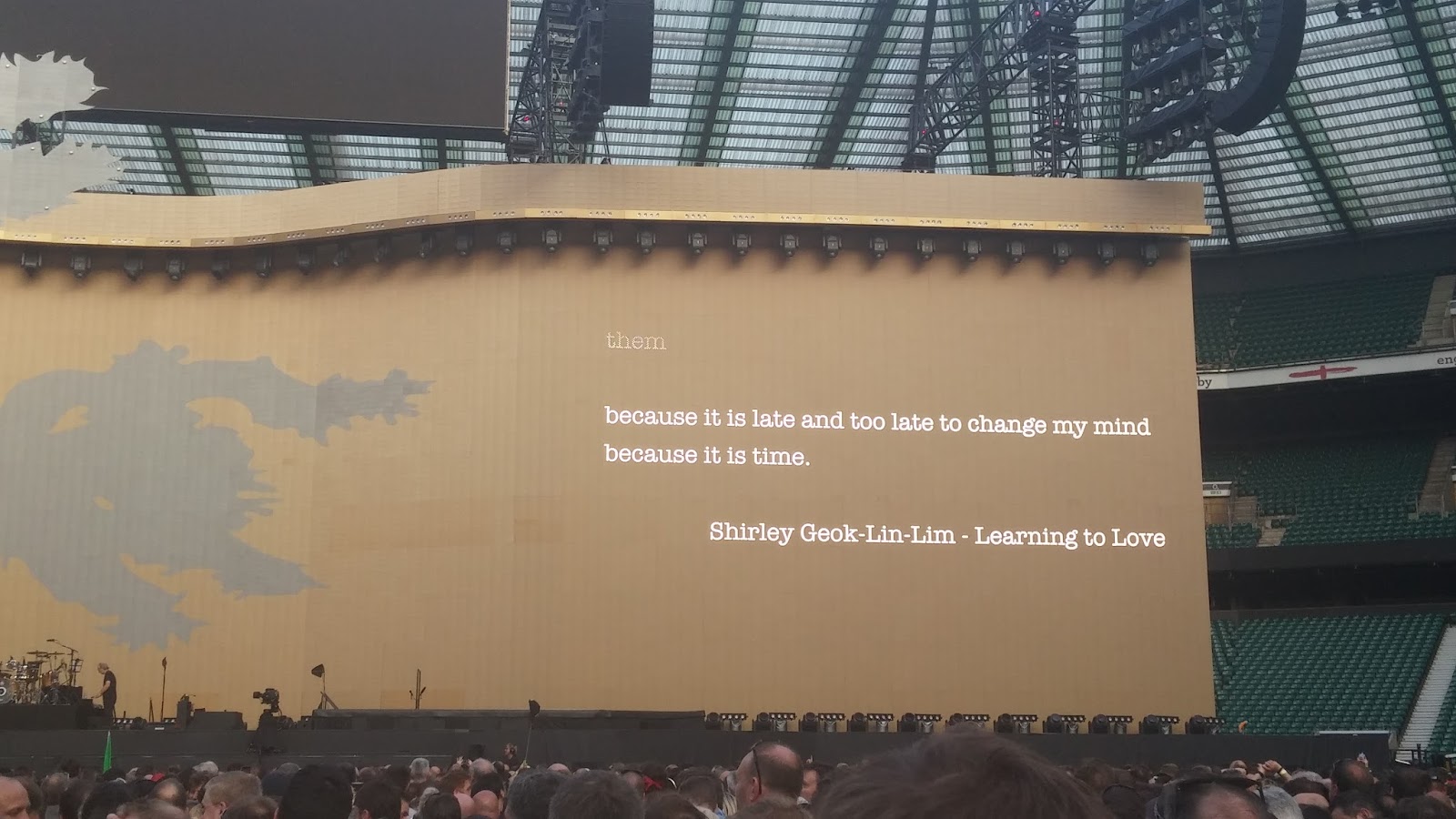
U2's current world tour is, unusually, not to promote a new album - it's for the 30th anniversary of The Joshua Tree and they are playing this album in its entirety, along with other songs before and after. I saw them last Sunday at Twickenham Stadium in London. It was a remarkable show for many reasons, not least of which was the screening of poems on the stage backdrop just before the show actually started.

I have a long history with U2, which sort of started close to 30 years ago when my brother bought The Joshua Tree. But it really started a few years later when I bought War, Under a Blood Red Sky, The Unforgettable Fire and later their other albums, when I was about 14. Those albums feature very prominently in my mental and emotional timeline from my early teens. I discovered those albums for myself, and the obsession was like falling in love. My relationship with The Joshua Tree is probably a bit harder to define, as I first encountered it through my brother and through the radio when I was younger. I was always impressed, but I also regarded the album with a slightly detached sense of awe which I've never quite shaken. I think it's their best record, but I'm not quite as closely bonded to it as I am to albums like War and Unforgettable Fire. I'm perhaps closer to its individual songs than I am to The Joshua Tree as a whole.

Before seeing U2 play on Sunday, I was already aware that they were scrolling poems on the big screen during the intermission between the opening act and the start of the main show. There was a fair amount of media coverage in Canada when one of the poems chosen was by Canadian poet laureate George Elliott Clarke. However, most (if not all) of the other poems chosen are by Americans, and it seems that different poems have been used at different shows. The poems that I saw were:

Elizabeth Alexander - 'Praise Song for the Day'. This poem was read at Barack Obama's inauguration.


Walt Whitman - a selection from Leaves of Grass


Sherman Alexie - 'The Powwow at the End of the World' 


Robinson Jeffers - 'Juan Higera Creek' 


James Dickey - 'The Strength of Fields'


Shirley Geok-lin Lim - 'Learning to Love America'  (this is actually the poem's full title, although it said 'Learning to Love' on the screen).


Pedro Pietri - 'Puerto Rican Obituary' (I didn't get a picture of this one, as the show was starting just as the poem finished...)

This U2 website has detailed more of the poems which were included on other shows (or perhaps I missed others when my friend and I were wandering around after the opening act.) Many of these poems will also be available to read online: http://www.u2songs.com/news/the_joshua_tree_tour_poetry

Personally, I was especially surprised and happy to see the Robinson Jeffers poem 'Juan Higera Creek'. Jeffers has been a bit of a well-kept secret for a long time, but in the current socio-political-environmental climate he seems to be enjoying something of a renaissance. I also love the James Dickey poem, 'The Strength of Fields'.

I don't know who was involved in selecting the poems, but to accompany (or precede) The Joshua Tree, they seemed to me exceptionally well chosen. In them, I saw the following which I also find in The Joshua Tree:

A variety of voices and experiences, including those of minorities and immigrants. The poems are by Native Americans, African Americans, Asian Americans and Hispanic Americans, among others. U2 composed The Joshua Tree in part because they'd fallen in love with America, and as Irish musicians they were well aware of their country's close links to America and of the huge numbers of Americans who are descended from Irish immigrants.

American landscapes. The landscapes of The Joshua Tree are dual (at least), as in poetry's landscapes. When U2 played 'Where the Streets Have No Name' ("I'll show you a place high on a desert plain, where the streets have no name"), the huge backdrop screen sent us flying along an American desert highway. The song was also partly inspired by Bono's humanitarian work in Ethiopia and by the divisions in Northern Ireland when he was growing up; finally, it seems to be about the speaker's spiritual quest (continued in 'I Still Haven't Found What I'm Looking For'. There seems to be something of this in 'The Strength of Fields'.) But the imagery of the album's lyrics often evoke idealised American landscapes, especially in the song 'In God's Country'. These poems also travel all over a real and figurative America.

Stories of oppression. 'Puerto Rican Obituary' came out of Pedro Pietri's experiences in advocating for civil rights along with fellow Puerto Ricans in America, and it tells a series of tragic stories. The songs 'Bullet the Blue Sky' and 'Mothers of the Disappeared', in particular, are about US military intervention in Latin America and about los desaparecidos in countries such as Argentina, Chile and El Salvador. There is a strong duality in The Joshua Tree between a mythical America and a violent one, whether internationally or closer to home (the song 'Exit' is about gun violence, and apparently the line "The hands that build can also pull down" also comments on the dual nature of US interference abroad).

The language of the poems may at times be prosaic, but the impression is often prophetic and spiritual, even shamanistic. This is also very reminiscent of U2's (Bono's) lyrical approach. Bono often includes literary references in his songs, and this was definitely a factor in my affection for U2, especially given that I was falling in love with U2 and with the poetry of WB Yeats at the same time in my early teens. Here are some of the notable poetry references in U2 songs:


  • "Into the half-light" - from 'Bad' (The Unforgettable Fire), also a reference to 'He Wishes for the Cloths of Heaven' by Yeats
  • 'A Sort of Homecoming' (The Unforgettable Fire). The title of one of my favourite U2 songs is taken from the quotation "Poetry is a sort of homecoming" from Paul Celan's 'Meridian' speech. When I learned that Bono had been influenced by Celan's writings in this song, I went to find Celan in the library, meaning that U2 are directly responsible for introducing me to his work. Also in 'A Sort of Homecoming', Bono sings 'O come away, o come away' which is a likely reference to 'The Stolen Child' by Yeats.
  • "In the world a heart of darkness, a fire zone/where poets speak their heart then bleed for it/Jara sang his song, a weapon in the hands of love/You know his blood still cries from the ground" - from 'One Tree Hill' (The Joshua Tree). Victor Jara was a Chilean songwriter, poet and political activist who was murdered under the rule of Pinochet. His last lyric was 'Estadio Chile' and it was written just before his violent death in the Chile Stadium (which has been renamed after him.)
  • "See the stone set in your eyes" - from 'With Or Without You' (The Joshua Tree). This reminds me of "The stone's in the midst of all", from Yeats's 'Easter 1916', but I admit this may be a long shot on my part.
  • "In dreams begin responsibilities" - from 'Acrobat' (Achtung Baby). This is adapted from the epigraph to the Yeats collection Responsibilities.
  • "Hope and history don't rhyme" - from 'Peace on Earth' (All That You Can't Leave Behind), a song partly based on the Omagh bombing of 1998 by the so-called Real IRA. This line is adapted from a famous quotation in Seamus Heaney's The Cure at Troy, a version of Philoctetes by Sophocles. Bono spoke here of his love for Heaney's work: https://www.theguardian.com/books/2013/sep/01/bono-seamus-heaney-tribute-poetry  

There are plenty of other literary references in U2, but I suppose it comes down to this: Sunday's concert was one of the best of my life (the fact that we had hard-to-come-by standing tickets helped a lot), and The Joshua Tree has more than stood the test of time. It was lovely to see some great poetry projected on the screen for all to read, and to reflect on how both poetry and U2 have accompanied me, and often intersected, for a very long time. 


Photos: The Joshua Tree Tour - Twickenham, July 9, 2017. Taken by Clarissa Aykroyd

Monday, 23 November 2015

Paul Celan: Sounds and Visions at Kings Place


Edmund de Waal, Karen Leeder, Grete Tartler and Isobel Colchester at Paul Celan: The Romanian Context (Kings Place, London, November 2015). Photo by Clarissa Aykroyd


On Thursday 12 November I went to a Paul Celan event hosted by Poet in the City, at Kings Place (a great arts venue near London's Kings Cross station).

It was actually a dual event, the first part of which was 'Paul Celan: the Romanian Context' and featured Edmund de Waal (author of The Hare With Amber Eyes - I finally read it and it's wonderful), Karen Leeder (Professor of Modern German Literature at Oxford, and translator) and Romanian poet Grete Tartler in conversation about Celan. Grete Tartler's opening talk on Celan was wonderful. She drew attention to his various roots - German (language), Romanian (geography and his Bucharest period), Viennese (surrealist context), French (Paris for much of his life) and of course Jewish. Apparently "all Romanians are born poets" is a saying in Romania (I can imagine), but because of his background as a German-speaking Jew, when he went to Bucharest people there were amazed by the quality of his Romanian. (He wrote early poetry, much less known, in the Romanian language). Two beautiful phrases which emerged from this part of the evening described his poetry as "a music of suggestions" and "symphony of origins". Celan had a collection whose title is usually translated as Poppy and Memory, but Tartler called it Moonflower and Memory, which I found equally wonderful.

In the subsequent discussion with Karen Leeder, Edmund de Waal talked about discovering Celan at 17, through a tribute poem by Geoffrey Hill - a mysterious reminder of my own discovery of Celan, at almost exactly the same age, through a song by U2 called A Sort of Homecoming. (Never, ever disdain the origins of your passions. I still love the song.) De Waal, as well as an author, is a potter, and talked passionately about the "texture" and "granular" quality of Celan, a wonderful sidelight for someone like me who has pretty much zero grasp of the world of pottery.

The second part of the evening, 'Paul Celan: Sounds and Visions' was the main event of the evening. Karen Leeder spoke about his life and poems, and Edmund de Waal spoke again about crossover and the inspiration provided by Celan for visual artists. We saw photos of some of his Celan-inspired works, with names such as Black Milk and Lightduress, and the number of pots echoing the number of syllables in a poem - and especially the spaces and silences. "He brings breath and white to the foreground," said de Waal. Celan also wrote about home and homecoming a good deal, but we were acutely reminded that this had resonances of loss and horror for Celan: when he came home one night in 1942, his parents were gone and he never saw them again - the key moment in his life which created a trauma he could never recover from.

There was music by Webern, Berg, Harrison Birtwistle and finally a premiere, Psalm by Martin Suckling (who was sitting two seats away from me), a tribute to Celan's own devastating 'Psalm'. The music was, I admit, avant-garde for my rather conservative tastes, but I was impressed by how Psalm, performed by players from the Aurora Orchestra, created a sort of echo chamber of reaching and loss (there were three quartets placed around the auditorium). Very unfortunately, for me, the real downside to the evening was the reading of Celan's poems. The selection was excellent - many of my favourites, including 'Homecoming', 'Etched away', 'Think of it' and others. However, the readings by actor Henry Goodman went way too far into 'actor' territory, and not in a good way (working for LAMDA, I know well that actors can perform poems superbly). Poems shouldn't be an opportunity for an actor to overact, and the power of Celan's words is such that just love, respect and restraint are needed (that goes for most poetry, actually). Sadly, he injected obvious sarcasm into every pronunciation of "Lord" in 'Tenebrae', and "over the top" doesn't even describe what happened to 'Death Fugue' (shouting in a fake German accent? Really?). I hope some of those who were less familiar with Celan in the audience look for the recordings available online of him reading his own poems, in the original German, in a tentative, trancelike voice.

Paul Celan was born 95 years ago today. It is sad to contemplate the fact that he committed suicide and that he could possibly still have been alive today. It's good, though, to see that a lot of people still love him, or that they're interested at least. I spoke with Grete Tartler afterwards and at the end of our conversation I said "I just really love him. I'm very sentimental about him, actually." She said "Yes, yes! You must be sentimental about him." She certainly understood. I am not quite sure whether she meant that my sentimentality about Paul was obvious, or whether it was a necessary approach for any reader, but certainly in my case, both apply.


Saturday, 9 March 2013

James Elroy Flecker's 'Ballad of the Londoner': "I Will Cross the Old River..."


Regent Street in the Rain by Grant Cherrington. Used under Creative Commons license


BALLAD OF THE LONDONER (James Elroy Flecker)


Evening falls on the smoky walls,
And the railings drip with rain,
And I will cross the old river
To see my girl again.

The great and solemn-gliding tram,
Love's still-mysterious car,
Has many a light of gold and white,
And a single dark red star.

I know a garden in a street
Which no one ever knew;
I know a rose beyond the Thames,
Where flowers are pale and few.


I came across this poem in one of the older Poems on the Underground anthologies. I wasn't at all familiar with James Elroy Flecker (1884-1915), but apparently his death from tuberculosis was considered a great loss to English literature, certainly in terms of what he might have accomplished. A quick glance at some of his other work makes me think that I would very much like to look into it further.

A few things struck me about this poem. I like the North London/South London nature of the romance; so many people think it's not possible to cross the Thames in any significant way. (I lived north of the river for several years, and have now lived south for a few years. and felt quite at home in both; this in itself is generally considered unusual. Maybe as a foreigner it's actually a little easier to manage than if you're a born-and-bred Londoner.) Flecker was from Lewisham in southeast London originally, but I am not sure whether there are any clues as to which direction the speaker is taking in this poem.

I also like the "hidden" nature of the poem; this is very London. Flecker's vision of the tram made me think of similar moments of unexpected urban transcendence in other works. There is a U2 song called 'Moment of Surrender' where the protagonist says "At the moment of surrender, I folded to my knees, I did not notice the passersby and they did not notice me...I was speeding on the subway through the stations of the cross, every eye looking every other way, counting down till the pain will stop..." I suspect this could be either London or New York, but it is very much about spiritual or transcendent experiences in big cities. I think such moments are why I continue to try writing about the Underground, too.

The final stanza is about bringing the hidden to light, too - or at least the speaker's delight in having found someone wonderful, and perhaps undiscovered by others, in the city wilderness. The mystery of it is rather lovely.

Saturday, 10 December 2011

"Her Fevered Smile By Night": Louise Imogen Guiney's 'The Lights of London'


THE LIGHTS OF LONDON (Louise Imogen Guiney)


The evenfall, so slow on hills, hath shot
Far down into the valley’s cold extreme,
Untimely midnight; spire and roof and stream
Like fleeing specters, shudder and are not.
The Hampstead hollies, from their sylvan plot
Yet cloudless, lean to watch as in a dream,
From chaos climb with many a sudden gleam,
London, one moment fallen and forgot.

Her booths begin to flare; and gases bright
Prick door and window; all her streets obscure
Sparkle and swarm with nothing true nor sure,
Full as a marsh of mist and winking light;
Heaven thickens over, Heaven that cannot cure
Her tear by day, her fevered smile by night.


I have a view from my current flat in south London that I never thought I'd have in this city. It looks out into a small park, which is a blessing just for the glimpse of trees and greenery; but beyond are almost all the major landmarks of the London skyline. Battersea Power Station is proudly front and centre; Big Ben and Westminster distant but clear, a small curve of the London Eye, the elegant, futuristic towers of the City. A friend pointed out one day that if you know where to look, you can even see the dome of the National Gallery, and Nelson's column.

I often prefer London by night. Especially if I have had a chance to watch a magnificent sunset first, which is surprisingly often the case. The City is like a huge space station, complete with bright red twinkles on the highest points, and the near-complete spikey Shard, even rising well above the lovable Gherkin. Big Ben's moon face is pale and watchful, and I can never quite believe that's what I'm looking at from my window.

Those London bridge walks, too; those delight me by day, but thrill me by night. I love emerging from Embankment station and seeing what colours are washing over the National Theatre that night. Off in the distance, the Oxo Tower and the magnificent spotlit St Paul's. The best view is from Waterloo Bridge. It gives those striking views both down to the City and to Westminster, and allows a view of the beautiful Hungerford Bridge, too.

Louise Imogen Guiney's sonnet 'The Lights of London' was unfamiliar to me, as was the poet - a turn-of-the-century American woman who also lived in England and was known for both poetry and criticism, now mostly lost to time. This poem struck me with its London truth. When I read it I can so vividly see nineteenth-century London and the gradual starring of its nights with the lighting of the gaslamps. A few years ago I went to see U2 at Wembley, and when they played 'Moment of Surrender' as the magnificent finale, all the lights were turned out and we all held up our lit mobile phones. Although it was so simple, it was one of the most beautiful moments of a show mostly filled with a very impressive light show. I imagine London in this poem "turning on" at night in much the same way.

This poet understood London skies, I think...those hazy, ever-changing, heartbreaking skies. And "Heaven thickens over, Heaven that cannot cure/Her tear by day, her fevered smile by night" - yes, that is London, to the very core.

Saturday, 15 October 2011

"There, A Feeling": Coming Home to Paul Celan


The above link will take you through to 'Homecoming' on the Poetry Foundation website (http://www.poetryfoundation.org/), as well as other information about Celan and more of his poems.

Writing about Paul Celan is difficult without sounding either trite or pretentious. It is important to know that he was a Jew, born in 1920 in a German-speaking enclave of Romania; that his parents were deported while he was away from home and that they died in the Holocaust. He spent time in labour camps himself. After the war he lived mainly in Paris, until his suicide by drowning in the Seine in 1970.

These are the very barest facts of his life. They can explain the guilt over his parents’ death and the anguish that haunted him, as well as his preoccupation with the fate of the Jewish people. However, I believe that his work is unique in the highly personal nature of its symbols, which translate mysteriously into something potentially universal.

My introduction to Celan was typical for me; in art, one thing always leads to another. I first read him when I was 17 or 18. I was a huge U2 fan at the time and one of my favourite songs was ‘A Sort of Homecoming’, from their beautiful early-80s album The Unforgettable Fire. Reading a book which described the stories behind U2’s songs, I discovered that “Poetry is a sort of homecoming” was a phrase taken from the poet Paul Celan, and that Bono had been reading his poems when he wrote that song.

I was curious enough to look for Celan in my university library. My memories of that early encounter are not very distinct, but I was definitely a bit puzzled. Among others, I read the famous ‘Death Fugue’ and was struck by its power. Obviously, I associated ‘Homecoming’ with the U2 song, although I didn’t realise for years that “Poetry is a sort of homecoming” was taken from Celan’s Meridian speech. I immediately realised that some of the images (the snow and the white flag, especially) echoed the imagery used by U2 in their lyrics, videos and artwork.

At some later point I bought Michael Hamburger’s translations. From time to time over the years I read some of the poems, but found most of them extremely difficult to grasp. Last year I started reading Celan again more in-depth, around when I went to a performance in London by the Michael Nyman Band of Nyman’s bleak settings of some of the poems. As the occasion was an anniversary of Celan’s birth, there were also readings and discussions of his poetry, by guests including A S Byatt.

I decided that this was the moment to explore Celan more deeply. Gradually I realised that the way to gain a better understanding of his work was to learn a little more about his life and his approach to poetry, and simply to sit with the poems and read them a great deal. It sounds facile, but once I had been reading more of the poems for a while, they started to make a lot more sense.

Certain images recur in Celan: the rose, the eye, hands, fragmentation, crystals, plants...a strange collection. When I read him I see images in my mind: green plants wreathing a doorway, white waves on a white beach, a beam of light broken up by turning blades. A childhood dream-thought of a star shining behind my wall now makes me think of Celan. Particularly with his later poems, the temptation is to call them “hermetic”; sealed, impossible for an outsider to understand. Celan loathed the term “hermetic” to describe his poetry. He called his poems “messages in a bottle”. While there was a meaning specific to him, anyone could discover their own personal meaning in them. I believe that it is the kind of art which gives a glimpse of varieties of experience. We know that certain images were specific to Celan’s experience. We also know that the reader relates the images to his or her own experience and finds personal meaning in them. Finally, certain images act as an unconscious trigger for certain feelings, which may seem completely unrelated in literal terms to the imagery. I am not sure yet if these are universal feelings or if they are very personal for each individual reader. However, this process is what I think of when he writes in ‘Homecoming’:


There: a feeling,
blown across by the ice wind
attaching its dove- its snow-
coloured cloth as a flag.


In our mind’s eye we see the snow, and the flag; we also feel something which is related but separate. To me, this is a poem about dislocation and the search for identity, but I can imagine that Celan may have been thinking of something else – or exactly the same thing – and different readers may have a different – or identical – experience.  

There is a lot of distress and confusion in Celan’s poems. He sounds as though he is stammering. Words are broken and reformed unexpectedly. Along with the anguish there is hope, invoking images of growth, upward movement and birth. In one of my favourite poems, ‘In Prague’, he describes a violent and transcendent death and rebirth specifically associated with his Jewish identity:


bone-Hebrew
ground into sperm
ran through the hourglass
through which we swam, two dreams now, chiming
against time, in the squares.


I wish that I could say something particularly illuminating about Celan, but I realise that I still have a very long way to go. George Steiner wrote in a review of Michael Hamburger’s translations of Celan: “Let him enter your life. At risk. Knowing that he will change it.” This is not an exaggeration. Celan’s work is truly unique, and the reader who takes the long gradual journey into the Celanworld will find that their way of seeing has been altered forever.