Showing posts with label translation. Show all posts

Sunday, 30 May 2021

Remembering Adam Zagajewski, 1945-2021


The great Polish poet Adam Zagajewski died on 21 March of this year - which was also World Poetry Day - and it has taken me this long to write about it. The coincidence of the date was a poignant one because I have often thought of and shared his poems on World Poetry Day and similar days for the discovery and appreciation of poetry. He was the ideal poet for the purpose.

A few of my very favourite writers have died in the past year, but this death was perhaps even a little harder to come to terms with as Zagajewski was only 75, relatively young. It's also simply difficult to imagine him gone. Whenever I thought of him, he was somewhere in Central Europe writing outdoors at a café, or reading at some gathering of world poets. 

I think Adam Zagajewski's poems were easy to love, which is no bad thing. When I think of his poems, words such as the following come to mind: humane, gentle, affectionate, clarifying. After 9/11, his poem 'Try to Praise the Mutilated World' became very famous in its English-speaking translation by Clare Cavanagh when it appeared in The New Yorker. Not one of my personal favourites of his poems, I still appreciate it and its immense value in the wake of a huge, world-changing tragedy. It distills what I think Zagajewski did best - the acknowledgement that dark, horrendous things happen but the equal observation that life continues and that the value of light, beauty and faith remains unchanged. 

If there is one contemporary poet who I most clearly see as an influence on my own poetry, it's Zagajewski. I relate profoundly to his vision of things and would aspire to write like him. The curious thing is that, unlike most poets who I consider a major influence on my life and writing, I can't now remember how and where I first encountered him. I did get to go to one of his readings, about five or six years ago at Wilton's Music Hall in east London. It was especially moving when he read 'To Go to Lvov', a very important poem for me which I wrote about here some years ago. I also met him very briefly when he signed a book of his selected poems for me. I thought that he seemed reserved but kind, and when I asked him if he recommended any contemporary Polish poets he suggested Tomasz Różycki (who in my opinion is of the stature of Zagajewski). I dug out the book after I heard that Zagajewski had died, and was touched to discover that he had actually written Różycki's name down for me on a card which I'd kept in the book - probably aware that English speakers tend to find Polish names extremely difficult. 

It's so hard to choose a favourite poem by Zagajewski. When I reread them now, years after first readings, they remind me of emotions and moments in my life, and they take me to places which I've visited or which I hope to visit some day. 'Star' has been a talisman for me for many years. 'Vita Contemplativa' occupies a central place of importance in my pantheon of poems, and lines from it often surface in my mind. 'Poetry Searches for Radiance' is a powerful mission statement for poetry. Whether one of his collections, a selected poems or something randomly found online, his works will reward both casual reading and prolonged engagement. What is much harder than finding the right poem by Zagajewski is accepting that he's not here any more. 

Be sure to read this powerful essay and personal remembrance on Zagajewski by the poet Ilya Kaminsky: https://yalereview.org/article/going-to-lvov 


Wednesday, 31 March 2021

Yang Lian's Anniversary Snow wins the Sarah Maguire Prize for Poetry in Translation


The inaugural Sarah Maguire Prize for Poetry in Translation, which recognises the best book of poetry by a living poet from Africa, Asia, Latin America or the Middle East published in an English translation, was awarded last Thursday 25th March. The prize is an endeavour of the Poetry Translation Centre and is in memory of its founder, the late Sarah Maguire, who I knew for a few years before her untimely death and who was a brilliant poet in her own right as well as a champion of poetry from parts of the world often under-recognised in English translation. 

Out of a fascinatingly diverse field, the award went to the collection Anniversary Snow by Yang Lian, translated from Chinese by Brian Holton with further translations from WN Herbert, L. Leigh, Liang Lizhen, Pascale Petit, Fiona Sampson, George Szirtes and Joshua Weiner. Anniversary Snow is published by Shearsman Books and you can find it on their website here: https://www.shearsman.com/store/Yang-Lian-Anniversary-Snow-p140803770  

The panel of judges commented: "The book is grounded in the historical roots of Chinese culture, poetry and art, but goes far beyond it, reinterpreting with poise and intelligence the very essence of our existence, from the changing landscape that surrounds us, the appeal of the natural world and the inner beauty of language, exemplifying its political force and its political teachings." 

The PTC website has several excellent articles regarding the prize but I particularly recommend this fascinating and touching article by the winning poet Yang Lian: https://www.poetrytranslation.org/articles/where-did-anniversary-snow-fall

I'm delighted to be able to share a poem from Anniversary Snow. It appears below first in the original Chinese and then in its English translation. 


三,学探——另一个嵌入的声音

不能真 是不是美的? 想象一件河底撒开的

柏林秋夜的黑
想象那双眼睛呛满 呛满

谁说死不是湿淋淋的和声? 河底的小窗亮着那演奏 河底 一个不停下的

不停找到漏下的 叶子向下而口向上

房子向下 的雪意向上 舌尖 住的是否远远?

想象一个落的自我 呛满历史的黑水 落如卵石

时间除了抽的肺

法除了剥开生命那件 身人形的茫茫

再淤是否仍然不?

     沉溺之里只有正在到来的

进这 力追赶自己的河底

亲飘散的白逆着美的方向  拓展噩耗 没目睹急急赶来

粉碎
煌如

的美学?


3. Poetic Inquiry − Another Embedded Voice

can’t be real is that beauty’s fault?
imagine a shirt spread out on the riverbed

steeping in the black of a Berlin night
imagine two eyes water-choked mother choking on water

who says death isn’t a drenched harmony?
a little window on the riverbed lights up the show riverbed a word that never stops leaping downwards

never stops finding leaked-out sobs leaves go down and wounds go up

houses down enjoyment of imminent snow goes up tongue tip is hooked ruin not enough by far?

imagine a self plunging down drowning in history’s black water plunging like a pebble

there’s no time other than a contraction of the lungs

there’s no grammar other than a shirt that strips life away say death’s immeasurable side-on human shape

is filling up with sediment again still not enough?
in self-indulgent poetry there are only newly-arrived words

touch in here he does all he can to pursue his own river bed to become it

mother’s vaporizing white travels in the opposite direction to beauty spreads the worst of news no one saw this poem coming so quickly

shattering
dazzling as

our aesthetic?


(from Anniversary Snow by Yang Lian, published by Shearsman Books) 

Monday, 8 February 2021

The Sarah Maguire Prize for Poetry in Translation Shortlist

 
A few days ago, the Poetry Translation Centre announced the shortlist for the inaugural Sarah Maguire Prize for Poetry in Translation. The Poetry Translation Centre has helped to bring great contemporary work from around the world to English speaking audiences, and this new translation prize is likely to play a significant role in years to come.

This new prize is in honour of the late Sarah Maguire, who founded the Poetry Translation Centre, and it will recognise the best book of poetry by a living poet from Africa, Asia, Latin America or the Middle East, translated into English. This year's judges are Alireza Abiz, Ida Hadjivayanis and Leo Boix. The award winner will be announced on Thursday 25 March.

The shortlist includes the following titles:

Factory Girls by Takako Arai (Action Books, 2019. Translated from Japanese by Jeffrey Angles, Jen Crawford, Carol Hayes, Rina Kikuchi, You Nakai and Sawako Nakayasu.)

A Boat to Lesbos and other poems by Nouri Al-Jarrah (Banipal Books, 2018. Translated from Arabic by Camilo Gómez-Rivas and Allison Blecker.)

Incomprehensible Lesson by Fawzi Karim (Carcanet Press, 2019. In versions by Anthony Howell after translations from the Arabic made by the author.)

Hysteria by Kim Yideum (Action Books, 2019. Translated from Korean by Jake Levine, Soeun Seo and Hedgie Choi.)

Tiawanaku: Poems from the Mother Coqa by Judith Santopietro (Orca Libros, 2019. Translated from Spanish by Ilana Luna.)

Anniversary Snow by Yang Lian (Shearsman Books, 2019. Translated from Chinese by Brian Holton with further translations by WN Herbert, L Leigh, Liang Lizhen, Pascale Petit, Fiona Sampson, George Szirtes and Joshua Weiner.)

You can read more here about this year's prize and associated events and publications: https://www.poetrytranslation.org/articles/sarah-maguire-prize-for-poetry-in-translation-shortlist 


Saturday, 28 November 2020

Remembering Paul Celan, 1920-1970


November 2020 is the centenary of Paul Celan's birth, and in 2020 it is also 50 years since he died. I have often written about him in this blog, but it has been lovely to see him widely commemorated this year and especially in this past month, even if many events had to be moved online due to the pandemic. And this has its advantages - in the past couple of weeks I attended a couple of excellent Celan events from Deutsches Haus in New York, despite living in the UK. 

While Celan's poetry is often considered difficult, he has managed to gain legions of readers who haven't been put off by this discouraging label and who often (like myself) can't read him in German, the language in which he wrote most of his poetry. Sometimes if I'm looking at Twitter late at night (a bad habit) I find myself searching to see who's tweeting about Celan all over the world (a good habit, or at least a better habit). English is by no means the dominant language, and I'm not sure German is either - he seems particularly popular in Spanish and Turkish. 

Celan's identity is very difficult to pin down in any way. He was Jewish, but that isn't necessary the dominant influence on his work (although it is massive). He was German-speaking but not German. He was Romanian, but his hometown of Chernivtsi is now in Ukraine. His greatest poetic work came from years in Paris, and he worked as a translator with many languages. All of this has probably succeeded in making him more universal. His poems are like radio transmissions directly from his mind and heart, in an new language, untranslated, somehow and mysteriously unmediated in a way that is different from most other poetry. The silences, gaps and elisions in his poems are also like the moments when the radio waves break up - but they are entirely deliberate, an essential part of the work of art, at times the most essential.

My love for Celan's work has sometimes puzzled me. He is not particularly like any other poet or writer that I love. The fact is, though, that he is simply not much like any other poet or writer at all. While his work evidently poses many extreme difficulties for translators, there is no question that the emotions carry across and pierce through. Celan's poems can seem surreal or abstract but they often refer to very specific people, places, events. To know him fully, perhaps these need to be unpicked to a level most of us never will reach. And yet Celan himself said that his work could be understand if readers would simply engage and read the poems again and again. At one of the events I attended, the author Paul Auster said that Celan's intellectual prowess was immense but that the defining factor and what has made his work so loved was the spirit, the emotion that burns from him onto the page. The Celan expert Christine Ivanovic said that even when you engage deeply with Celan and read him again and again, there will be texts that you don't understand, but you still live with the words. This has been entirely my experience. I have lived with Celan since my late teens (which seems to have been a crucial moment at which many enthusiasts and experts encountered him.) I love and admire translations by dedicated translators such as Pierre Joris and John Felstiner, but in English Celan truly lives in me through the work of translator and poet Michael Hamburger, because that was the encounter from which everything else followed. There is always an encounter with Celan - there are many encounters and they persist and can last for a lifetime. He once wrote "I see no difference between a handshake and a poem," and this despite the extraordinarily personal and often mysterious nature of his work. 

In some way I think about Paul Celan and his words every day. I feel as though a small, dedicated area of my mind (or perhaps more accurately, my heart) is occupied with his poetry all the time, even if I may not have read him for a while. He influences my own poetry and beyond that, he takes me to a Celanworld of such unique specificity and beauty that it hurts. His words are a place where no one else had ever gone and where we can all go now, across the threshold. "Louder whirring. Nearer glow. This world and the other." (from 'Under a Picture', translated by Michael Hamburger)

Here are a few of his poems to read if you haven't before or if you wish to revisit him.


Image: Paul Celan's passport photo, 1938. Author unknown. 

Monday, 30 March 2020

My translations of Benjamin Fondane in Modern Poetry in Translation


In a very uncertain and disturbing moment worldwide, literature can only do so much, but there is no doubt that it can cross borders even where physical borders have closed.

Modern Poetry in Translation is one of the best examples of this, and I'm so pleased that I have finally placed a couple of translations there. The new issue features my translations from the original French of Benjamin Fondane's poems 'All at once' and 'When the shipwrecked traveller'.

I am really honoured that I can do something to bring Fondane to a wider audience. I think he is still not well known except somewhat in Romania (his country of origin) and France (where he did most of his mature work, and his philosophy is more famous than his poetry). From the moment I first read Fondane a few years ago, I knew that I wanted to try translating his work. Modern Poetry in Translation also published my review, about a year and half ago, of a new translation by Nathaniel Rudavsky-Brody of Fondane's long work Ulysses.

The focus for this issue of Modern Poetry in Translation is Japan (obviously my translations are among those which sit outside the focus). As always, the whole issue is wonderful and worth your time. A full table of contents is here, and a few poems from the issue, although my translations appear only in the print version: https://modernpoetryintranslation.com/magazine/dream-colours-2020-number-1/

Wednesday, 29 January 2020

Alice Oswald's Nobody at Kings Place, and Anselm Kiefer at White Cube


In the past couple of weeks I went to two events which were either poetry, or poetry-adjacent ("adjacent" is my current overused word) and wanted to write a little about them here.

Alice Oswald, who is definitely "the great Alice Oswald" and is also now the first woman Oxford Professor of Poetry (though not the first to be elected - that was Ruth Padel), performed at Kings Place on 17 January with live music by Ansuman Biswas. Oswald does specifically "perform" rather than "recite" or "read" - even her more conventional appearances involve her almost chanting her poems off by heart, unforgettable performances unlike anyone else's. I have written about seeing her a couple of times before, and this was one of the less conventional appearances. It started with a "sound calendar" or seascape by Chris Watson, and the actual performance was mostly in total darkness, although there was partial lighting for sections of it.

Oswald was performing Nobody, her most recent book, based on stories of water, humans and gods from Greek mythology. I'm only superficially knowledgeable about the Odyssey and related works, so I appreciated Nobody more from a sea-perspective, but the tales that washed in and out sometimes had an odd familiarity. Ansuman Biswas performed on the aquaphone, which reminded me of sea sounds washing into a cave, and also an enormous gong, which was overwhelming to the point of being almost distressing at certain points. The whole performance was mesmerising, thrilling and absolutely haunting.

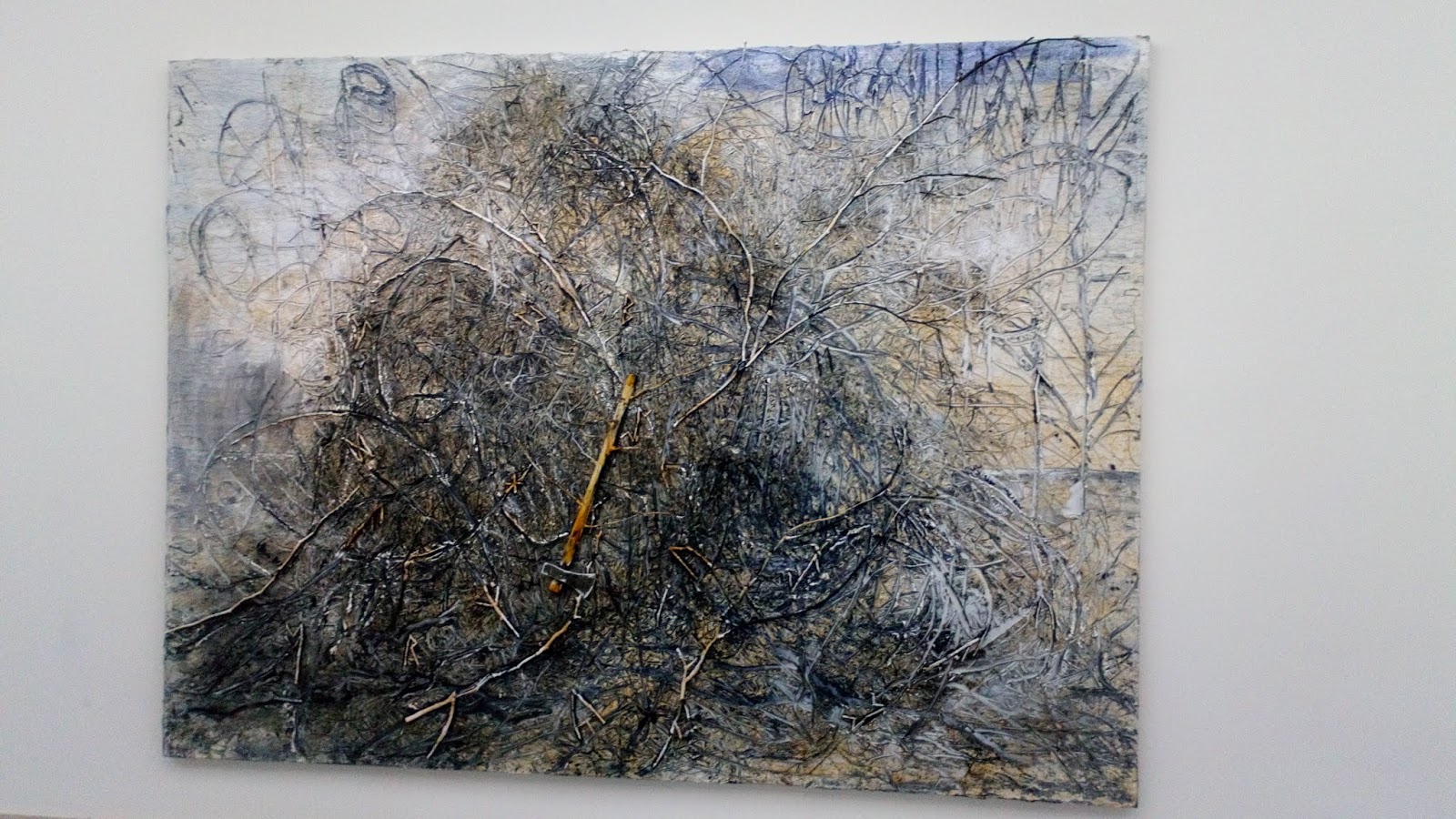
Last weekend I went to Anselm Kiefer's new exhibition Superstrings, Runes, The Norns, Gordian Knot at White Cube in Bermondsey. I got in just under the wire - the exhibition had been on for a few months but was in its final hours when I went. I was very glad that I did make it, as I've found that Anselm Kiefer is one of the very few contemporary artists who I really connect with. I've written about him on this blog before, as my way into his work was through the poetry of Paul Celan, one of his greatest inspirations (and mine...)

The tangled, broken, cascading canvases and masses of wires weren't quite as enthralling to me as Kiefer's exhibition Walhalla, also at White Cube a few years ago, or the retrospective at the Royal Academy which introduced me to his work - although this was still excellent. This exhibition also seemed a little less poetry-influenced. But poetry was still there: one canvas took inspiration from Georg Trakl, another from the Kalevala, a work which brings together traditional poetry about Finnish mythology. In one of the books accompanying the exhibition, Kiefer referred to Ingeborg Bachmann's poem 'Bohemia Lies By the Sea'.

The painting below, one of the Gordian Knot series which featured axes, seemed slightly more optimistic than most of the other works in the exhibition (which probably tells you something about how "optimistic" it was overall: Kiefer is pretty shattering, almost literally.) I don't quite know what it was - perhaps the colours. I just knew that I felt a slight lifting of the heart. But it also reminded me of Paul Celan's poem 'I hear the axe has flowered'. You can read this poem in full, along with a few others, in translation by Ian Fairley on this link: https://www.guernicamag.com/four_new_translations_of_paul/


Wednesday, 14 August 2019

My poetry pamphlet is coming...and an MPT acceptance


I have a couple of publication announcements to make, and they're both particularly good ones.

In October, Broken Sleep Books will publish my first poetry pamphlet. It seems to have taken me 25 years of writing poetry fairly seriously to get to this point (I am not especially prolific), so I'm delighted. Broken Sleep Books, run by Aaron Kent and Charlie Baylis, have only been around for a couple of years but have already published many acclaimed pamphlets in lovely minimalist designs.

Of course, I will post more details when the pamphlet is actually available. Watch this space!

As for my second announcement: I don't usually post about acceptances from journals - just actual publications, when they appear - but I'm really excited about this one. Modern Poetry in Translation have accepted two of my translations from the original French of Benjamin Fondane's poems, and they should be appearing in a spring 2020 issue. I've loved Fondane's work for a couple of years now, and I feel quite honoured to be able to share him with MPT's audience, following the review I wrote for them in 2018 of Nathaniel Rudavsky-Brody's translation of Fondane's long poem Ulysses.


Saturday, 20 April 2019

Michael Hamburger Event and Questions of Translation


A couple of days ago I went to an event at the British Library, 'Poet in the Archives: Michael Hamburger', with discussions between Karen Leeder, Jen Calleja and Iain Galbraith.

I will immediately admit that my interest in Michael Hamburger is (so far) almost entirely related to his translations of Paul Celan's poems: in fact, for me, he is the voice of Paul Celan in English. I have also been impressed by others' translations (Felstiner, Joris, etc) but I first encountered Celan through the English words of Michael Hamburger when I was only about 18 years old, and that was inevitably a more powerful experience than I was even able to comprehend at the time. In a way, it was good that this event didn't involve a lot of discussion of the Celan translations - it was more about his own poetry, his criticism, his correspondence, and his general approaches to translation (he also worked on Rilke and Hölderin among others), and so it broadened my horizons.

Karen Leeder said: "He wrote his criticism with the voice of a poet" and that Hamburger was interested in translation as a mirror image rather than as an imitation - "he only translated what he felt he could understand." There was discussion of the peculiar musicality of his translations, and his love of letter-writing - he sometimes kept up intense correspondences with people he'd only met once or who had simply written to him with a question or observation. Iain Galbraith, who had known him personally, quoted Hamburger as having said "The poems that don't embarrass me are the ones that surprise me." Jen Calleja, who had been working on Hamburger's material in the British Library archives, read poems based on this exploration, some of them wittily based on subjects like disgruntled readers' corrections of his English equivalents.

On a different but related note, I have just read this Asymptote article by Jen Calleja and Sophie Collins about translation: https://www.asymptotejournal.com/special-feature/jen-calleja-sophie-collins-she-knows-too-much/

I wanted to share it because I have occasionally thought of writing something along the same lines on this blog, but this is much more informed and thorough than anything I could have written. In essence, while there's an obviously growing interest in poetry translation and that's fundamentally a good thing, it's also quite obvious that some potential or even tangible problems have arisen, along the lines of poets who are only fluent in English superseding the actual translators in collaborative translation, and related issues. This article is essential reading for anyone interested in current developments in the translation of international poetry into English.


Sunday, 3 March 2019

Serhiy Zhadan: "Don't Stop, Just Write..."


Back in November I went to an event at the British Library where Ukrainian poet Serhiy Zhadan was interviewed and read some of his poems. I actually went to several interesting poetry events between about September and December - a talk by the great Syrian poet Adonis, also at the British Library; a live reading with actors of Emily Wilson's new translation of The Odyssey, at Southbank; a couple of events remembering Ted Hughes and his ties to Modern Poetry In Translation and the poetry translation world in general; and others. But I was also in the midst of a very stressful time at work (not out of the woods for a while yet, I'm afraid) and so didn't write about these at the time.

What reminded me of Serhiy Zhadan this week was that I was reading Timothy Snyder's new book The Road to Unfreedom, which is largely about the incalculable effect that Russia has had on world events during the 2010s, and Zhadan is mentioned in this book. The incident he was involved in took place in 2014 during the Maidan protests around the country and the Ukrainian revolution, and can be read about here: https://www.poetryfoundation.org/harriet/2014/03/ukraines-best-known-poet-injured-in-protests 

The other thing that reminded me was reading this remarkable interview with Zhadan which has just appeared: https://www.calvertjournal.com/articles/show/11022/everything-changed-ukraines-literary-star-serhiy-zhadan-on-5-years-since-euromaidan

In this interview he talks about how the war in Donbass has changed the country, how he feels about Russia and Russian literature, and so on. It's a good summation of his perceptive, strong but compassionate views. I thought his comments on whether writers should be seen as moral authorities were especially interesting: certainly a contrast to a lot of the claims I see on social media and elsewhere.

When I saw Zhadan at the British Library in November, I think I was one of the few people in the audience who wasn't a Ukrainian or Russian speaker (though I did recognise a few words). There was, of course, a translator. I took a few notes. Zhadan spoke about the importance of poetry in a country like Ukraine and how thousands might come to a poetry reading (I thought to myself: eat your heart out, poets in English-speaking countries, at least most of the time...). In Ukraine, he said, poetry is part of politics, civic life, and history. However, he also said that at times, writers speak about things they don't know enough about! "Writing about war goes deeper than politics," he said. "The war is setting the tone in Ukrainian literature, and war changes the intonation of literature." Zhadan is something of a rock star in Ukraine, and not just for his poetry: he's been involved in theatre and music and is currently a member of the ska band Zhadan and the Dogs.

I've been reading Zhadan's poetry, at least occasionally, for a few years, and it's always a delight for me to come to his poems. You can read his poems 'Stones' and 'A city where she ended up hiding', translated by Valzhyna Mort, here: https://pionline.wordpress.com/2016/12/17/two-poems-by-serhiy-zhadan-translated-by-valzhyna-mort/

And this poem, 'History of Culture at the Turn of This Century', is a favourite of mine: https://www.poetryinternational.org/pi/poem/5646/auto/0/0/Serhiy-Zhadan/History-of-Culture-at-the-Turn-of-This-Century/en/tile


Photo: Serhiy Zhadan, 2015, by Rafał Komorowski. Used under Creative Commons license

Thursday, 31 January 2019

Poetry and TV: From Battlestar Galactica to The Little Drummer Girl


I recently finished watching all four seasons of Battlestar Galactica (the 2000s 'reboot' series - and yes, I am aware that it actually finished ten years ago. I'm also aware that streaming services are pure evil and that I have been watching too many box sets recently.) I'm not quite sure how I got started on this series; it is considered one of the best science fiction TV series ever made, but on the other hand, sci-fi is not usually my thing. However, Battlestar Galactica is really about politics, faith, human identity, the terrible challenges of leadership, conflicting loyalties, and a lot of other fascinating stuff, so it worked for me (as do films like Blade Runner, Inception and Arrival, and the works of Ursula Le Guin). It also turned out to have one of my favourite on-screen relationships of all time - William Adama (Edward James Olmos) and Laura Roslin (Mary McDonnell).

Anyway - in my defense for watching too much TV - I love a good poetry reference in the middle of an episode, and in Battlestar Galactica it happened during the episode 'A Disquiet Follows My Soul' (season 4), when an already bleak series has quickly become about ten times bleaker. Admiral Adama is heard reciting the first few lines of this poem by Emily Dickinson.


THERE IS A LANGUOR OF THE LIFE (Emily Dickinson)


There is a Languor of the Life
More imminent than Pain --
'Tis Pain's Successor -- When the Soul
Has suffered all it can --

A Drowsiness -- diffuses --
A Dimness like a Fog
Envelops Consciousness --
As Mists -- obliterate a Crag.

The Surgeon -- does not blanch -- at pain
His Habit -- is severe --
But tell him that it ceased to feel --
The Creature lying there --

And he will tell you -- skill is late --
A Mightier than He --
Has ministered before Him --
There's no Vitality.


I find it equally moving to imagine that some viewers will hear these words, have no idea where they're from and still be touched by them, while others will catch (or look up) the reference and appreciate the added dimension of intertextuality. Although only a few lines were quoted, the poem as a whole seemed to intersect with the show's themes in many ways.

I'm more used to finding poetry references in novels, short stories, or even non-fiction writing, but it occurred to me that I've come across several wonderful poet/poetry quotations or allusions in a few TV shows recently. In the most recent season of Elementary, the modern Sherlock Holmes adaptation which places Holmes (Jonny Lee Miller) in New York alongside Watson (Lucy Liu), Holmes quotes Rainer Maria Rilke: "When anxious, uneasy and bad thoughts come, I go to the sea, and the sea drowns them out with its great wide sounds, cleanses me with its noise, and imposes a rhythm upon everything in me that is bewildered and confused" (translated by Jane Bannard Greene and M.D. Herter Norton). I thought this was a particularly nice touch because the original Holmes liked to quote Goethe, among others; surely he would have quoted Rilke as well, but that poet's work came a little late for Holmes's original moment in time.

A few spy shows I've watched have also contained intriguing poetry references. This is often also the case in spy novels, and it always seems appropriate because poetry can resemble a code (which does not necessarily mean that it is a code). In the recent TV miniseries adaptation of The Little Drummer Girl by John le Carré, the young actor Charlie (Florence Pugh) reads a Mahmoud Darwish poem as part of the (literally) theatrical love affair she's embarked on:


Did you dance with young angels
while you were dreaming? Did the butterfly
light you up when it burned with the eternal
light of the rose?

(translated from the Arabic by Omnia Amin and Rick London)


In Season 4 of The Bureau (Le bureau des légendes), an exceptional French espionage show, a book of poems by Robert Desnos makes a brief appearance. The surrealist poet Desnos, who perished in Terezín in 1945, was also involved in the Réseau AGIR, a French Resistance espionage network providing information on German bombing facilities. Desnos' work for them involved the creation of false identity papers.

I've also been watching Counterpart, a disturbing spy show about parallel worlds in Berlin (obviously inspired by, but not exactly about, the divided city of the Cold War). Rilke also makes an appearance here, when Howard Silk (JK Simmons) reads his poetry to his wife, who is in a coma:


You, you only exist.
We pass away, till at last,
our passing is so immense
that you arise: beautiful moment,
in all your suddenness...

(translated from the German by Stephen Mitchell)


In another scene, the children's poem 'On the Other Side of the Door' by Jeff Moss is quoted, in one of the most bone-chillingly inappropriately appropriate uses of poetry I've seen on screen:


On the other side of the door
I can be a different me
As smart and as brave, as funny or strong
As a person could want to be.


TV shows (like any other entertainment) are never without their flaws, but the genuine depth added and the respect for literature shown by these poetry references are something I truly appreciated and for which I'll continue to watch.


Thursday, 22 November 2018

Recent Publications: Modern Poetry In Translation & Sherlock Holmes Is Like...


I've recently had a couple of essays (or, a review and an essay) published in print, which for me at least is less common these days, and is always a special delight. (It's not as good for sharing widely, but it has a little extra gravitas and permanence.)

My review of a translation of Benjamin Fondane's Ulysses (translated by Nathaniel Rudavsky-Brody, Syracuse University Press, 2017) appears in 'In a Winter City' (Modern Poetry in Translation, No. 3, 2018). I cannot deny that I am very excited about this. On social media I often see people talking about their "dream journals" for publication: Modern Poetry in Translation is mine. Hopefully I'll get one of my own translations in there some day. I also love Fondane, and it was a privilege to review this excellent translation from the original French. You can access a full table of contents, buy a print copy, subscribe to the journal (which I highly recommend) and read a few of the poems here, but the review and most of the issue is only available in print or by a digital subscription. The focus of this issue, which my review sits outside of, is Hungary and Ted Hughes. It's 20 years since Hughes died, and as one of the founders of MPT, he dreamed of a Hungarian issue but didn't edit one in his lifetime.

The essay is non-poetry, but I am also proud of it - and oddly enough, I managed to quote Ted Hughes in it. It's entitled 'Tinker Tailor Sherlockian Spy: George Smiley', and it appears in Sherlock Holmes Is Like, published by Wildside Press. Edited by Christopher Redmond, this book contains 60 essays comparing Sherlock Holmes and characters of fact and fiction ranging from Loki to The Beatles (and everyone between that you can think of). As I'm quite immersed in spy literature, especially John le Carré, these days, it was a natural choice to pick le Carré's master spy George Smiley for this commission, especially as le Carré has often spoken of the inspiration he found in the Sherlock Holmes stories from a young age. You can buy the book directly from the publisher or from the other usual outlets. Authors weren't paid, and royalties go to the Sherlockian charity The Beacon Society.


Thursday, 19 July 2018

Poem review + recent translation at the PTC


A thoughtful review of my poem 'Carousel', recently published by Strange Horizons, appeared on Charles Payseur's Quick Sip Reviews, and you can read it here: https://quicksipreviews.blogspot.com/2018/06/quick-sips-strange-horizons-06182018.html

In translation news, I joined the Poetry Translation Centre workshop a few weeks ago to help translate an Arabic prose poem, 'Savannah' by Amjad Nasser. I was really pleased that a few sixth-formers (that's high school...ish...for the North Americans) joined the workshop with their teacher, made interesting contributions, and evidently enjoyed it.

Monday, 7 May 2018

Osip Mandelstam: 'The Admiralty'


This poem, 'The Admiralty' by Osip Mandelstam, appeared a few years ago as a Guardian Poem of the Week in a translation by Yuri Drobyshev and Carol Rumens. It describes the Admiralty building in St Petersburg, Russia.

Carol Rumens' comments on her work with Yuri Drobyshev, and on the poem, are as always very much worth reading, particularly because Mandelstam is a complex poet who apparently is insanely hard to translate well (although a lot of people have tried - this always makes me, a non-Russian-speaker, a little nervous when I read his work in translation.)

What I've found in my somewhat intermittent reading of Mandelstam over the years is that his poems typically have an extremely concrete, physical focus (like a close-up, almost through a microscope) which then explodes into a constellation of observations (whether temporal or more philosophical). In this poem, Mandelstam cleverly gives the authority of a "demi-god" to human craftsmen, including the ability to transcend space and time.

I visited St Petersburg, then Leningrad, in 1985. It was summer, my family was on a side trip of a few days from Finland, and I would have been either almost six years old or just turned six. It's rather mysterious to me now to think that I visited Soviet Russia a few years before the end of the USSR (when I read the recent biography of John le Carré by Adam Sisman, I realised that I travelled there before le Carré ever did).

While I was a fairly well-informed kindergartner, I don't think I knew much about Russia or its history. It seems, though, that my parents had grasped the effect that travel can have on a growing mind. I didn't know that some day I would read Mandelstam, or that more than 30 years later I still wouldn't have returned to Russia. I don't remember if we saw the Admiralty building. What I remember are images from somewhere between dream and reality, which I have carried with me my whole life since: the customs officer at the Finland-Russia border, a young man probably no more than 20 years old, smiling down at me as my parents lifted me up; the Winter Palace, carved from an iceberg and stranded on the edge of a square the size of a planet; crowds on a street and a kvass machine; the cake-yellow Summer Palace and a trick fountain in the shape of a little dog; a white cat delicately carrying a fish along the street; an oppressive red velvet dining room at the Hotel Evropeiskaya (yes, we actually stayed there on a package tour); hockey-playing bears at the circus on ice; a city outside of darkness, sailing on the edge of a world vaster than anything I knew.


Photo: Admiralty, St Petersburg by Dominic Sayers. Used under Creative Commons license

Thursday, 14 December 2017

Iraj Ziayi: 'Tehran letter'


I recently went to my first Poetry Translation Centre workshop in a while, where we translated a couple of poems by the Persian poet Iraj Ziayi (using a literal translation by Alireza Abiz, who was also present, as a starting point). He is known as "the poet of objects", often imbuing inanimate things with an unusual charge of meaning in his poems.

One of the poems in particular, 'Tehran letter', affected me deeply. It accomplished what honestly I'd probably like to do in all of my own poems: in a brief format (14 lines) it evokes the emotions and memories that cling to a place, and a non-linear sense of time. The intimacy of translation - and in a Poetry Translation Centre workshop every line is carefully debated, discussed and decided on, with an expert in the original language present - immersed us in the poem and its mysterious approach to time.

By the end of the poem, I realised that it reminded me of TS Eliot's Four Quartets, perhaps 'Burnt Norton' in particular. "If all time is eternally present/ All time is unredeemable": in 'Tehran letter', "they came and killed and burnt" is a reference, well-known to Iranian readers, to the 13th-century Mongol invasion. To me, there was a kind of agitation in the postman's repeated return to number 49, even if it's to seek birdsong (also reminiscent of 'Burnt Norton': "Quick, said the bird, find them, find them/ Round the corner..."), a sad sense of a broken automaton. The poem is beautifully constructed and deeply poignant, but the way the central image of a letter exists and un-exists, writes and unwrites itself, is also disturbing. It seems to spool in a motion that suggests both the "river-that-isn't", and a kind of eternal Mobius strip (as another workshop member said), even a trap.

As well as the final translation of 'Tehran letter', do read the 'About this poem' section, describing the meanings that we explored - some of them nearly impossible to translate without a considerable loss of the original meaning. Translation, especially of poetry, really is a joy and a sadness.


Photo: Glassware and Ceramics Museum by reibai. Used under Creative Commons license 

Thursday, 23 November 2017

In memory of Sarah Maguire, 1957-2017


Al-Saddiq Al-Raddi and Sarah Maguire at Dove Cottage


Sarah Maguire, an outstanding London poet and the founder of the Poetry Translation Centre, died at the beginning of November. She had been ill for a few years.

I think it would be presumptuous to say that Sarah and I were friends. We were, however, good acquaintances who were always very happy to see each other and chat at poetry events. The first time I saw her read and briefly met her was at the 2007 TS Eliot Prize readings, when her collection The Pomegranates of Kandahar was nominated (that was when the TS Eliot was still at the small Bloomsbury Theatre). In 2012 I was deeply impressed by the Poetry Translation Centre readings at Poetry Parnassus on London's Southbank, and I started attending the PTC's translation workshops shortly after that, usually a few times per year. This was how I got to know Sarah.

Sarah Maguire was a wonderful poet, one who I feel was very under-recognised. Her poems aren't flashy or zeigeisty, but they are models of restraint and precise concision. She was exceptionally good at conveying emotion obliquely. I find that her poems often seem dispassionate on the surface but they prove to have an emotional depth without falseness. There are excellent poems in all of her collections but out of Spilt Milk (1991), The Invisible Mender (1997), The Florist's At Midnight (2001) and The Pomegranates of Kandahar (2007), I'd especially recommend The Pomegranates of Kandahar, with its memorable poems about London, the Middle East, and gardens (three of her great loves).

Sarah is almost certainly going to be best remembered for her work with the Poetry Translation Centre. The only sadness in this is that it overshadowed her own work and, from what she said to me, probably didn't leave her enough space to write her own poetry. But it's hard to overstate how important the PTC has been in bringing foreign and non-English-language writers into the consciousness of English-speaking poets and readers (even a little). Sarah had been to Palestine and Yemen under the aegis of the British Council and this awakened her interest in poetry from these countries and from others, often with exceptionally rich poetic traditions, but also often portrayed in the media exclusively as countries of war and turmoil (she had a particular love for Somalian poetry).

I have realised that the PTC has been very important to me personally as a poet and a (tentative) translator. The PTC workshops, where all that was required from participants was an ability to make a contribution, opened up new vistas for me particularly with Arabic-language and Persian-language poetry. It gave me confidence that I had an ear for translation and it also helped me to value the contributions of others (an average PTC workshop might include SOAS students, linguists, poets and others). Sarah didn't speak the languages which the PTC translates from, but she was passionate about ensuring that the poems were translated as carefully as possible. Beyond the poems translated in the workshops, many exceptional poets came on board to assist with the PTC's translation pamphlets and books. It always struck me that everyone involved was very self-effacing. Perhaps most importantly, without the PTC, it's unlikely that English-speaking audience would even have the opportunity to know of and read truly great poets such as Al-Saddiq Al-Raddi (Sudan) and Hadraawi (Somalia).

Sarah Maguire was someone who truly appreciated and respected other cultures, and who also saw people from other countries just as they are - people, fellow humans, equals, with respect and no condescension. All this is rarer than it should be. Myself, I always found Sarah to be extremely personal and kind. They were only small things, but she was truly appreciative when I wrote about the PTC on my blog, when I expressed enthusiasm for Arabic poetry, when I got one of Al-Saddiq Al-Raddi's poems into an anthology I was editing, or when I asked if I could write about one of her own poems on my blog. At times, these encounters were when she was suffering from personal losses or when she was very ill. Even though I knew about her illness, it was a great shock to learn that she had died, far too young. She will be missed so much by friends, poets and colleagues from a wide variety of cultures.

Here are a few of Sarah's own poems:

Almost the Equinox
The Florist's At Midnight
Spilt Milk

And a couple of poems which she co-translated:

Garden Statues (Al-Saddiq Al-Raddi, translated by Sabry Hafez and Sarah Maguire)
The Schoolchildren (Pedro Serrano, translated by Gwen MacKeith and Sarah Maguire)

Here, finally, is her lecture Singing About the Dark Times: Poetry and Conflict.


Sunday, 29 October 2017

Keep My Words Forever: Mandelstam at Pushkin House


London's Russian cultural centre Pushkin House is currently running a programme about Russian poetry in exile, to commemorate the centenary of the Russian Revolution. Along with information about their 101st km Further Everywhere pavilion on Bloomsbury Square (until 10 November) you can also find the programme of poetry events here. There are still a few events to go.

On 19 October I went to see the film Keep My Words Forever (directed by Roma Liberov, in Russian with English subtitles), about the life of Osip Mandelstam. The film combined puppetry, animation using cutouts and other effects, and documentary filming. I wasn't totally sure how this was going to work but it turned out to be an extremely moving film, capturing Mandelstam's often manic energy and its disintegration into illness and depression after years of persecution. As the director said, particularly with the use of puppets, it felt as though there was a short period of adjustment needed while watching and then viewers start to see the people in the puppets. This was exactly how it was, for me. The translations used were by a wide variety of Mandelstam's many translators.

Speaking after the film, Roma Liberov referred to the Russian Revolution and what followed as "interrupted history - a social experiment" (which reminded me of when I saw Russian poet Maria Stepanova some years ago and she spoke of decades of "frozen history"). Liberov pointed out that poets in Russia died for the right to write outside of the propaganda machine, and that Mandelstam died principally because people in the literary establishment didn't like him and decided to ensure his downfall. (The latter was an interesting point because it is often assumed that he died specifically because of the 'Stalin Epigram', but Mandelstam didn't particularly consider himself a political poet and his views were more complex than that.) He was hard to capture in the film, said Liberov, but I felt there was success up to a point. I thought Keep My Words Forever was a beautiful and appropriate title. Osip Mandelstam's wife Nadezhda memorised his work and ensured that it was preserved (her story is completely extraordinary in itself) and there we were hearing his words nearly 80 years after the poet died. I wondered how Mandelstam would feel if he could know that.

In the lobby at Pushkin House, film clips with photos of Mandelstam and his handwriting were playing, and a recording of his voice. Liberov said that while it is often difficult to know at which speed old recordings should be played, this one had been listened to by Mandelstam's friend Korney Chukovsky (himself a famous Russian children's poet and literary critic) and that Chukovsky had confirmed at which speed his friend's voice sounded right to him.


Thursday, 26 October 2017

A Report from Poetry International (London) 2017


Joy Harjo at Poetry International, October 2017


Ted Hughes founded the Poetry International festival in 1967, and its 50th anniversary celebration was on 14-15 October at Southbank Centre in London, where it all started.

I had hoped to attend more events at this year's Poetry International, but I've been very busy lately and couldn't manage to plan a whole weekend of poetry events; I still made it to a few, though. There was a particular focus this year on disappearing languages, and the first event I went to was called Seven Thousand Words for Human: Endangered Poetry. Translator and poet Stephen Watts asked "Is poetry an endangered language?" and pointed out that translation can either be colonising, or have a bringing-in effect. Joy Harjo, a Native American of the Muscogee (Creek) Nation, read in her indigenous language and said "Part of coming home is the language." There were also wonderful readings by Nick Makoha and others from a variety of languages under threat, such as Luganda and Sardinian.

The Modern Poetry in Translation event on Saturday evening was partly to say goodbye to Sasha Dugdale as its editor - she is handing on the role to Clare Pollard. Sasha has done an incredible job in extending the reach of MPT during her years with the journal. There were amazing readings by the Syrian Kurdish poet Golan Haji, whose work I first discovered a few years ago now, and his translator Stephen Watts, who also read some of his own poetry.

On Sunday, the World Poetry Summit featured Joy Harjo (US), Sjón (Iceland), Yang Lian (China), Anne Carson (Canada), Claudia Rankine (US), Vahni Capildeo (Trinidad) and Arundhathi Subramaniam (India). Choman Hardi should have been there and at other events, but couldn't get out of Kurdistan due to the ongoing crisis there. We did hear recordings of her poems. All of the readers were excellent, but I was particularly moved by Joy Harjo singing her extraordinary poem 'Equinox' and by Claudia Rankine's contrasting readings from Citizen and Don't Let Me Be Lonely (the former sombre, the latter more hopeful.)

Coincidentally, at the World Poetry Summit I found myself sitting next to Elzbieta Wójcik-Leese, who I already knew a little and who is one of the world's foremost translators of contemporary Polish poetry. It was good to catch up, and after the readings we went to the Poetry Library's open day, which this year focused on the theme 'A Universal Language'.


Photos by Clarissa Aykroyd, 2017