"Poetry searches for radiance, poetry is the kingly road that leads us farthest" (Adam Zagajewski)
Showing posts with label Coleridge. Show all posts
Sunday, 14 April 2013
Poetry on the Slopes of Mount Everest
Everest photo by shrimpo1967. Used under Creative Commons license
Thus far, in a break with the tradition established by T S Eliot, March was the cruellest month this year and seems to have left me pointlessly exhausted for April - hence a slight lack of posting enthusiasm lately, though I have a long list of entries that I absolutely have to write sooner or later...
Today I was watching a documentary on BBC iPlayer about the Eiger, one of the great mountains that is always alive in my subconscious mind. I saw the Eiger a few years ago, and passed through it on the railway up the Jungfrau, and that was one of my travel dreams fulfilled. Watching the documentary, about the tragic and dynamic history of its climbs, played out on the brutally visible "theatre" of its North Face, I realised that I know the names and the stories quite well: the White Spider, the Traverse of the Gods, Toni Kurz, Heinrich Harrer, Chris Bonington, John Harlin, so many others... Some survived and some didn't; it has claimed more than sixty lives. I found it impossible to look at the mountain without a lot of emotion, and the view from the window halfway up the North Face was overwhelming.
I recently finished reading Into the Silence by Wade Davis, an account of the early British expeditions to Everest with Mallory and others, which culminated in the death of Mallory and Irvine in 1924. The book sets the expeditions firmly in the context of the horrors of World War I (which I have never found so vividly, accurately and graphically described) and how this affected the national consciousness.
For the purposes of this blog, a detail which fascinated me was the fact that Mallory brought a poetry anthology with him on the expeditions, and that he spent a lot of time reading it. Published during the war, the anthology was called The Spirit of Man and was intended to rally the spirits of the British public. It was edited by Robert Bridges, who was then the poet laureate.
Mallory wrote to his wife about a month before his death on Everest in 1924, one afternoon huddled in a tent during a storm, of reading from this anthology with his companions: "We all agreed that [Coleridge's] 'Kubla Khan' was a good sort of poem. Irvine was rather poetry shy but seemed impressed by the Epitaph to [Thomas] Gray's 'Elegy'. Odell was much inclined to be interested and like the last lines of [Shelley's] 'Prometheus Unbound'. Somervell, who knows quite a lot of English literature, had never read a poem of Emily Brontë's and was happily introduced."
The actual poetry of World War I would, of course, take poetry into new and frightening areas with the emergence of figures such as Wilfred Owen and Isaac Rosenberg, who saw clearly how the world and its certainties were being brutally shattered, and thousands of lives with them. Mallory and his companions were perhaps among the last representatives of an age where men fought, or climbed, for high ideals of conquest and nationalism which turned out to be desperately flawed. But I still love the idea of these brave men reading poetry on the slopes of Everest, and I'm glad that it brought them some peaceful moments.
Here is a link to Gray's 'Elegy', which Irvine had liked - its Epitaph does seem especially poignant in light of the fact that Mallory and Irvine were to die so soon afterwards.
ELEGY WRITTEN IN A COUNTRY CHURCHYARD (Thomas Gray)
Monday, 21 January 2013
"The Secret Ministry of Frost": Coleridge's 'Frost at Midnight'
It has been snowing in London, and around the UK, on and off for a few days now. Yesterday I watched flakes pouring past my window for hours on end. (I wasn't feeling well and other commitments had already been scuppered, so I wasn't about to actually go out in it.) There is likely to be more on the way, here or elsewhere, and with more snow will come more of the disruption that visits a country which seems utterly unprepared for snow but still gets it on a semi-regular basis.
Anyway, with the coming of the cold came thoughts about Samuel Taylor Coleridge's 'Frost at Midnight'. It is one of my favourite poems by a Romantic poet - perhaps simply one of my favourite poems - and has attached itself to my life in various ways over the years. Recently it took on a little more significance after I saw the cottage where Coleridge wrote the poem, in Somerset, which I wrote about here.
It also reminds me of one of the first English classes I took at university. I was young, only seventeen (which seems even younger to me now) and it was a second-year class, so most of the students were at least two or three years older than me. I remember feeling nervous for the first while and hoping I wasn't going to get told I didn't belong there (a fear I occasionally experience when I feel out of my depth.) However, I also remember the kindness of the professor, whose name now escapes me (only my terrible memory is to blame) but who was from Northern Ireland, I think. His demeanour made it easier to ease into an unfamiliar environment. When I asked about the image of the "film which fluttered on the grate", which told me very little, he explained that this was a vestige of a bygone age and that it was the soot in the fireplace, which was also supposed to be the omen of the coming of a stranger. Strange how I remember that, when other details of studying the poem have gone.
'Frost at Midnight' is, to me, purely poetic in an unselfconscious way. "The Frost performs its secret ministry,/Unhelped by any wind" and "the trances of the blast" have a perfection about them that I have found equalled almost nowhere else in poetry, of any era. Coleridge's focus on his sleeping child, and his hope that the child will perceive in nature the "eternal language" of God, are also deeply moving.
Here, then, is the poem:
FROST AT MIDNIGHT (Samuel Taylor Coleridge)
The Frost performs its secret
ministry,
Unhelped by any wind. The
owlet's cry
Came loud—and hark, again!
loud as before.
The inmates of my cottage, all
at rest,
Have left me to that solitude,
which suits
Abstruser musings: save that
at my side
My cradled infant slumbers
peacefully.
'Tis calm indeed! so calm,
that it disturbs
And vexes meditation with its
strange
And extreme silentness. Sea,
hill, and wood,
This populous village! Sea,
and hill, and wood,
With all the numberless
goings-on of life,
Inaudible as dreams! the thin
blue flame
Lies on my low-burnt fire, and
quivers not;
Only that film, which
fluttered on the grate,
Still flutters there, the sole
unquiet thing.
Methinks, its motion in this
hush of nature
Gives it dim sympathies with
me who live,
Making it a companionable
form,
Whose puny flaps and freaks
the idling Spirit
By its own moods interprets,
every where
Echo or mirror seeking of
itself,
And makes a toy of Thought.
But O!
how oft,
How oft, at school, with most
believing mind,
Presageful, have I gazed upon
the bars,
To watch that fluttering
stranger ! and as oft
With unclosed lids, already
had I dreamt
Of my sweet birth-place, and
the old church-tower,
Whose bells, the poor man's
only music, rang
From morn to evening, all the
hot Fair-day,
So sweetly, that they stirred
and haunted me
With a wild pleasure, falling
on mine ear
Most like articulate sounds of
things to come!
So gazed I, till the soothing
things, I dreamt,
Lulled me to sleep, and sleep
prolonged my dreams!
And so I brooded all the
following morn,
Awed by the stern preceptor's
face, mine eye
Fixed with mock study on my
swimming book:
Save if the door half opened,
and I snatched
A hasty glance, and still my
heart leaped up,
For still I hoped to see the
stranger's face,
Townsman, or aunt, or sister
more beloved,
My play-mate when we both were
clothed alike!
Dear Babe, that
sleepest cradled by my side,
Whose gentle breathings, heard
in this deep calm,
Fill up the intersperséd
vacancies
And momentary pauses of the
thought!
My babe so beautiful! it
thrills my heart
With tender gladness, thus to
look at thee,
And think that thou shalt
learn far other lore,
And in far other scenes! For I
was reared
In the great city, pent 'mid
cloisters dim,
And saw nought lovely but the
sky and stars.
But thou, my babe!
shalt wander like a breeze
By lakes and sandy shores,
beneath the crags
Of ancient mountain, and
beneath the clouds,
Which image in their bulk both
lakes and shores
And mountain crags: so shalt
thou see and hear
The lovely shapes and sounds
intelligible
Of that eternal language,
which thy God
Utters, who from eternity doth
teach
Himself in all, and all things
in himself.
Great universal Teacher! he
shall mould
Thy spirit, and by giving make
it ask.
Therefore all seasons
shall be sweet to thee,
Whether the summer clothe the
general earth
With greenness, or the
redbreast sit and sing
Betwixt the tufts of snow on
the bare branch
Of mossy apple-tree, while the
nigh thatch
Smokes in the sun-thaw;
whether the eave-drops fall
Heard only in the trances of
the blast,
Or if the secret ministry of
frost
Shall hang them up in silent
icicles,
Quietly shining to the quiet
Moon.
Sunday, 6 January 2013
England's West Country: Coleridge, Shelley, Mayne...and Baskerville Hounds
At the end of December a friend and I spent a few days in the West Country - mainly Devon, with a quick foray into Cornwall and Somerset. Reports that Devon was an entirely underwater county proved to be more or less unfounded, and although there was definitely quite a lot of rain, there were also many sunny intervals. Most importantly, Dartmoor featured some satisfyingly foggy moments.
Dartmoor has probably been on my must-visit list ever since I read Conan Doyle's The Hound of the Baskervilles (a long time ago) and the only slightly less-known story 'Silver Blaze', both of which feature a fairly well-known detective named Sherlock Holmes. I would be at least mildly interested in visiting almost every place I have ever come across in a book; even if they are not terribly exciting places in themselves, the literary associations will add and add and add to them. If the place is beautiful and wonderful in itself, though, few things could be more wonderful.
Approaching Dartmoor by train with Sir Henry, Dr Watson describes what he sees in vivid terms: "Over the green squares of the fields and the low curve of a wood there rose in the distance a gray, melancholy hill, with a strange jagged summit, dim and vague in the distance, like some fantastic landscape in a dream." Later, as they approach Baskerville Hall by carriage:
We had left the fertile country behind and beneath us. We looked back on it now, the slanting rays of a low sun turning the streams to threads of gold and glowing on the red earth new turned by the plough and the broad tangle of the woodlands. The road in front of us grew bleaker and wilder over huge russet and olive slopes, sprinkled with giant boulders. Now and then we passed a moorland cottage, walled and roofed with stone, with no creeper to break its harsh outline. Suddenly we looked down into a cuplike depression, patched with stunted oaks and firs which had been twisted and bent by the fury of years of storm. Two high, narrow towers rose over the trees. (from The Hound of the Baskervilles)
My friend, less enthused by Holmesiana than I am and a little tired of driving, still drove me obligingly all over the moor, and the above descriptions were exactly what I found. At one point we plunged into a cloud; later, in a moment of madness, I braved the wind and rain and ran up the eerie and beautiful Haytor. Here is a picture:
I was struck by how utterly vast Dartmoor seemed. Its skies were wider than I imagined; maybe it's partly that TV screens make it small, but I felt that I had to go there to really understand. Although we did not drive all around its edge, I had a very strange feeling that the moor was larger inside its boundaries than ordinary physical dimensions would permit, and that I had passed into a place which was utterly detached from the soft and lovely countryside around it.
On a more poetic note, the West Country held more poetry associations than I had imagined. In Lynmouth, we found Shelley's Hotel, although this may or may not have been the exact building where Percy Bysshe Shelley and his young bride stayed during their honeymoon. I was even more fascinated by the Coleridge associations. We had lunch in Porlock, a beautiful town on the north coast which yielded a sinister Person from Porlock, who disturbed the drugged-up and dream-haunted Samuel Taylor Coleridge and prevented him from giving us the fullest possible account of 'Kubla Khan'. Near the Quantock Hills, we stopped briefly at the Coleridge Cottage, where he wrote 'The Rime of the Ancient Mariner', among others. Here is a picture:
We based ourselves in a flat kindly lent by a colleague, in a very small town called Hatherleigh. I discovered that this was the birthplace (or at least place of baptism) of Jasper Mayne, a clergyman, translator and poet who lived in the seventeenth century. This rather fascinating poem, 'Time', is his:
TIME (Jasper Mayne)
Saturday, 10 November 2012
Jim Newcombe's 'Crepuscular Canticle': "A Covenant With The Things Of This World"
Today's entry and poem have been contributed by Jim Newcombe.
Jim and I worked together on transcripts for the Royal Courts about five years ago, and discovered a common love of poetry. We still see each other once in a while at poetry and art events or exchange messages about dire or sublime moments in our poetic lives.
Probably the most Byronic individual I know, Jim also manages to be somewhat Blakean, Wordsworthian and Hughesian. His Facebook updates make a day at work sound like The Canterbury Tales and a night on the town sound like Blake's Marriage of Heaven and Hell.
Jim is also a published poet and he has contributed this beautiful and rather Derek Mahonian poem, 'Crepuscular Canticle', along with his comments on the poem's genesis and thoughts on the state of modern poetry and art.
The following poem evokes an evening of having the house to myself, and hence it's a celebration of solitude, even privacy. Although the tone of the poem is contented, it nevertheless carries, perhaps only for its author, a tiny note of retrospective disquietude, in that it remembers a time when I lived with my daughter. Her mother and I separated when the little one was only a year old, so the fleeting evocation of her by her absence in this poem stings me a little now, four years after it was written, because it remembers a time that can never be recalled in life. I miss her clambering over me in the mornings, for instance, after she'd woken up and I'd rescued her from her cot in the adjacent room, crying out of fear or loneliness or imaginary monsters: things that can make grown-ups weep. But to say it can never be recalled in life is only to say what is true for all parents: we witness a swift evolution, all natural beauty being brief, each phase supplanting the former, and the older we get, the swifter our own evolutions seem to be. The physicists say time is relative, and tempus fugit becomes truer the older one gets. Still, the poem is written in the present tense, and I'm imposing subsequent autobiography where none exists in the text. All that aside, the poem needs no explanation.
CREPUSCULAR CANTICLE (Jim Newcombe)
I pour another drink and dim the lights,
once more salting your absence with solitude
as you drive from London on your way to Bath.
Into my tumbler of Havana rum
plonked icecubes snap and echo against glass
and bob like seals. Against the slatted window
the lamplight's yolky yellow glow fuses with
cobalt noon haze, the gentle sound outside
of splintery ringlets in the puddled rain;
the sodium glare of the PC screen
lunar, uninspiring. I pour big slugs, let
my mood with dark liquid diffuse, expand.
"Be thou mindful to entertain strangers..."
The pale flicker of a pirouetting moth
tripping the light fantastic. Enter, Erato.
Taking the Gregorian Chant as my cantata
then Górecki's Third Symphony, these ghostly airs
invoke an ambience of sacred ritual.
This territory's limits are my freedom -
the double bed, the steep and creaking stair.
We who can count our blessings have so much.
The book in hand, the empty glass refilled
and the long, clockwork zeroes of the day
are smoke-rings dissolved in resinous air.
I lift a tiny outfit and inhale
the biscuit and warm dust of baby-smell
by the scent of which her absence is appeased.
Tonight I celebrate nothing more besides
a book, a drink, a lamp, the here and now -
a covenant with the things of this world.
As can be seen, the poem is written in unrhymed pentameters, the tone open, intimate. Whether reading or writing verse I have a general preference for metrical form; on the eye and on the ear it merges into a mathematical and musical nexus and writes itself more indelibly into the memory and the central nervous system. It connects us with something ancient, with the drum rhythms of our first tribal societies, the beating of the mother's heart in the womb, and as a consequence I'm unhappy about how much contemporary verse has lost this affinity with song and ceremonial structuring. If I peruse a book by an unknown author and my page-skim finds no metrical structure or craftsmanship I very quickly lose interest and put the book back on the shelf. Poetry is more than a string of images. Like Robert Frost, the first thing I do is look for the rhymes, though admitting this will make me no friends. Barely any contemporary magazine which publishes poetry prints anything that doesn't sound, to my fraught and biased ear, anecdotal, homogenous, slipshod, pedestrian. I haven't read a competition-winning poem in my lifetime that has meant anything to me. This is not to claim that I myself can produce the work I'd like to read. As Chaucer wrote, "The lyf so short, the crafte so long to lerne."
I dislike drafting poems on computers, not least for what they've done to my vision. I dislike being sedentary in general and will take standing over sitting, being outdoors over being indoors, motion over stillness. Admitting this as an obscure writer is like a sculptor saying he hates stone, except that really a poem is an oral thing to be committed to memory - what Yeats called "a mouthful of air" - and is as potentially inert as any script before actors enhance its drama, or as inert as a Haydn score before the musicians conjure magnificent music seemingly out of nowhere.
"Execution is the chariot of genius," said Blake, and works of genius hover above the age; they contain their age more than their age contains them. We have this 'democratic' notion nowadays, post-Dadaism, that we are all artists and that we can prove this with the absolute minimum effort of execution. Someone will scrawl with an agitated hand a five-minute doodle - not worth the cognomen of a tabloid cartoon (this is not to denigrate cartoonists) - and have the audacity to proclaim themselves an artist.
To claim that art which reflects modern life in its superficial and commercial aspects is meaningful and vital seems to me a diminishment of the potential of what was once the best synthesis for our humanity. To have made screen prints of tinned beans may have been to do something new, but that doesn't mean it was of indispensable value. Making a mass-produced product of a mass-produced product is merely a debasing irony and serves no enlightening cultural edifice. Admittedly, it may not claim to. Indeed, much of modern art with its ironic distancing makes barely any claims at all. "It doesn't mean anything," the self-styled artist will say, or "it means what you want it to mean" - statements which are risible evasions. Likewise, for anyone to state that representational art no longer is worthwhile because photography has rendered it pointless, or because the Old Masters excelled in it, is the sidestep of a swindler and a charlatan. A true painter who feels impelled to paint the fish on her plate is impelled to do so to record the subject with her feeling inward nature. Replicating a disintegrative worldview neither imbues the artist with a gift of vision nor enlightens anybody else; it merely retches a void stomach.
Nobody needs the vacuity of our age mirrored to them in post-modernist irony, unless as a satirical integration, which is better done by comedians. What we need, I believe, is someone possessed of an uplifting and transforming vision. Compare the works of art commissioned by the Medici to those authorized by Saatchi to see how far we have fallen. The name of Saatchi is a corrosive on modern culture; theirs is a deeply cynical enterprise, as fraudulent as any promulgated by today's bankers, as equally spiritless and philistine. There are also the followers of Francis Bacon (not the great Elizabethan, but the twentieth-century painter whose vision of humanity was a sudden spasm of tormented flesh) who submit that accidents have value, who find virtue in error. I can think of no great master of whom this could be said. Nothing was left to chance; the mastery and control was itself attained through aemulatio. The coarser brushstrokes of Titian and Rembrandt don't betray a lack of finish; they are a deliberate counter to the technical culmination of Michelangelo, Raphael and Correggio. Man may believe he has killed God, but the work of great artists is a homage to the original act of creation. Today's iconoclasts - though they would not admit it - suffer from the Oedipus complex, the past masters being giants of unkillable paternity. Why should a public pay heed to an art that displays not even the merit and discipline of craftsmanship? When someone picks up a guitar, it's not unreasonable to expect they can play chords. All this finds a parallel in contemporary poetry.
Anyhow, I shall stop this diatribe before I start to sound reactionary. Suffice it to say, in poetic terms I go along with Coleridge when he said that the strength of the genie comes from his having been confined in a bottle. I realize the danger of sounding my resistance while displaying here a quiet and unassuming offering of my own, since some will interpret a note of afflatus in what accompanies it, as though my own efforts are a reckoning of some sort. If I fail to reach "the roll, the rise, the carol, the creation" - as inevitably I do - then interpret my stance more as a baptist in the wilderness anticipating one who is to come.
Jim Newcombe lived in the heart of the Midlands before migrating to London in 2006, where he can be found on ragged evenings wandering Soho, believing a poet requires liquid purification to compensate for the unyielding tensions of an unstable muse. He works for a legal firm for his beer and bread, the formality of the profession veiling the shambolic life of a writer. He has had work published in Staple, Poetry Nottingham, Tears in the Fence, The Bohemian Aesthetic, Shot Glass Journal, The Poetry Box, Mobius and The Recusant.
Poem and essay © Jim Newcombe, 2012
Sunday, 18 March 2012
Coleridge's 'Kubla Khan': Canada, Van Halen, Cairo and All Between
KUBLA KHAN (Samuel Taylor Coleridge)
In Xanadu did Kubla Khan
A stately pleasure-dome decree:
Where Alph, the sacred river, ran
Through caverns measureless to man
Down to a sunless sea.
So twice five miles of fertile ground
With walls and towers were girdled round:
And there were gardens bright with sinuous rills,
Where blossomed many an incense-bearing tree;
And here were forests ancient as the hills,
Enfolding sunny spots of greenery.
But oh! that deep romantic chasm which slanted
Down the green hill athwart a cedarn cover!
A savage place! as holy and enchanted
As e'er beneath a waning moon was haunted
By woman wailing for her demon-lover!
And from this chasm, with ceaseless turmoil seething,
As if this earth in fast thick pants were breathing,
A mighty fountain momently was forced:
Amid whose swift half-intermitted burst
Huge fragments vaulted like rebounding hail,
Or chaffy grain beneath the thresher's flail:
And 'mid these dancing rocks at once and ever
It flung up momently the sacred river.
Five miles meandering with a mazy motion
Through wood and dale the sacred river ran,
Then reached the caverns measureless to man,
And sank in tumult to a lifeless ocean:
And 'mid this tumult Kubla heard from far
Ancestral voices prophesying war!
The shadow of the dome of pleasure
Floated midway on the waves;
Where was heard the mingled measure
From the fountain and the caves.
It was a miracle of rare device,
A sunny pleasure-dome with caves of ice!
A damsel with a dulcimer
In a vision once I saw:
It was an Abyssinian maid,
And on her dulcimer she played,
Singing of Mount Abora.
Could I revive within me
Her symphony and song,
To such a deep delight 'twould win me
That with music loud and long
I would build that dome in air,
That sunny dome! those caves of ice!
And all who heard should see them there,
And all should cry, Beware! Beware!
His flashing eyes, his floating hair!
Weave a circle round him thrice,
And close your eyes with holy dread,
For he on honey-dew hath fed
And drunk the milk of Paradise.
A stately pleasure-dome decree:
Where Alph, the sacred river, ran
Through caverns measureless to man
Down to a sunless sea.
So twice five miles of fertile ground
With walls and towers were girdled round:
And there were gardens bright with sinuous rills,
Where blossomed many an incense-bearing tree;
And here were forests ancient as the hills,
Enfolding sunny spots of greenery.
But oh! that deep romantic chasm which slanted
Down the green hill athwart a cedarn cover!
A savage place! as holy and enchanted
As e'er beneath a waning moon was haunted
By woman wailing for her demon-lover!
And from this chasm, with ceaseless turmoil seething,
As if this earth in fast thick pants were breathing,
A mighty fountain momently was forced:
Amid whose swift half-intermitted burst
Huge fragments vaulted like rebounding hail,
Or chaffy grain beneath the thresher's flail:
And 'mid these dancing rocks at once and ever
It flung up momently the sacred river.
Five miles meandering with a mazy motion
Through wood and dale the sacred river ran,
Then reached the caverns measureless to man,
And sank in tumult to a lifeless ocean:
And 'mid this tumult Kubla heard from far
Ancestral voices prophesying war!
The shadow of the dome of pleasure
Floated midway on the waves;
Where was heard the mingled measure
From the fountain and the caves.
It was a miracle of rare device,
A sunny pleasure-dome with caves of ice!
A damsel with a dulcimer
In a vision once I saw:
It was an Abyssinian maid,
And on her dulcimer she played,
Singing of Mount Abora.
Could I revive within me
Her symphony and song,
To such a deep delight 'twould win me
That with music loud and long
I would build that dome in air,
That sunny dome! those caves of ice!
And all who heard should see them there,
And all should cry, Beware! Beware!
His flashing eyes, his floating hair!
Weave a circle round him thrice,
And close your eyes with holy dread,
For he on honey-dew hath fed
And drunk the milk of Paradise.
'Kubla Khan' is perhaps the ultimate poem which has intertwined with at least fifteen or twenty years of my existence. Perhaps it has been with me for so long that I can't remember how it came into my life. I am nearly certain that my brother introduced it to me, perhaps while studying it in high school (or when he started university? But I think it was earlier than that.) As well as a writer and student of literature, he also happens to be an expert on Van Halen. One of their songs was (at least partly) inspired by this poem, although I think it is about the pitfalls of fame. Perhaps that was Kubla's problem.
Into a world so far from home
Miles and miles from nowhere
Rooms without doors open for me
Taking me miles and miles from nowhere
Lost in this pleasure dome
Lost in my own pleasure dome
(from 'Pleasure Dome', Van Halen)
My brother and I always found the "damsel with a dulcimer" sequence a bit disappointing compared to what had gone before, even though the portrait of the insane guy was appealing. However, the poem certainly stimulated my interest in poetry, and it confirmed Coleridge as my favourite Romantic poet, if not one of my favourite poets. I never did like Wordsworth, but I am slowly coming round to him.
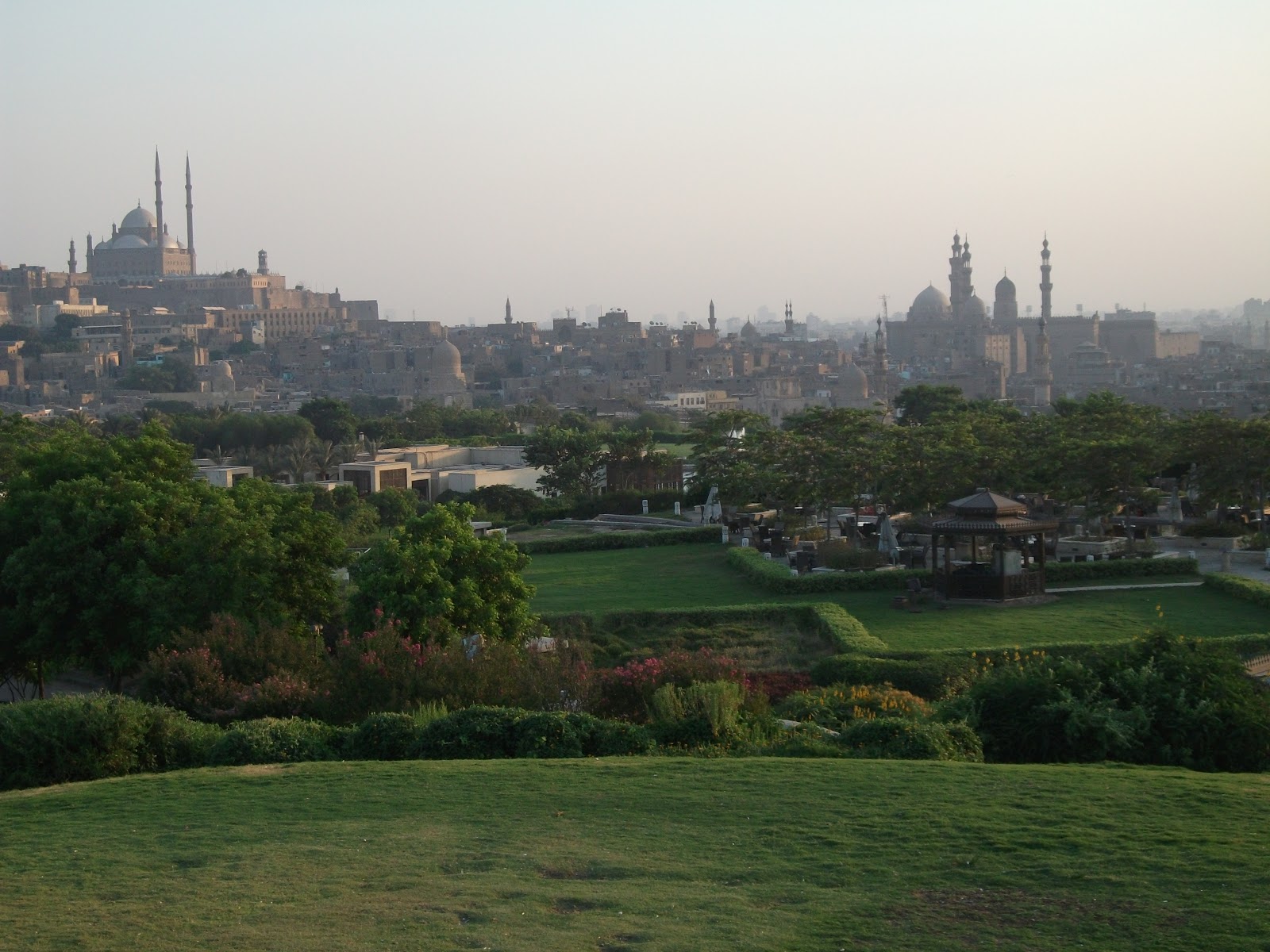
I knew the poem off by heart for years. I can still recite most of it at least, though there are a few bits in the middle where I tend to get stuck. I have recited it as an assignment in my grade eleven Drama class, and in al-Azhar Park in Cairo (see the above picture - it felt incredibly appropriate for the setting). My parents also bought me a psychedelic pop-up version by Nick Bantock, author of the then very trendy Griffin and Sabine. A lot of memories - some which make me smile, some with an element of loss involved.
Thursday, 1 December 2011
'The Rime of the Ancient Mariner': Coleridge Goes To Antarctica and Gets Back In Time to Ruin One Out of Three Wedding Guests' Day
From THE RIME OF THE ANCIENT MARINER (Samuel Taylor Coleridge)
And now the storm-blast came, and he
Was tyrannous and strong;
He struck with his o'ertaking wings,
And chased us south along.
With sloping masts and dipping prow,
As who pursued with yell and blow
Still treads the shadow of his foe,
And forward bends his head,
The ship drove fast, loud roared the blast,
And southward aye we fled.
Listen, stranger! Mist and snow,
And it grew wondrous cold:
And ice mast-high came floating by,
As green as emerald.
And through the drifts the snowy clifts
Did send a dismal sheen:
Nor shapes of men nor beasts we ken--
The ice was all between.
The ice was here, the ice was there,
The ice was all around:
It cracked and growled, and roared and howled,
Like noises in a swound!
'The Rime of the Ancient Mariner' is possibly Samuel Taylor Coleridge's most famous work, although personally I probably still prefer 'Frost at Midnight' and especially 'Kubla Khan'. This is only a very brief excerpt from the very long original poem, which appeared in Coleridge's Lyrical Ballads. It has variously been interpreted as a parable about the sanctity of nature and all living things, a Christian allegory, or simply a great story which warns the reader not to randomly kill an albatross or stop for an Ancient Mariner while en route to a wedding.
'The Rime of the Ancient Mariner' may also have taken some inspiration from some of the earliest Antarctic exploration of the eighteenth century, including the voyages of Captain James Cook through the Pacific Ocean into the Antarctic Circle. Coleridge obviously never went near the Antarctic, but "ice mast-high...As green as emerald" is pretty spot-on. The picture which I have posted above is of Ernest Shackleton's ship Endurance, which was trapped in the Antarctic pack ice in 1915 - leading to the failure of the expedition, but even greater acts of heroism and the safe return of all of Shackleton's men. It could be an illustration for this passage from the 'Ancient Mariner'.
I have Antarctic dreams and have had them for several years now. Not dreams while I'm asleep, usually - but sometimes it feels like a vast white expanse, translucent ice castles and heroic beard-encrusted men wandering amongst penguins are all a constant part of my mental landscape. It has actually been well over ten years since I first read Sara Wheeler's Terra Incognita and that was when my long walk into the ice fields of this southern desert - for Antarctica is considered a desert - began. I picked up the book a bit sceptically, intrigued because it was shelved under "travel" and at the time I was reading any and all travel books. I did think there was a pretty good chance that it would be boring. How much can you say about ice?
I was completely captivated by Wheeler's account of her trips to Antarctica, the eccentric characters she met at McMurdo Sound, her South Pole journey, her time at Scott's hut. She writes with humour and charisma but also offers moving descriptions of the peace and serenity she found there: a "certainty" which she calls "something that put everything else - everything that wasn't Antarctica - in true perspective." She continues: "I felt as if I was realigning my vision of the world through the long lens of a telescope. It emanated from a sense of harmony." I have not yet been to Antarctica, but I have had very short sojourns in the Moroccan Sahara and the Western Desert in Australia - as well as a part of the Okanagan in British Columbia which I believe is considered a desert ecosystem. The sense of peace is almost overwhelming. I remember that as an experiment, during my overnight with a friend in the Sahara, in a Berber camp, I made the experiment of trying to worry. Usually this is something that I find all too easy. Here, I was unable to do it. I felt as though the top of my head had opened up and the worries were floating away into the darkness. I imagine that Antarctica would be similar - but on the flip side.
I chase this particular fascination in various ways. Antarctica also fits in well with my hero complex, although I will probably never stop debating whether Scott was a hero or a selfish fool, or both. But who can forget the words of Oates, one of his companions who met the same death: "I am just going outside and may be some time"? Currently I'm reading The Worst Journey in the World, by Apsley Cherry-Garrard, also one of Scott's men. Shackleton trumps Scott, with his extraordinary voyage in the James Caird from Elephant Island to South Georgia, and the saving of all his men (many of whom then went off to die in the war.) I recently saw a wonderful performance by LAMDA Drama School students of Terra Nova, about Scott's expedition and his relationships with his wife and with Amundsen - very moving. I have been revelling in the BBC's new series Frozen Planet, with some of the most incredible footage ever seen of penguins soaring in a graceful but slightly ridiculous manner through the air to belly-flop on the ice; killer whales and their frightening phalanx manoeuvres to create a wave that will wash a poor seal to its eventual death; the incredible, perspective-defying walls of ice. Frozen Planet is also about the Arctic, which has a more wonderful variety of animal life, including wolves, my favourites. But Antarctica is - Antarctica. There is no other place like it on earth: hostile, overwhelming, blindingly beautiful.
Whether or not I ever go there - and I hope that some day I will - I know that for me Antarctica is above all a kind of spiritual landscape. My friends have grown used to me posting "I'm moving to Antarctica" on my Facebook status updates. In a sense, that's not usually a good thing. It means I want to run away, that life is overwhelming, that people in particular are exhausting and selfish and I'd prefer the company of penguins, scary whales, and ice. But at the very least it comforts me to know that it is there; another place, perhaps even more beautiful than the Sahara, where I would find myself completely unable to worry.
Subscribe to:
Posts (Atom)