"Poetry searches for radiance, poetry is the kingly road that leads us farthest" (Adam Zagajewski)
Showing posts with label T S Eliot. Show all posts
Saturday, 13 July 2019
Review: David Howard - The Ones Who Keep Quiet
New Zealand poet David Howard, who lives in the South Island city of Dunedin, has held residencies as close to home as the University of Otago and as far away as Prague; his next residency will be in Ulyanovsk, Russia. His most recent collection, The Ones Who Keep Quiet (2017, Otago University Press), is equally connected to New Zealand, the South Pacific and cities of the Northern Hemisphere, through the shifting figures of Auckland businessmen, alleged spies, and others.
It's an ambitious comparison, but The Ones Who Keep Quiet has something in common with TS Eliot's Four Quartets in that its poems are typically grounded in real-world places, with an almost overwhelming level of historical detail (a couple of the poems have end notes to rival Eliot's The Waste Land), but they feel internal, intellectual, mystical. If anything, they seem to depict the movement of the human mind, with its blend of the abstract and the concrete, and often under great pressure. In some cases, the pressure takes the most final form, death.
The first piece in the book is a long poem written in sestains. 'The Ghost of James Williamson 1814-2014' is about the Belfast businessman's youth on his father's ships and his eventual existence in New Zealand - both before and after his death on 22 March 1888. Appropriately, the sestains flow down the page in shapes suggesting waves, or brainwaves. There are also the tides of belief, their ebb and flow:
...Our fall into Paradise shows
God is an ironist
who gives the knife another twist -
pointed refusal to disclose
proof He's the first cause.
There is, perhaps, also an echo of the famous ship appearing at Clonmacnoise in Seamus Heaney's 'Lightenings' (viii), when "stunned under the Gothic/arch of a monstrous swell", James Williamson declares: "the unreal becomes our last port of call". As with most poems in The Ones Who Keep Quiet, the writing is very dense and allusive, with occasional leaps which seem almost random but are carefully calculated. This poem concludes on a very odd and ironic note of "sex, drugs and rock'n'roll", which at first seemed entirely incongruous to me based on its protagonist's life in the 19th century: however, it succeeds in giving the impression that the ghost is floating freely in time, but also trapped.
Throughout, and with rare exceptions, I was more enthralled by the collection's long poems than by the shorter lyrics, as Howard's work seems to excel when it has more leisure to establish a voice and to sink into a story or a train of thought. 'The Speak House' is another centrepiece of the book, a dive into the mind of Robert Louis Stevenson in the last few hours of his life. The poem is full of very specific references to Stevenson's life and work and had a slightly overwhelming level of end notes, but the most rewarding moments are often those of sudden clarity: "Starlight strikes the dead and the living/with equal intensity, flesh being what it always was" and "breathless/running after my shadow: that is what writing is." After the demands of 'The Speak House' I turned with some relief to one of the best shorter poems (well, two pages), 'The Vanishing Line', a self-scrutinizing poem with an unfolding/enfolding structure and echoes of Paul Celan: "Between, that is where the poem grows/between the visible, the invisible."
Howard touches on family history, on love, and dedicates a beautiful poem ('L'Histoire du Soldat') to Russian poet Tatiana Shcherbina. Particularly intriguing, though, is the long poem 'Prague Casebook' which, as Howard says in the end notes, "circles the character of the New Zealander and alleged spy Ian Milner (1911-1991)". A Rhodes scholar and friend of Miroslav Holub, Milner was eventually identified as a spy who passed information to the Soviets while working for the Australian Department of External Affairs in the Post-Hostilities Division during the 1940s. He defected to Czechoslovakia, but denied having been a spy. Milner's case is still controversial. His voice in 'Prague Casebook' is ironic and elusive, sliding away, providing excuses or perhaps simple facts: "Poetry's half a meal. Don't go hungry." Milner seeks kinship with Russian poets Mayakovsky and Mandelstam - "Sing/Vladimir, sing Osip, to show we are still men among men", but no doubt also recalls their troubled or fatal relationships with the Soviet authorities. Addressing God in the closing lines of the poem, Milner could be admitting to guilt, or defining himself as a victim, or both: "Your paradise was a short ride in a fast car, I got out/on the wrong side, that's clear as ice on the highway at first light."
The Ones Who Keep Quiet isn't a perfect collection: I found that its self-consciousness could occasionally be stifling, and Howard succeeds noticeably better with male voices and characters than with female perspectives. However, it is an exceptionally skilled and ambitious work which will reward rereading, as it offers so many layers to explore. Readers who appreciate psychology, flair and challenge in their poetry will enjoy The Ones Who Keep Quiet.
Review copy courtesy of Otago University Press
Tuesday, 28 May 2019
TS Eliot's Four Quartets in dance, at the Barbican
Nijinsky in Le Spectre de la Rose at the Royal Opera House, London (1911)
This past weekend I went to the Barbican's presentation of a dance version of TS Eliot's Four Quartets, choreographed by the American choreographer Pam Tanowitz and first performed last year in the United States. Alastair Macauley, who was the chief dance critic for the New York Times until 2018, called this adaptation "the greatest creation of dance theatre so far this century".
I wanted to see Four Quartets because it combined a few of my interests and passions: TS Eliot's poetry, dance, and being Finnish (ok, the latter is a stretch, but the soundtrack featured music by the well-known contemporary composer Kaija Saariaho). My love for Eliot's poetry probably needs no explanation, but dance as one of my interests/passions might. I always had some interest in ballet, based on having seen The Nutcracker at a young age, loving Tchaikovsky's music generally, and reading some of the classic children's books about ballet, such as Noel Streatfeild's Ballet Shoes. However, I never learned ballet myself, and I always thought of dance as a beautiful and intriguing art form, but one which I was far more ignorant of than literature, music and visual art. Rather to my surprise, a few years ago I then found myself in a new job as a publisher for the Royal Academy of Dance, and I'm still there. I love the company but occasionally I am still a bit nonplussed that I'm working in dance education. Fortunately, the job required expertise in publishing rather than in dance (although having a bit of a music background helped.) And I have, of course, learned so much about dance.
However, it would probably be a stretch to say that my experience at the RAD helped me a great deal with the dance experience presented to me by Four Quartets. The RAD's main (though by no means exclusive) focus is on classical ballet, and the extent of my dance knowledge for my whole life has mostly resided in that area. I've mostly found modern dance to be a bit of a mystery. I am sure, though, that most of the audience members were there either mainly for the dancing, or mainly because of TS Eliot, and my way in was always going to be the words of Four Quartets. In fact, this show was truly multidisciplinary because the accompanying sets and artworks were by the American visual artist Brice Marsden. Four Quartets was read in its entirety by the US actor Kathleen Chalfant, and the dancers accompanied the words.
The dancers didn't, in fact, try to illustrate the words, which was both challenging and fascinating. As they leapt, rolled, and circled against the delicate but powerful greens, reds and whites of the set, I found myself sometimes confused and irritated, sometimes enthralled, and I think this may have been the idea. This was not a literal interpretation, but one which set up all kinds of tensions, and Four Quartets generates tensions and juxtapositions in almost every line, starting from the opening of 'Burnt Norton': "Time present and time past/Are both perhaps present in time future,/And time future contained in time past." At times I thought that the dancers were trying to do the opposite of what the text was saying, and I wondered: is this escape, or a source of power? This performance helped to remind me that (and this makes it quite the opposite of much poetry, particularly now) Four Quartets is a sequence often inspired by very concrete places and things, but frequently presented in very abstract terms. Visitors to the real places of the poems - Burnt Norton, East Coker, the Dry Salvages and Little Gidding - are often surprised that the places are not only real but described with great accuracy. And yet, their explorations feel more mental and emotional than "real-world", at least to me. (I must say that the "rose garden", the "box circle" and the "drained pool" of 'Burnt Norton' feel to me like part of the disturbing, preternaturally silent landscapes of a 1970s/1980s text adventure computer game such as Zork, which is probably both blasphemy and highly accurate, and another area of opposition and tension. What is a computer game, anyway - abstraction or "reality"?)
Saariaho's sparse music accompanied the performance's visual impressions, and the words, beautifully. I may have been confused and challenged by much of the dancing, but I think that it helped to open the poems to me in a different way. Art exerts pressures on our minds, and watching the dancers, listening to the music and to the poetry all at the same time undoubtedly shifted that pressure so that I experienced Four Quartets in a new way.
The Four Quartets program has an excellent essay by Dana Mills about 'TS Eliot and the dance of writing', from which I learned a lot about Eliot's interest in dance; again, he seems to have transformed real people and artistic references into metaphysical concepts. Eliot saw the great dancer Isadora Duncan, as well as Nijinsky dancing in Le Spectre de la rose, which he specifically mentions in 'Little Gidding' ("Nor is it an incantation/To summon the spectre of a Rose"). Later, the groundbreaking dancer and choreographer Martha Graham was influenced by Four Quartets. Famously, in 'Burnt Norton' Eliot wrote "...at the still point, there the dance is"; more tension and contradiction resolved into a strange unity. Mills writes: "Four Quartets dances on the boundaries between the human and the inhuman; bodiless and visceral; past, present and future; the emotive and the emotionless. The poems are verse that transcends its sum of words. The words have body and transcend their flesh; they are, like dance, both still and shifting."
This page on the Barbican website (which I hope will stay for a little while, as I believe the performances are over) has images from the production and more interesting information about its conception and development: http://sites.barbican.org.uk/fourquartets/
Sunday, 25 November 2018
The Spindrift Pages: A Poetry Mystery
Tonight I thought I would share a mystery with my readers.
Back in 2012, or maybe 2011 - around when I first started writing The Stone and the Star - I somehow came across this blog, The Spindrift Pages. I don't know how this happened: I might have stumbled across it, or someone might have clicked through to my blog from it, or the blogger might have followed me.
15 posts appeared in 2011, 14 posts in 2012, and then they stopped in March 2012. Most of the posts are original poems. The blogger's name, at least on the blog profile, is Beetle Taylor (possibly a car name??) and they described themselves as "19 years old, between school and university, in the middle of nowhere, with endless supplies of books to read, thanks to thursday market. Hoping to write a poem a day (at the very least) for a year...and hoping that someone might read them!" I commented a few times, so we had some warm but very slight interaction.
The point that I am building up to is that the poems are absolutely remarkable. I think there's a little Sidney Keyes there, a little TS Eliot, a little Wallace Stevens: older but good influences, perhaps not the most original, but this poet was very young. They are authoritative, coolly observant, fond of light alliteration, beautifully shaped, and not facile in the least. I've returned to them a few times in subsequent years, reading a poem or two and wondering if the writer would come back. So far, no.
Assuming that the basic biographical details, at least, are correct, this poet is probably 26 now, and I sincerely hope they are still writing poetry. I have wondered if they started a blog under a different name or their real name, if they moved on to other things, or indeed if they are okay. I've also wondered if this could be someone I know online or in real life.
Do read and enjoy The Spindrift Pages, and if you have a clue to the mystery, let me know.
Photo: Auriga Spindrift by euphro. Used under Creative Commons license
Wednesday, 29 August 2018
Adam Hall's Quiller Meets the Poems In My Head
In the past year, I started reading a series of books by Adam Hall (one of the pseudonyms of British author and playwright Elleston Trevor) about a spy known only as Quiller. Quiller is something of an enigma who also bares his mind's intricate workings to an uncomfortable degree: it's as though you're in his body, seeing through his eyes, and calculating the angle at which a very fast car is going to ricochet when it hits the guard rail.
The terse stream-of-consciousness poetry of Hall's writing, and the multiple layers of his central character, attracted me to this series even more than the undeniably exciting plots. A few books into the series, I read The Striker Portfolio (1968) and The Tango Briefing (1973) within a week. At this point, something both strange and familiar started to happen: the books went into my head and started talking to the other books, and poems, that I've stashed in there over the years.
In The Striker Portfolio, Quiller finds himself on the Frontier between West and East Germany, at night, following a man through a minefield. 'It was an eerie place,' he says, 'a landscape with dead figures: the posts leaning like gibbets and the web of the wire breaking the flat two-dimensional background into sections as if the whole scene were cardboard, a badly lighted stage. Perhaps it was difficult for him to believe in the unlikely: that a man was standing not far from him, thrown up from the waste of earth where armies had once passed, leaving their dead.'
When I read this, I suddenly flashed to the war poems of Keith Douglas: 'a landscape with dead figures' called up his poem 'Landscape with Figures 2':
On scrub and sand the dead men wriggle
in their dowdy clothes. They are mimes
who express silence and futile aims
enacting this prone and motionless struggle
at a queer angle to the scenery
crawling on the boards of the stage like walls
deaf to the one who opens his mouth and calls
silently. [...]
In The Tango Briefing, Quiller is sent to the Sahara (as usual, with minimal information) to investigate a plane crash. Preparing for his mission in the crumbling Auberge Yasmina, he notes 'a forecourt buried under the shade of rotting palms where I could hear rats running.' Later: 'The curved fronds of the palms hung piled against the minarets and the filigree of window-grilles, their tips burned brown by the heat of never-ending noons; in them I could hear rats rustling.' Amidst the nervous tension of these scenes, I found myself thinking of TS Eliot: 'I think we are in rats' alley/Where the dead men lost their bones' (The Waste Land), and the 'rats' feet over broken glass' of 'The Hollow Men'. Sent into the desert on a glider (an eerie voyage which made me think of Antoine de Saint-Exupéry's writings, particularly Vol de nuit) and isolated in an extraordinarily dangerous environment, Quiller has to seek a specific outcropping of rocks, his only point of reference...
[...] you know only
A heap of broken images, where the sun beats,
And the dead tree gives no shelter, the cricket no relief,
And the dry stone no sound of water. Only
There is shadow under this red rock,
(Come in under the shadow of this red rock) [...]
(TS Eliot, The Waste Land)
Does any of this mean anything, I wondered? Was Adam Hall reading Keith Douglas, TS Eliot or Saint-Exupéry? Was he alluding to them, consciously or otherwise? Maybe. Probably. Probably not. But what I realised as I flashed back and forth between the books I was reading and the poems I carry around with me was that this dialogue (for want of a better word) in my head was a strong indicator of how much the books were affecting me. Not all books will awaken these tenuous and uncertain echoes. I think it means that they've already entered one of my mind's inner rooms, where bits of literature meet and talk to each other. It's a compliment to all of the writers involved, and it's also a source of creativity, a catalyst, an opening into a further palace of doors.
Photo: Desert of Legend by Preston Rhea. Used under Creative Commons license
Thursday, 14 December 2017
Iraj Ziayi: 'Tehran letter'
I recently went to my first Poetry Translation Centre workshop in a while, where we translated a couple of poems by the Persian poet Iraj Ziayi (using a literal translation by Alireza Abiz, who was also present, as a starting point). He is known as "the poet of objects", often imbuing inanimate things with an unusual charge of meaning in his poems.
One of the poems in particular, 'Tehran letter', affected me deeply. It accomplished what honestly I'd probably like to do in all of my own poems: in a brief format (14 lines) it evokes the emotions and memories that cling to a place, and a non-linear sense of time. The intimacy of translation - and in a Poetry Translation Centre workshop every line is carefully debated, discussed and decided on, with an expert in the original language present - immersed us in the poem and its mysterious approach to time.
By the end of the poem, I realised that it reminded me of TS Eliot's Four Quartets, perhaps 'Burnt Norton' in particular. "If all time is eternally present/ All time is unredeemable": in 'Tehran letter', "they came and killed and burnt" is a reference, well-known to Iranian readers, to the 13th-century Mongol invasion. To me, there was a kind of agitation in the postman's repeated return to number 49, even if it's to seek birdsong (also reminiscent of 'Burnt Norton': "Quick, said the bird, find them, find them/ Round the corner..."), a sad sense of a broken automaton. The poem is beautifully constructed and deeply poignant, but the way the central image of a letter exists and un-exists, writes and unwrites itself, is also disturbing. It seems to spool in a motion that suggests both the "river-that-isn't", and a kind of eternal Mobius strip (as another workshop member said), even a trap.
As well as the final translation of 'Tehran letter', do read the 'About this poem' section, describing the meanings that we explored - some of them nearly impossible to translate without a considerable loss of the original meaning. Translation, especially of poetry, really is a joy and a sadness.
Photo: Glassware and Ceramics Museum by reibai. Used under Creative Commons license
Sunday, 11 June 2017
Poets and Spies at London's City Lit
City Lit, London, 1940
Earlier this year, I took an InDesign course for my work. It was at City Lit college in central London, near Holborn station. I hadn't thought much about the type of institution where I'd be brushing up my InDesign skills for a few weeks - but when I arrived for my first class, I was impressed at the range of classes taking place at the same time as mine, and also a little jealous of the people who were taking Basic Danish or Biblical Hebrew. The floor where my classroom was located seemed to have a good deal of painting and sculpture going on.
When I looked up further details about City Lit (mainly in the history section of their website) I discovered that they had originally been established in 1919 by the London County Council as a "literary institute", along with several others around the city. Essentially, these were non-vocational colleges (but not universities) where students could take humanities courses and the like, without committing to something like a degree program.
The website provides more details about the fascinating history of this institution, but I was very taken with the fact that their teachers and lecturers included the likes of Edith Sitwell, TS Eliot, Cecil Day-Lewis and Dylan Thomas, among others. When their new building opened in 1939, John Masefield (then Poet Laureate) did the honours.
The moral of the story is that in London, if you scratch just the tiniest bit beneath the surface, you'll probably receive disproportionate rewards, and they might include poetry. I also ran into a bit of synchronicity at this point. Around when I was taking the InDesign course, I was reading A Colder War, the second volume of a trilogy by spy novelist Charles Cumming. The trilogy features disgraced spy Thomas Kell, who desperately wants to "get back in the game" but has found himself with some time to kill. At one point, he thinks "of the long afternoons he had spent brushing up his Arabic at SOAS, the solo holidays in Lisbon and Beirut, the course he had taken at City Lit in twentieth-century Irish poetry." In other words, when all you think you're doing is taking a desktop publishing course, there are probably some bored spies just around the corner in the same building who hope that poetry might help to fill the slow hours. It also turns out that Thomas Kell enjoys reading Seamus Heaney's The Spirit Level and that he especially likes the poem 'Postscript' (so do I).
Monday, 22 May 2017
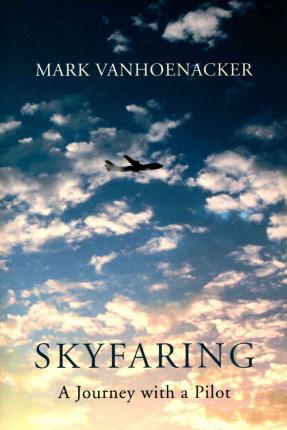
Skyfaring by Mark Vanhoenacker: Poetry Takes Flight
There are times when I'm not reading a great deal of poetry (or, less than at some other times) but it still finds its way into my life. (It always does that.) A recent example was when I read the book Skyfaring: A Journey With a Pilot by Mark Vanhoenacker.
Flying isn't particularly my favourite subject to read about. I fly at least a couple of times a year, usually more, but have struggled with it for years to the extent that each flight is anywhere from uncomfortable to a major ordeal. Oddly enough, this was partly what impelled me to read Skyfaring. The description attracted me: an experienced pilot evokes the perspective shifts, the emotional challenges and rewards, the friendships and unusual messages, and the pure beauty of flying.
I really wasn't disappointed with the book and I would certainly recommend it for a nervous flyer, at least one who can bear the thought of reading about the experience they dread. There is such an air of wonder and serenity about it that it had a noticeably calming effect on me (and yes, I did read parts of it on long plane flights a few weeks ago, between London and the west coast of Canada.) The writing is exquisite. I particularly enjoyed some of Vanhoenacker's descriptions of night flying (not my favourite time to be flying, due to a weird psychological cocktail of reasons.) Such as this:
In the high night...are many phenomena we cannot see so clearly, if we see them at all, when the sun is up. There are nameless ships of cloud that seem to sail best under a bright moon. There are vast lobes of lightning, flashbulbing out from deep within the grey matter of distant equatorial thunderstorms, while on the windowpanes St Elmo's fire, a kind of static that appears in startling bursts of flat blue veins, flickers like Prufrock's 'nerves in patterns on a screen'.
And...there's the other reason why I enjoyed Skyfaring. It opens with, as epigraph, the latter half of one of the poems in Derek Walcott's Midsummer sequence, a poem that actually is about flying (and landing):
It comes too fast, this shelving sense of home -
canes rushing the wing, a fence; a world that stands still as
the trundling tires keep shaking and shaking the heart.
Vanhoenacker obviously has a rich appreciation for literature: as well as Walcott and TS Eliot, Philip Levine, Robert Frost, 'Dark Night of the Soul' by St John of the Cross, all appear along with other poems and poets. A book well worth reading, then; but it did make me think that to enjoy flying, you really have to be a pilot - or at least sitting in business class.
Sunday, 26 March 2017
In memory of Derek Walcott, 1930-2017
Derek Walcott, poet and playwright of Saint Lucia, died on 17 March at the age of 87.
I think I recall my first Derek Walcott poem. It was 'The Season of Phantasmal Peace' and I encountered it in a literary criticism class at university. I would have been 18 or 19. I don't remember what we said about this poem, or which angle we approached it from, but I do remember how it looked in my mind and I have some recollection of the sensation. It was a vision of a murmuration of starlings - those strange, almost supernatural flock movements - and the poem came with a sensation of power and lift-off that I found unusual and exhilarating.
I've read Derek Walcott on and off since then. I was at the 2010 TS Eliot Prize readings when he won for White Egrets, but sadly he wasn't present to read (Seamus Heaney was there to read from his own nominated collection, though. How amazing would it have been to see them on the same stage...). I correctly picked him as the winner out of an especially strong field, though. Amongst 20th century poetry, his work just might be the most outstanding example of how to unite far-flung influences. Walcott was mixed-race and as with his background, his writing brought together Caribbean culture, classical literary influences, and the various legacies of colonialism. I think of his poems as being like Rembrandt's paintings, or a seemingly effortless and flawless work of architecture. The craftsmanship is almost too good to be grasped. You just experience something of exceptional depth, beauty and clarity - which also stands up to extremely close analysis, if you want to go there.
Walcott was every bit as good as TS Eliot or Elizabeth Bishop or Seamus Heaney; often better, I think. He is the poet who reminds us that constant attention to craft and openness to the world's variety are powerful things.
Here are a handful of poems to start with, or to go back to.
THE SEA IS HISTORY
THE FIST
SEA CANES
SEA GRAPES
Photo: Derek Walcott, VIII Festival Internacional, 1992. By Jorge Mejia Peralta. Used under Creative Commons license
Thursday, 29 December 2016
Richard Adams and the Rabbit World of Literature
Richard Adams, the author of Watership Down and other novels for children and adults, died on 24 December. He was 96 years old.
In a year where celebrity deaths seemed nonstop, his passing was overshadowed moments after it was announced, by the death of actress Carrie Fisher, who sadly was only 60. But it was particularly hard to hear that Richard Adams was gone, given the importance of Watership Down in my life.
As a child I loved talking-animal books, a genre which seems to have gone thoroughly out of fashion (for anyone older than picture book age, at least). It was inevitable that I would read Watership Down. My first attempt was when I was seven or eight and I didn't get very far. I found the style a bit heavy and the action a little too frightening, and abandoned it. When I picked it up again I think I was ten or eleven, and I was hopelessly lost in the best possible way. I followed Hazel, Fiver and their friends out of the Sandleford warren and never looked back.
Many books have moved me, but I think there are only a few (another important one being The Lord of the Rings) which on repeated readings have proved so emotionally overwhelming that they leave me physically drained. I read and re-read Watership Down with cold shivers, with the complete disappearance of the world around me, in tears. Again and again I seemed to find myself physically in the midst of scenes - 'racing through the ochre light' of a thunderstorm ahead of a murderous gang of thugs, trying to save my friend from the deadly snare, staring awestruck at the enormous, silent movement of clouds over the downs. I have finished it and started it again immediately. I have read it several times in a year, although not for quite a few years, I admit. Despite that, its words and images are always within me. My visualisations of the book play through my head sometimes, or I hear the words, or read them behind my eyes.
Watership Down can be read as a really great adventure story blending the fantasy of anthropomorphic animals and their society with accurate details about the natural life of the rabbits and the English countryside they move through. It also has elements of allegory, particularly about the dangers of totalitarian rule. I have, however, read many beautifully written adventure stories, or allegories about fascism (I was even younger when I read Orwell's Animal Farm). What makes Watership Down unique is the way it subtly draws the reader into a literary world. It contains so many literary references that reading it is a remarkable education.
The book is famous for its epigraphs at the start of each chapter, which range from Xenophon to the Bible to Joseph Campbell to Jane Austen to Dostoevsky to WH Auden - and many others. In subsequent years, every time I have come across one of these quotations within the work of literature it was taken from, I feel a kind of time-shock and I am in Watership Down again. I discovered the World War II poet Sidney Keyes through one of these epigraphs, and he has become one of my favourites. Robinson Jeffers' poem 'Hurt Hawks' also came to me in this way. But the epigraphs are far from being the only references. Within the text itself, Richard Adams compares the adventures of the rabbits to those of Odysseus. The poem recited by Silverweed, the eerie rabbit-poet who appears in one of the book's most sinister passages, contains the phrase 'the heart of light, the silence', which is a quotation from TS Eliot's The Waste Land. (The blunt Bigwig refers to Silverweed as 'that lop-eared nitwit of a poet'.) There are glancing references to Sherlock Holmes and Robin Hood, to 'Everyone Sang' by Siegfried Sassoon, to the Psalms, and more.
Watership Down has thus been a kind of slow-release of literature into my bloodstream throughout my life. I have finally realised that this, more than anything else, has made it so important to me. It has created echoes everywhere and has accustomed me to walking through a world where I see and hear literature in everything. It seems that this is how Richard Adams saw the world, or at least how he wanted his readers to see it. I am used to carrying quotations and stories and references and poems with me wherever I go, seeing and hearing them everywhere. And because of this book, I know that it's ok to do so. Some of us see the world in this way, and it enriches us. It makes life a little easier and a little more beautiful. It helps us to understand the interconnectedness of things, to see cause and effect, and to act with compassion and understanding. It shows me that understanding my connections to literature is a way of understanding connections to the world around me.
I don't think Watership Down, which first appeared in 1972, would be published now. If it were, it would be in a massively butchered form. The style would not pass an editorial team today. It would be viewed as too dense and difficult, too prescriptive of the pantheon of literature, too paternalistic. Most books aimed at adults today don't have a tenth of the complexity and beauty of Watership Down. But despite that complexity, it is also far less didactic than many books published now, which tend to hit the reader over the head with a dumbed-down style and a painfully obvious worldview. Richard Adams wrote this book at a time when authors still allowed their convictions and principles to imbue their writing, but not to overwhelm it. This is rare today, but it's good to know that so many people still love his work.
Goodbye and thank you, Richard Adams.
Thursday, 24 November 2016
Keith Douglas: 'The House'
Mysterious door by Scott Wylie. Used under Creative Commons license
This poem by Keith Douglas, 'The House', haunts me from time to time. It sometimes comes to mind when I think of houses associated with my childhood and the movement of memory within them, although it really functions on a more symbolic level.
It has the shifting personas and (il)logical leaps of a dream, but 'The House' seems to be mainly about the mysterious workings of imagination, what can impede it, and the at least occasional fear of every artist that creativity is departing, perhaps for good. In this respect, I think it may share a common theme with 'The God Abandons Antony' by CP Cavafy.
There is also a touch of TS Eliot in the disembodied voices and shadows. A copy of the poem exists in which Eliot had made marginal notes.
THE HOUSE (Keith Douglas)
I am a pillar of this house
of which it seems the whole is glass
likewise transparent to the touch
for men like weightless shadows march
ignorantly in at the bright portico
or through a wall serenely go
unnoticing: myself am like a mouse
and carefully inspect all those that pass.
I am the pillar about which
like a conjured spectacle, such
amazing walls and floors appeared
as in the house that devils made.
Yet this queer magnificence
shows not to many, its defence
not being walls but in the property
that it is thin as air and hard to see.
I am the pillar and again the one
walking a perpetual up-and-down
scrutinizing all these
substances, shadows on their ways
crowding or evacuating the place.
At times a voice singing, or a face
may seem suspended in the cunning air;
a voice by itself, a face traversing the stair
alone, like a mask of narrow porcelain.
These I introduce but lose again
which are of the imagination, or of air,
being in relation to the house, actually there
yet unreal till I meet with one
who has that creative stone
to turn alive, to turn all alive:
prospecting this is all the care I have.
In order of appearance chosen by chance
whether to speak, to sing, to play, or dance
to my mute invisible audience
many have performed here and gone hence.
Some have resided in the house a time
the best rooms were theirs, also for them
scents and decorations were introduced
and other visitors were refused.
But when for weeks, months no one came near
an unpleasant prompting of suspicious fear
sent me climbing up to inspect the high
attic, where I made a curious discovery.
In this room which I had not entered for months
among the old pictures and bowls for hyacinths
and other refuse, I discovered the body
conventionally arranged, of a young lady
whom I admit I knew once, but had heard
declined in another country and there died.
Here's the strange fact, for here she lies.
If I but raise them my incredulous eyes
discern her, fairer now than when she lived
because on death her obscure beauty thrived;
the eyes turned to fine stones, the hair to flexible
gold, her flesh to the most natural marble,
until she's the most permanent thing
in this impermanent building
and to remove her I must use
some supernatural device
it seems: for I am forced to say
she arrived in a miraculous way.
I never studied such things; it will need a wiser
practitioner than me to exorcize her
but till the heart is dust and the gold head
disintegrates, I shall never hear the tread
of the visitors at whom I cannot guess,
the beautiful strangers, coming to my house.
Wickwar, Glos., 1941
Friday, 18 November 2016
The Open Eye: Five Years in Blogland
Photo by Clarissa Aykroyd, October 2016
Open one eye only -
the horizon is in the closed eye.
-Nikola Madzirov
As of October, I have been blogging fairly regularly for over five years. It feels like longer, which may or may not be a good thing. This blog has, at various times, been a release, an obligation, a handshake, and a door. Here you can read my first blog post ever, which may give some indication as to why I chose the quote above. (Although it's only a partial indication, because the quote came to mind when I took the photo above - a piece of found art.)
I can see from early blog posts that I had a slightly more rigid approach in mind; or not rigid, exactly, but more of a template. Discuss a poem and then open it up to touch aspects of my life; or pick something in my life, write about it and then draw it down to a poem. This works quite well, and at times I still use this template, more or less. Perhaps I should use it more often - in terms of close reading, there are other blogs out there that put mine to shame.
But over the course of a few years, one of the things I have discovered in myself is a general interest in poetry as a concept - what it touches and what is touched by it - in other words, everything. I am quite capable of finding a particular poet's work, or a particular school of work (tellingly, I saw this referred to as 'factions' on Twitter today) uninteresting or unlikeable in a personal, aesthetic or moral sense. In terms of the part that this work or idea plays in poetry, however, it is always interesting - the breadth of poetry as a concept, and what it can come into contact with. And in this sense, the metaphor of the eye is especially important. Poetry is everywhere, so I have to keep my eyes open for it - except it doesn't just happen through the eye; it's every way in which we experience our self, other people and the world, every way in which we come into contact with the things within ourselves and the things outside of ourselves.
It has also been fascinating to see how my tastes have developed and which poets or poems I write about. Poets such as Yeats, Celan, MacNeice, Eliot and Keith Douglas come and go, except they never really go because even if I were never to read another word of their work, at this point they can never leave me. (As for Celan, I don't get tired of him - I just get tired.) But in this regard, the most essential thing is the fact that I have embraced poetry in translation. Poetry-wise, if one thing over the past five years has influenced not only my reading choices and my own writing, but my life in general - this is it. In the early stages of this blog, I was still very hesitant about reading poetry in translation. In this aspect and the progress I have made, I also owe a lot to Paul Celan, because he was there right at the beginning.
And then, over five years I have also come a long way with my own poetry, met some amazing people, and discovered a lot about what I love about the poetry world, and what I don't love. But that is another story and shall be told another time, as Michael Ende wrote in The Neverending Story.
If you are a reader, and especially if you are a regular reader, thank you so much for coming with me. When I started blogging, I wasn't sure if I even needed readers - but as it turns out, I really do.
Friday, 1 July 2016
Geoffrey Hill, 1932-2016
Shadows, Severn Valley by Kumweni. Used under Creative Commons license
We learned today that the English poet Geoffrey Hill died yesterday, on 30 June 2016.
Many will have something more insightful to say about Geoffrey Hill today or in the days to come. I am a long way from being an expert on his work, though I have read some of it. It always seemed to me that his work would demand the same level of engagement as, say, Paul Celan's (one of Hill's influences.) But I haven't gone there yet.
In a quiet way, Geoffrey Hill bestrode the literary world like a colossus. It was like being alive at the same time as TS Eliot. From reading other tributes today, I would say that it is a little difficult to talk about his death without sounding superstitious. This may have something to do with the times we live in, and the questions about the United Kingdom and about identity that many are asking themselves. It also has something to do with the fact that hearing of his death is like turning around and noticing that Stonehenge has vanished without trace.
There is a sort of Geoffrey Hill thing that happens, at times. It is a feeling like being watched, then realising that an enormous mountain is looming over you. It could also be the feeling just before the avalanche hits you.
Here are a few poems to read today.
from MERCIAN HYMNS
OVID IN THE THIRD REICH
TENEBRAE
Tuesday, 7 June 2016
Poetry in Our Kind of Traitor: Unreal Cities
I recently saw Our Kind of Traitor, the new film based on the 2010 novel by John le Carré. A story about the Russian mafia and corruption in the highest levels of British society, it may not sound like anything particularly out of the ordinary - but although this was not my favourite le Carré book nor film, it was still very good (in both forms) and it does have the vivid, ironic writing and the complex ambiguity of his other works. The film is visually beautiful and has some excellent performances, especially the tour de force by Stellan Skarsgård, who plays the Russian money launderer Dima.
In the novel, the protagonist Perry Makepiece is a teacher of English literature, and there are references to poetry, but it isn't necessarily his main area of expertise. In the film, he has become specifically a teacher of 'poetics', which he also describes as "so boring" (to a Russian, who predictably tells him that poetry isn't boring. He then adds that it's only boring "when it's put under a microscope.") I had to wonder if Perry became a poetry instructor for the film, rather than just an English literature expert, because to many people poetry would suggest a particularly high level of detachment from reality. Alternately, he could be a poetry instructor because of poetry's peculiar insights into the nature of reality. In one scene, Perry is giving a lecture on TS Eliot's The Waste Land, quoting some of my favourite lines:
Unreal City,
Under the brown fog of a winter dawn,
A crowd flowed over London Bridge, so many,
I had not thought death had undone so many.
The film also ends on a rather beautiful visual reference to these lines. In the lecture room, however, when Perry goes on to 'Sighs, short and infrequent, were exhaled,' the camera lingers on the bored faces of the students. In his lecture, Perry speaks of the "corrupt listless societies" described by both Dante and Eliot, populated by "lost souls". His wife Gail points out to him that the Russian vory recruit "people who are disillusioned with their lives and have lost their way."
The irony is that Perry's life shifts from the unreality of the poetry lecture room to a cascading hierarchy of power games and violence (often referenced with games such as tennis, chess, and even children's hide-and-seek), the secret world of the spies, and the unreal cities of London's chrome and glass to Switzerland's beautiful sterile music-box towns, which hide uglier realities (or unrealities.) Nothing in le Carré's works is entirely free of corruption or ambiguity. Criminals and traitors on both sides show deep, sincere love for their families. Loyalty comes in unexpected forms. Everything slides away and resists definition. The MI6 agent Hector makes reference at one point to the Polish philosopher Kolakowski and his stern definitions of good and evil, but the film suggests that things are not always so black and white.
This isn't the first novel or film from le Carré to feature poetry quite prominently: The Russia House quotes poets including Boris Pasternak, Stevie Smith and Theodore Roethke, and Our Game alludes to Osip Mandelstam. Smiley, his most famous character, is fascinated by the German poets. I think John le Carré understands how poetry hangs in the balance between realities and unrealities, and how - as in the best poetry, or simply the best writing - people and situations can be both intensely metaphorical, and intensely real-world.
Tuesday, 31 May 2016
Alberto de Lacerda at the Poetry Library
The Poetry Library at London's Southbank Centre recently had an exhibition about Portuguese poet Alberto de Lacerda and his relationship with London.
Alberto de Lacerda lived in many countries in his lifetime, but London was his greatest love and he lived here for years, also working as a BBC presenter. His friends and colleagues included Edith Sitwell, TS Eliot, Alec Guinness, Christopher Middleton and many others.
His work was new to me, but from the handwritten manuscripts and short poems displayed at this exhibition, it was extremely beautiful, personal but with the breadth of the light and the sky. Southbank was one of his spiritual homes, and apparently he was living a lonely existence in Battersea (my area) when he died in 2007 at the age of 78.
Looking at the exhibition, I felt as though I were shaking hands with this poet across years, or as though he were someone I could have smiled at or chatted with on one of my many visits to Southbank. There is something special about writers who loved the places you love.
Here are some photos from the exhibition:
Sunday, 20 September 2015
Guy Goffette's 'Elegy for a Friend': A Long Journey
Nicolas Vigier, Rain in Paris. Public domain
When I first read 'Elegy for a Friend', a sequence of thirteen-line poems by Guy Goffette written for his friend Paul de Roux, I was left overwhelmed and in tears. This reaction came from the pure beautiful power of the poem and its wonderful translation from French by Marilyn Hacker. It probably also had something to do with the fact that elegy has unfortunately been quite relevant in the lives of my family and friends in the past twelve months (not to speak of most of my life, it seems.) But when I started thinking about how I could write about the poem, it took me on a long and revealing journey of its own.
'Elegy for a Friend' has a certain focus on the cumulative effect of words, of events, and of simply living a life, which is perhaps also why it hit me so hard (a couple of years ago, a close friend and I were discussing the fact that 'cumulative' was one of the words of the year, and not in a good way.) Looking back on his relationship with his friend, the poet wishes that certain patterns could have been broken.
Always, still, tomorrow, these paltry
words, thrown off in passing, overflow us.
[...]
if we had known
that, would we have stayed
sitting so long in our afflicted bedrooms?
[...]
It’s the same story always and we blame ourselves
afterwards for having in the heat of words
and wine allowed dark clouds to rise
on the friend’s brow
Beyond this, on further readings I found myself quickly associating this poem with Ecclesiastes and re-reading it through that filter. The final stanza is, to me, overwhelmingly reminiscent of Ecclesiastes 12: "One day we must depart, no longer knowing/anything of what was at the source/of the fire...", alongside the vivid description of the decline of a human being with age: "before the silver cord is removed, and the golden bowl is crushed, and the jar at the spring is broken..." The conclusions are different: Ecclesiastes 12:13 says "Fear the true God and keep his commandments, for this is the whole obligation of man," whereas the poem is secular and contemplates the meaning of life and art ("written, read and reread/by a blind man dancing in the fire"), but it seems to me that both arise from a similar line of questioning.
I first read 'Elegy for a Friend' some months ago and have been thinking about it - and thinking about writing about it - for some time, whether actively or subconsciously. Recently, in relation to the Goffette poem, these lines by another poet came back to me:
Do you know how it is when one wakes
at night suddenly and asks,
listening to the pounding heart: what more do you want,
insatiable?
I was so convinced that these lines were from Rilke that I leafed through my entire volume of his collected German poems and finally realised they weren't. The lines hadn't come back to me in an exact enough form to Google them accurately, but eventually I remembered enough key words to find them - in this poem by Czeslaw Milosz, 'Farewell' (scroll down to find it).
The connection isn't entirely clear to me: I think there are some stylistic similarities (although the fact that one poem is originally French and the other originally Polish may cloud this somewhat, in translation.) There are echoes of imagery across the poems: the suddenly beating heart, the self-questioning about life, meaning and desire. Milosz also asks: "From life, from the apple cut by the flaming knife,/what grain will be saved", which seems to echo the final lines of Goffette's poem. (Very starkly, Milosz concludes: "Nothing remains.") Milosz's poem is, too, a kind of elegy, though it seems to me to mourn the loss of places, groups of people and moments in time, than a single person.
In the past week, when I re-read the first stanza of Goffette's poem, something started nagging at me, and I had a feeling it had to do with TS Eliot. Granted, when things nag at me and they involve poetry, it's not that uncommon for them to have something to do with TS Eliot. (Also, I had just been listening to Viggo Mortensen read The Waste Land at the British Library, and I met him afterwards, and it's safe to say all of that had a lasting effect.) But eventually, after digging around for a while in a) my mind, and b) the Internet, I finally figured it out. It wasn't The Waste Land: it was a poem I have never loved quite as much, 'The Love Song of J Alfred Prufrock'.
'Prufrock' opens with an epigraph from Dante's Inferno, which translates as:
If I but thought that my response were made
to one perhaps returning to the world,
this tongue of flame would cease to flicker.
But since, up from these depths, no one has yet
returned alive, if what I hear is true,
I answer without fear of being shamed.
I suppose I was reminded of this for two reasons, both of which are found in the first poem/stanza of 'Elegy for a Friend'. This section refers to the friends "slipping from the métro to Dante’s/hell without changing faces or/pace", and then moves on to imagery of flame and finally "that shadow/that burns all shadows while it waits for us". I don't know whether or not Goffette intended a direct reference. But I do know that by the time I had tracked down the 'Prufrock' epigraph, I felt as though I had travelled a long journey.
Tuesday, 14 January 2014
"Oh Sherlock, Sherlock, He's In Town Again": Sherlock Holmes in Poetry
Sherlock Holmes and Dr John Watson as portrayed by Sidney Paget
If you have any interest in detective/spy stories and shows, television, modern updates of old stories, popular culture, or just a famous character named Sherlock Holmes, you may have heard that the latest series of the BBC's Sherlock series has just wrapped up. As Sherlock's big brother Mycroft once said to Watson, "I hear of Sherlock everywhere since you became his chronicler": the current Watson's chronicles appear in blog form, not in the Strand magazine, but not a lot has really changed. Sherlock Holmes is once again the talk of the town, but for me he never really goes away; he and Watson are always around, just a little more in or out of focus at different times. While Jeremy Brett, along with his Watsons David Burke and Edward Hardwicke, will probably always be my favourite screen Holmes and Watsons, Benedict Cumberbatch and Martin Freeman are superb and entertaining and the modern update is incredibly clever. (And yes, in case you're wondering - I totally heart Benedict.)
I have devoted quite a few conscious and subconscious hours to the mystery of why Sherlock Holmes is so important to me and I have essentially concluded that I am a bit too close to him to ever be able to really puzzle it out. I suppose we have some early influences that become so deeply woven into our lives that there's no way to really discern their exact nature, and in my case some of those influences were always going to be literary. I think I was seven when Holmes entered my life, both in the original stories and in Jeremy Brett's version. I was particularly obsessed through my teens, and it's all returned full force with years of living in London and with his recent upsurge in popularity; it's kind of nice that more of my friends "get it" at the moment. I know that when I was younger I both identified with Holmes (perhaps the fate of a few angsty misfit teenagers with a love of English literature) and had a crush on him; later on I realised that I actually identified more with Watson - less hyper-intelligent, emotionally locked up and rude; more loyal, anxious and both down-to-earth and adventurous. However, I think even now I probably alternate between identifying with Holmes and identifying with Watson, depending how I'm feeling. (Watson is the healthier option.) They could represent two sides of one personality, I suppose.
I do know that my Holmes is very much the guardian spirit of a place, London. Even when he goes out to the countryside, which he often does, he somehow represents London. I suspect that the intensity with which Holmes has remained in my life has a lot to do with place, perhaps more than anything else. The success of the current series, set very firmly in our modern day but also in London, tells me that place is more important for Holmes and Watson as convincing characters, than time. "It is my belief, Watson, founded upon my experience, that the lowest and vilest alleys in London do not present a more dreadful record of sin than does the smiling and beautiful countryside," Holmes comments one lovely morning as they head out to the countryside to investigate the sinister Copper Beeches (thus totally ruining Watson's fun day out on the train.) Spoken like a true Londoner, is all I can say.
Rather to my surprise, I've gradually realised that although there is a fair amount of cute-but-painful Holmes-related doggerel out there, there is also some genuinely beautiful and thought-provoking poetry inspired by the great detective, as well as some that is really funny and clever. I wrote some time ago about T S Eliot's 'Macavity, the Mystery Cat', which is a real classic and based on Holmes's arch-enemy Professor Moriarty. A less-known but also extremely funny work, written for Holmes's original miraculous return from the dead more than 100 years ago, is P G Wodehouse's 'Back to His Native Strand' (1903):
Oh Sherlock, Sherlock, he's in town again,
That prince of perspicacity, that monument of brain.
It seems he wasn't hurt at all
By tumbling down the waterfall.
That sort of thing is fun to Sherlock.
(from 'Back to His Native Strand', P G Wodehouse)
As a relative latecomer to the delights (if that's the right word) of Sylvia Plath, I was astonished to discover not that long ago that one of her poems, 'The Detective', refers to Holmes and Watson. I read it as a poem about metaphorical death, perhaps due to emotional cruelty by someone close to the victim. Ominously, it concludes:
Then the dry wood, the gates,
The brown motherly furrows, the whole estate.
We walk on air, Watson.
There is only the moon, embalmed in phosphorus.
There is only a crow in a tree. Make notes.
(from 'The Detective', Sylvia Plath)
Much more recently, I found out that Jorge Luis Borges wrote his own absolutely amazing 'Sherlock Holmes', a meditation on the relationship between the creator and the created, among other things. In this translation by Willis Barnstone, it opens:
Not of a mother born, no elders known,
he was like Adam and Quijano. He
is made of chance. Near or immediately
the whim of varied readers guide his tone.
It isn't wrong to think that he was born
a moment when the Other One may tell
his story, and he dies with each farewell
of memory in us who dream him.
(from 'Sherlock Holmes', Jorge Luis Borges, translated from Spanish by Willis Barnstone)
And I also discovered this beautiful poem by Susan Fromberg Schaeffer, 'Sherlock Holmes', where the poet uses the figure of Holmes to meditate on certainty versus uncertainty and ambiguity.
SHERLOCK HOLMES (Susan Fromberg Schaeffer)
I wanted to conclude with this most famous of Holmes poems, Vincent Starrett's '221B'. Although it isn't poetically quite in the class of the above works, it is beloved of Holmes fans and it represents a lot of what we love about the stories and the characters. (I've been advised that copyright in Vincent Starrett's estate is sufficiently murky that I shouldn't worry about reproducing the poem, but if anyone wants to hunt me down with an air gun like Moriarty's henchman Colonel Sebastian Moran, please think about just dropping me a line, first.)
221B (Vincent Starrett)
Here dwell together still two men of note
Who never lived and so can never die:
How very near they seem, yet how remote
That age before the world went all awry.
But still the game's afoot for those with ears
Attuned to catch the distant view-halloo:
England is England yet, for all our fears -
Only those things the heart believes are true.
A yellow fog swirls past the window-pane
As night descends upon this fabled street:
A lonely hansom splashes through the rain,
The ghostly gas lamps fail at twenty feet.
Here, though the world explode, these two survive,
And it is always eighteen ninety-five.
Saturday, 26 October 2013
"Twittering World": The Stone and the Star Joins Twitter
"Not here/Not here the darkness, in this twittering world" wrote T S Eliot in 'Burnt Norton'. Even Keats, a long long time ago, had "gathering swallows twitter in the skies" (ok...I admit that's a stretch.)
In that spirit, The Stone and the Star has caved in and joined Twitter. You can find me under TheStoneAndTheStar or under username @stoneandthestar.
Monday, 29 April 2013
The Poetry of Sidney Keyes: "We Shall Never Forget Nor Escape You..."
Takrouna - Two Miles West of Enfidaville, in Tunisia during World War II, by Alex J Ingram. Used under IWM Non Commercial Licence
He said 'Dance for me,' and he said,
'You are too beautiful for the wind
To pick at, or the sun to burn.' He said
'I'm a poor tattered thing, but not unkind
To the sad dancer and the dancing dead.'
-Sidney Keyes, from Four Postures of Death
It is 70 years today since the death of Sidney Keyes, on 29 April 1943. He is considered one of Britain's most important World War II poets along with Keith Douglas and Alun Lewis. Aged only twenty, he died during his first battle of the war, in Tunisia.
It may not be a great surprise to readers of this blog that I discovered Sidney Keyes through Watership Down. The quotation above, from a poem sequence called Four Postures of Death, appears as the epigraph at the start of one of the book's chapters. What I find somewhat more mysterious is how I came to start reading his poetry, beyond those few lines. From the age of about ten, I read Watership Down so many times that the literary epigraphs, and the words of the book itself, are buried very deep inside me. However, even after I started using the internet (in 1995, I think) and after I started my university studies (in 1996, which gave me access to a whole new library) I don't recall looking for more information on Keyes, though I'm sure I could have.
I moved to Dublin in 2002, and from there to London in July 2005. My final 2004-2005 year in Dublin was largely spent trying to decide where I wanted to go next - it was only by April or May of 2005 that I was certain I wanted to go to London. In March, I visited London for a few days, partly to meet up with friends from Canada who were passing through. I was ill with flu for most of those few days, but fortunately I managed to see my friends, visit the amazing Caravaggio exhibition at the National Gallery, and see Derek Jacobi perform in the extraordinary revival of Schiller's Don Carlos.
I also went to Foyles bookshop on Charing Cross Road and bought Carcanet's edition of Sidney Keyes's Collected Poems. The mysteriousness of this is due to a "why then?" question in my mind which I can't resolve. I remember going to Foyles, and I remember that I specifically wanted to look for poetry by Sidney Keyes. But I had already been reading and buying poetry for years, and I had certainly visited Foyles before - so I don't know why I only went looking for Keyes in 2005. I can only assume that something told me that the time was now right.
I don't think I had previously been aware that Keyes was only twenty when he died, or even that he was a "war poet". It certainly put everything in context - the tragedy of his death, like the tragedy of other war deaths; and also the extent to which he was already a "finished" poet versus showing potential. I don't see Keyes as a "finished" poet in the way that Keith Douglas was, but they were plainly two very different people with very different styles, and this probably also has something to do with the difference between twenty-four (Douglas's age when he died) and twenty. Keyes really didn't have time to fully move beyond his influences, and their presence is a weighty one in his work: Yeats, Rilke, Eliot, Hölderlin and others. The translator Michael Meyer, a friend of Keyes who edited his work, wrote of Keyes not long after his death:
He had either inherited or been infected with a sense of guilt and evil destiny. The subject of pain and death fascinated him, and his duality had sharpened since his childhood. That inner chamber of his mind, where he held converse with the heroes of his imagination, had become unapproachable to human beings. It was inhabited only by ghosts and phantoms. Keyes had developed an acute historic sense which enabled him to recreate the very spirits of those who stirred his imagination; and the poet within him dwelt only among the mighty dead. Blake, Schiller, Wordsworth and, above all, Yeats and Rilke, were more intimate to him than the contemporary world. He was in the closest and most constant contact with their minds through their writing, and he preferred their company to that of the living. (from Memoir by Michael Meyer, reproduced in Carcanet's Collected Poems of Sidney Keyes)
There is certainly an inescapable morbidity to much of Keyes's work - I think I guessed as much as a child from those short lines from Four Postures of Death. One of his first significant poems, written when he was only sixteen, commemorates the death of his grandfather. His own death in April makes it that much more poignant:
April again, and it is a year again
Since you walked out and slammed the door
Leaving us tangled in your words. [...]
(from 'Elegy (In memoriam S.K.K.)')
He also wrote poems with titles such as 'Shall the Dead Return?', 'Schiller Dying' and 'An Early Death'. His most reproduced poem (though not his best, I think) is 'War Poet', which you can find under Excerpt on Carcanet's Sidney Keyes page. He was also very interested in themes of nature and visual art ('Pheasant', 'The Kestrels', 'Paul Klee'). His love poetry tends to be sadly lacking in optimism, either for himself or for his beloved. He wrote this poem for Milein Cosman, a young German artist who only saw him as a friend:
NOT CHOSEN (Sidney Keyes)
(For Milein)
Not chosen, but unsure protagonist
Of my father's folly and his father's greed,
I rake the acres that I should have sown
And burn the corn to save next season's seed.
Forgive my heavy hands their new precision
Learnt otherwise than we had wished or hoped;
Look not too closely as I move beside you -
My feet are shackled and my neck is roped.
I am the watcher in the narrow lane -
My tongue is schooled in every word of fear.
O take me back, but as you take remember
My love will bring you nothing but trouble, my dear.
He was partly a Romantic (he wrote a very beautiful elegy for William Wordsworth, another influence) and partly a Symbolist; in his fascinating poem 'The Anti-Symbolist', he comments wryly:
[...] The tall old woman
Eating her sandwiches on a pompous vault
And her dog who loves to play tag with tombstones,
Need never recur, yet link me with the drowned ones
Of earth, quite unforgettably.
(from 'The Anti-Symbolist')
I have to admit that the sensitive, death-preoccupied Keyes reminds me somewhat of Joy Division's Ian Curtis. It's hard not to see the deaths of these young men as inevitable, though the war poets such as Keyes and Douglas were really just caught up in very difficult, deathly times and influenced by the profoundly dark atmosphere of the world at that time.
For myself, I prefer Keith Douglas's work at this point in my life, but Keyes has had a long influence on me just through those few lines reproduced in Watership Down, and through several years of reading his work on and off since 2005. I go back to his poetry when I want something dark, thoughtful and highly symbolic, to admire his developing voice and to wonder how he might have gone on to transcend his influences if he hadn't died when he was just a boy. The words "We shall never forget nor escape you," from the 'Elegy' for his grandfather, are very appropriate.
I really recommend that anyone with an interest in Keyes look up the Carcanet Collected Poems, as it not only reproduces all the poems available to us, but also includes interesting commentaries by those who have studied his work closely or knew him personally. This review by Robert Richman of the Collected Poems is also excellent, and challenges both the ideas that he was a "war poet" and that he was obsessed with death: http://www.newcriterion.com/articles.cfm/Ruined-squire-5645
I am happy to be able to conclude this entry with a long excerpt from 'The Foreign Gate'. Although considered a war poet, Keyes's own participation in the war was obviously short-lived, and I think he was influenced much more by the darkness of his times than by war as a literal theme. 'The Foreign Gate' is certainly about war, though, and the bringing together of the voices of those affected by and participating in war across the ages. There are lines in it which have echoed through me ever since I first read it.
from THE FOREIGN GATE (Sidney Keyes)
IV
The moon is a poor woman.
The moon returns to weep with us. The crosses
Burn raw and white upon the night's stiff banners.
The wooden crosses and the marble trees
Shrink from the foreign moon.
The iron gate glitters. Here the soldiers lie.
Fold up the flags, muffle the soldier's drum;
Silence the calling fife. O drape
The soldier's drum with heavy crêpe;
With mourning weeds muffle the soldier's girl.
It's a long way and a long march
To the returning moon and to the soil
No time at all.
O call
The soldier's glory by another name:
Shroud up the soldier's common shame
And drape the soldier's drum, but spare
The steel-caged brain, the feet that walk to war.
Once striding under a horsehair plume
Once beating the taut drums for war
The sunlight rang from brass and iron;
History was an angry play -
The boy grew tall and rode away;
The door hung slack; the pale girl wept
And cursed the company he kept.
And dumb men spoke
Through the glib mouths of smoke;
The servile learned to strike
The proud to shriek;
And strangled in their lovers' lips
The young fell short of glory in the sand
Raking for graves among the scattered sand;
The tattered flags strained at the wind
Scaring the thrifty kite, mocking the dead.
But muffle the soldier's drum, hide his pale head,
His face a spider's web of blood. O fold
The hands that grip a splintered gun.
The glittering gate
Baffles him still, his starvecrow soul. O drape
The soldier's drum and cry, who never dare
Defy the ironbound brain, the feet that walk to war.
The cold hand clenches. The stupid mouth
Writhes like a ripple. Now the field is full
Of noises and dead voices ...
'My rags flap
Though the great flags are trampled ...'
'My mouth speaks
Terror and truth, instead of hard command.'
'Remember the torn lace, the fine coats slashed
With steel instead of velvet. Künersdorf
Fought in the shallow sand was my relief.'
'I rode to Naseby' ... 'And the barren land
Of Tannenberg drank me. Remember now
The grey and jointed corpses in the snow,
The struggle in the drift, the numb hands freezing
Into the bitter iron ...'
'At Dunkirk I
Rolled in the shallows, and the living trod
Across me for a bridge ...'
'Let me speak out
Against this sham of policy, for pain
Alone is true. I was a general
Who fought the cunning Africans, returned
Crowned with harsh laurel, frantically cheered
Through Roman streets. I spoke of fame and glory.
Women grabbed at my robe. Great poets praised me.
I died of cancer, screaming, in a year.'
'I fell on a black Spanish hillside
Under the thorn-hedge, fighting for a dream
That troubled me in Paris; vomited
My faith and courage out among the stones ...'
'I was a barb of light, a burning cross
Of wood and canvas, falling through the night.'
'I was shot down at morning, in a yard.'
The moon regards them without shame. The wind
Rises and twitters through the wreck of bone ...
'It is so hard to be alone
Continually, watching the great stars march
Their circular unending route; sharp sand
Straying about the eyes, blinding the quick-eyed spirit.'
A soldier's death is hard;
There's no prescribed or easy word
For dissolution in the Army books.
The uniform of pain with pain put on is straiter
Than any lover's garment; yet the death
Of these is different, and their glory greater.
Once men, then moving figures on a map,
Patiently giving time and strength and vision
Even identity
Into the future's keeping;
Nourished on wounds and weeping
Faces and laughing flags and pointed laurels,
Their pain cries down the noise of poetry.
So muffle the soldier's drum, forget the battles;
Remember only fame's a way of living:
The writing may be greater than the speaking
And every death for something different
From time's compulsion, is a written word.
Whatever gift, it is the giving
Remains significant: whatever death
It is the dying matters.
Emblematic
Bronze eagle or bright banner or carved name
Of fighting ancestor; these never pardon
The pain and sorrow. It is the dying pardons,
For something different from man or emblem.
Then drape the soldier's drum
And carry him down
Beyond the moon's inspection, and the noise
Of bands and banners and the striking sun.
Scatter the soldier's emblems and his fame:
Shroud up the shattered face, the empty name;
Speak out the word and drape the drum and spare
The captive brain, the feet that walk to war
The ironbound brain, the hand unskilled in war
The shrinking brain, sick of an inner war.
Permission to reproduce the poems was kindly given by David Higham Associates. Poems © Sidney Keyes and the Estate of Sidney Keyes, taken from Collected Poems of Sidney Keyes, published by Carcanet Press Limited.
Subscribe to:
Posts (Atom)