"Poetry searches for radiance, poetry is the kingly road that leads us farthest" (Adam Zagajewski)
Showing posts with label Alice Oswald. Show all posts
Wednesday, 29 January 2020
Alice Oswald's Nobody at Kings Place, and Anselm Kiefer at White Cube
In the past couple of weeks I went to two events which were either poetry, or poetry-adjacent ("adjacent" is my current overused word) and wanted to write a little about them here.
Alice Oswald, who is definitely "the great Alice Oswald" and is also now the first woman Oxford Professor of Poetry (though not the first to be elected - that was Ruth Padel), performed at Kings Place on 17 January with live music by Ansuman Biswas. Oswald does specifically "perform" rather than "recite" or "read" - even her more conventional appearances involve her almost chanting her poems off by heart, unforgettable performances unlike anyone else's. I have written about seeing her a couple of times before, and this was one of the less conventional appearances. It started with a "sound calendar" or seascape by Chris Watson, and the actual performance was mostly in total darkness, although there was partial lighting for sections of it.
Oswald was performing Nobody, her most recent book, based on stories of water, humans and gods from Greek mythology. I'm only superficially knowledgeable about the Odyssey and related works, so I appreciated Nobody more from a sea-perspective, but the tales that washed in and out sometimes had an odd familiarity. Ansuman Biswas performed on the aquaphone, which reminded me of sea sounds washing into a cave, and also an enormous gong, which was overwhelming to the point of being almost distressing at certain points. The whole performance was mesmerising, thrilling and absolutely haunting.
Last weekend I went to Anselm Kiefer's new exhibition Superstrings, Runes, The Norns, Gordian Knot at White Cube in Bermondsey. I got in just under the wire - the exhibition had been on for a few months but was in its final hours when I went. I was very glad that I did make it, as I've found that Anselm Kiefer is one of the very few contemporary artists who I really connect with. I've written about him on this blog before, as my way into his work was through the poetry of Paul Celan, one of his greatest inspirations (and mine...)
The tangled, broken, cascading canvases and masses of wires weren't quite as enthralling to me as Kiefer's exhibition Walhalla, also at White Cube a few years ago, or the retrospective at the Royal Academy which introduced me to his work - although this was still excellent. This exhibition also seemed a little less poetry-influenced. But poetry was still there: one canvas took inspiration from Georg Trakl, another from the Kalevala, a work which brings together traditional poetry about Finnish mythology. In one of the books accompanying the exhibition, Kiefer referred to Ingeborg Bachmann's poem 'Bohemia Lies By the Sea'.
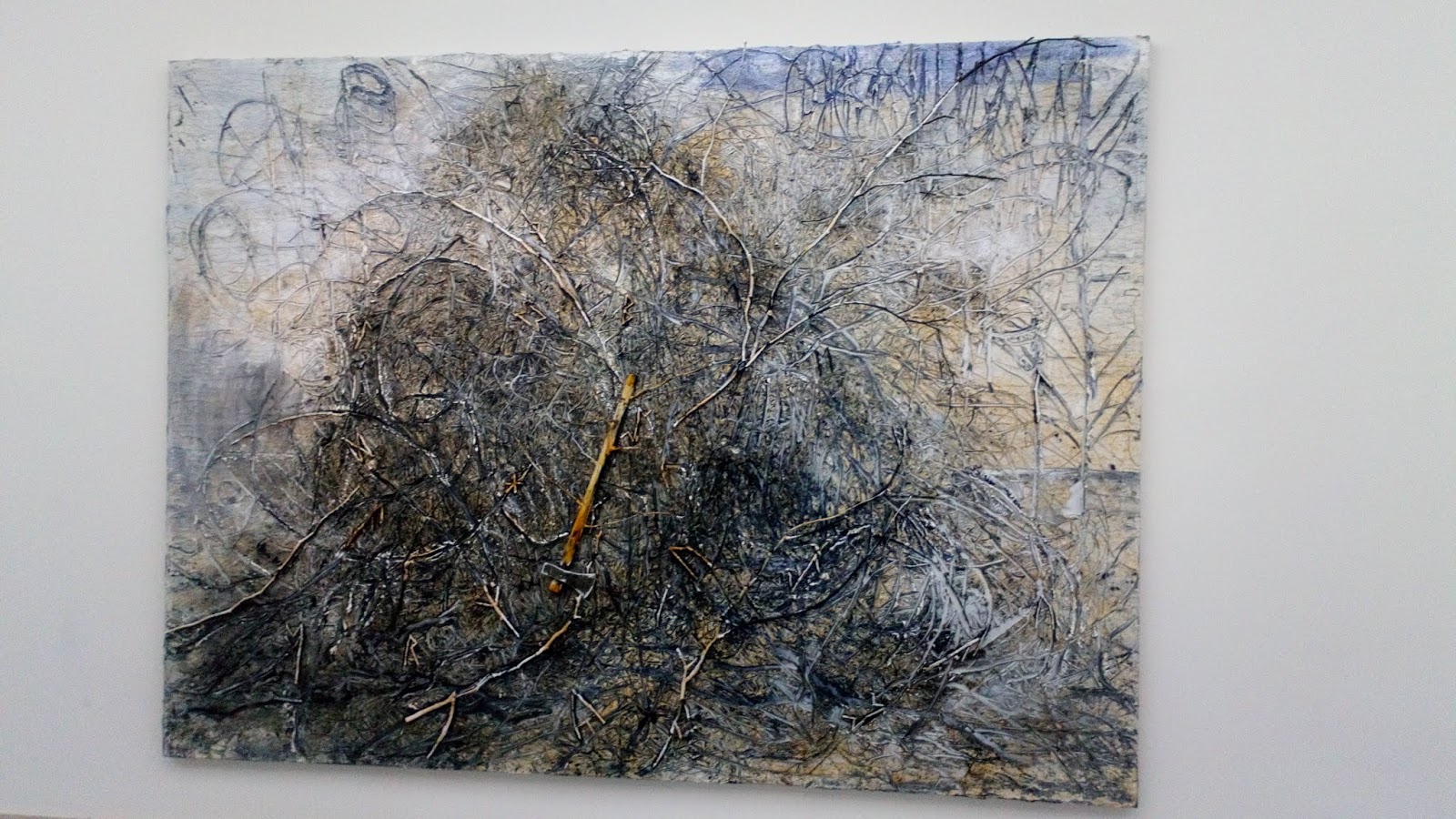
The painting below, one of the Gordian Knot series which featured axes, seemed slightly more optimistic than most of the other works in the exhibition (which probably tells you something about how "optimistic" it was overall: Kiefer is pretty shattering, almost literally.) I don't quite know what it was - perhaps the colours. I just knew that I felt a slight lifting of the heart. But it also reminded me of Paul Celan's poem 'I hear the axe has flowered'. You can read this poem in full, along with a few others, in translation by Ian Fairley on this link: https://www.guernicamag.com/four_new_translations_of_paul/
Sunday, 24 September 2017
A Salt Wind: Cross Currents in Polish & British Poetry
A few days ago, I went to a launch event at Ognisko Polskie in Knightsbridge for the online publication of A Salt Wind - a series of commentaries and poetic responses to each other's work by Polish and British poets. Unsurprisingly, this was a project of the great Modern Poetry in Translation.
Poets working on the project, some of whom read at the launch event along with translators, included Jahcek Dehnel, Tara Bergin, Vahni Capildeo, Ruth Padel, David Harsent, George Szirtes, Alice Oswald, and Krystyna Dąbrowska. They responded to the work of poets including Philip Larkin, Czesław Miłosz and Leopold Staff, among others. You can read the original poems and responses here: http://modernpoetryintranslation.com/a-salt-wind/
There was a lot to like about this project, but I was intrigued by the fact that every response was very different: some poets wrote commentaries, some wrote poems or translations, some did both. The openness of the project was intended as a response to recent rises in xenophobic attacks and hate speech in the UK and, indeed, in other countries. In the light of recent events in the UK, many of these attacks have targeted Polish people.
This year when I've gone to poetry events, they've usually been translation-related: poetry-wise, this is what gets me out of the house. It's no coincidence. In a world not characterised by its selflessness, translation does a pretty good job - it's hard work, it's often not well paid or recognised, and few people read poetry, let alone poetry in translation. I've found this reflected in the poetry-in-translation communities, which (it seems to me) are less noted for their egos and drama than other parts of the literary world, including the poetry world.
Thursday, 28 July 2016
Alice Oswald: Falling Awake
Leaf by daBinsi. Used under Creative Commons license
A couple of weeks ago I went to the launch of Alice Oswald's new collection, Falling Awake, at Southbank. A collection of mostly nature poems, it is also a book of high-level anxiety, with a tick tick tick of paranoia throughout. "It's as if the whole book is a kind of parking meter," said Oswald, noting that all of the poems are in some way about time. The reading, as always with her appearances, was not actually a reading, but a hypnotised/hypnotic recital.
Nature poetry can be really dull - well, this applies to any subject for poetry, but perhaps it has been my misfortune to read a lot of really dull nature poetry. Alice Oswald is never dull, not just because of the paranoia (which I have also noticed in her earlier work), but because her work partakes of a kind of super-perception. In April I went to an event celebrating Christopher Logue's War Music, a version of Homer's Iliad. Along with classicist Bettany Hughes, Alice Oswald was one of the speakers, on the basis of her own Memorial, which is another groundbreaking version of the Iliad. In the course of the discussion, Oswald mentioned that when she read the Iliad in the original ancient Greek, there was a sense that she was not just reading a powerful description of a river, or a battle, or a leaf - but that she was actually seeing these things directly, through a kind of periscope into another time and another mode of perception. I would describe her own work in a similar way; this super-perception makes me think of the title of Wallace Stevens' poem 'Not Ideas About the Thing but the Thing Itself.' It is also like the moment when out of the corner of your eye, you see a face in the crowd of someone you thought you had lost - in a way which is more than imagination, a physical shock strikes you, and then you realise it wasn't them, after all.
Reaching this level of intensity through the power of the written word is unusual even in poetry - amongst the poets I love who succeed, I would name Oswald, Paul Celan and Vasko Popa, and the latter two I can read only in translation. There are others, but even with the greatest of writers, I think this is rare. I think it helps enormously to be a writer who can recall the extraordinary intensity of childhood experience (not all writers can), and through a combination of effort and unconscious reach, perceive adult experience in this way, as well.
Here are a few poems from Falling Awake:
BODY
FLIES
ASIDE
Sunday, 12 October 2014
Alice Oswald Performs Tithonus: "As Soon As Dawn Appears..."
Susanne Nilsson, Flying at Dawn. Used under Creative Commons license
In a literary world where words like "stunning", "powerful" and "unforgettable" get bandied about pretty freely, Alice Oswald's work deserves it more than most. It's safe to say that she is one of the most important English/British/English-language poets now working, and some would call her the most important.
On Thursday night I went to Southbank (the Purcell Room) to see Alice Oswald perform her new work, Tithonus. This was the second time I'd seen her and the first, about a year and a half ago, was a revelation as I was only slightly familiar with her work at that point and had no idea what kind of performer she was. It is more accurate to describe her appearances as "performances" - she recites by heart rather than reading, but "recital" doesn't exactly cover it. When I saw her at the T S Eliot Memorial Meeting, performing an excerpt from Memorial and shorter lyric poems, I was totally mesmerised and knew I had to read more, and hopefully see her again.
Following Oswald's radical reframing of the Iliad in Memorial, Tithonus is another look at a tragic story from Greek mythology. Tithonus was a Trojan who became the lover of the dawn. When she asked Zeus to make Tithonus immortal, she forgot to ask that he stop aging. Eventually he became unimaginably ancient and the dawn locked him in a room, where he sat babbling to himself. In this version of the story, he meets the dawn at midsummer.
I bought my ticket for this event (part of the London Literature Festival) a while ago and it came at a good time in a fairly stressful week. By the time I got to the front of the bar queue, I'd had to listen to the annoying publishing types behind me alternately raving about how marvellous Alice Oswald was when they didn't see her at Hay, and "the horror" of a new novel by a famous rock star. At that point I was more than ready to sit in the dark and listen.
The performance lasted 46 minutes, which was the length of midsummer dawn, and the first five minutes were in near-complete darkness. Oswald was accompanied by Griselda Sanderson on the nyckelharpa, an unusual instrument which I may or may not have come across in the Nordic parts of my childhood. The lights on stage came up very gradually and the effect was beautifully and subtly done to resemble dawn light.
Oswald called Memorial "a trauma" and has said how difficult it was for her to perform it. Tithonus is plainly also about trauma, in part, and an enormous tension ran through the whole performance, counterpointed by the weirdly soothing nature of half-darkness and the sounds of the nyckelharpa. Oswald holds herself totally still while performing and never falters. This had a particularly shocking effect in the passages where Tithonus really lapses into a traumatised babbling ("behind that cloth another cloth behind that cloth another cloth and then another and then another cloth and then another..."). These frantic moments in the piece contrasted with long pauses and descriptions of dawn sounds and sights, along with Tithonus' visions of himself as a sort of dogged survivor in the natural world. These had both a delicate, accurate charm and an almost unbearable sadness.
and getting accustomed to
surviving like a bramble very good
at growing anywhere you ought to
praise me for this trailing bloom this
must be the heart this is only a dream
It's hard to describe an experience like this and do it justice. I bought a copy of the limited edition pamphlet of Tithonus on sale at the event, and re-reading it allows me to relive it to a certain extent. I think that it is enormously impressive even if only experienced on the page, but the combined effect of the lighting, the music and especially Oswald's performance was overwhelming.
Oswald and Sanderson signed the pamphlet for me afterwards. Oswald looked tired and drained, although she was gracious, so I didn't ask her questions, just said "Thank you, it was amazing", to which she said "Good" and smiled. Her signature was a small diffident scrawl and she said "My signature is disappearing" a bit wryly. The signature might be self-effacing, and so is the poet, despite the almost frightening power of her performances: everything is given to the poem, when she recites. But this is a voice which, in its blend of tradition, avant-garde modernity and simply great art, is likely to outlast that of most contemporary poets.
Wednesday, 20 March 2013
The T S Eliot Memorial Meeting with Alice Oswald and Robin Robertson
On Monday night I went to the T S Eliot Memorial Meeting, at the Courtauld Institute (Somerset House). I had been going back and forth a little over whether I wanted to buy a ticket to the event, but my dilemma was solved when I won a pair of tickets through the Poetry Society. This also allowed me to bring a friend - it turned out that she was rather starved for some poetry, so that worked out well.
The evening was organised by the Royal Society of Literature, and so I had the added pleasure of seeing my favourite travel writer, the charming and erudite Colin Thubron, introducing the evening. On this occasion, critic and novelist James Wood was also admitted as a Fellow of the RSL. I had no idea that so much ceremony accompanied these occasions, but it seems that a new Fellow must sign the almost-200-year-old roll book, and that this is traditionally done with a famous writer's pen. In the past, Byron's and Dickens's pens have been used, but this year the RSL has a new pen, and a very exciting one: TS Eliot's.
Photo by I've Read That (www.ivereadthat.com)
A trustee of the T S Eliot estate who presented the pen said: "Before Valerie [T S Eliot's widow] died, it was just known as Tom's pen and she kept it with Tom's wallet, Tom's glasses and Tom's cheque book, and that was its proper home and where it belonged. When Valerie died, it stopped being Tom's pen and became T S Eliot's pen and so needed a home." There was definitely an emotional charge in the air when the pen was presented.
The poetry readings were by Alice Oswald and Robin Robertson. I was only slightly familiar with Alice Oswald's work but I found her quite extraordinary. The lights were dimmed (for both poets, except a small reading lamp on the podium) but Oswald didn't read - she recited her poetry for half an hour, and with great presence and sense of timing. Her work struck me as layered and cumulative, like the interior of a seashell or some beautiful symmetrical form in nature, using language which was both musically poetic, and simple. As well as several shorter poems, she recited a long passage from Memorial, her version of the Iliad, which was powerful and unforgettable, bringing home both the violence of war and the details of the individuals who met their deaths. (On this link, you can read excerpts from Memorial or listen to Oswald reading them herself: http://www.poetryarchive.org/poetryarchive/singlePoet.do?poetId=15354)
Robin Robertson read poems about (among other things) what sounded like a rather grim childhood in Scotland, about heart surgery and its aftermath (I am now quite grateful that I'm closer to the A&E at St Thomas's, rather than the Denmark Hill A&E, which was described in the poem as an "abattoir" on a weekend night), and invented tales of Scottish mythology. I thought Oswald was a tough act to follow but Robertson reads with great Scottish gravitas and I've always found his readings to be wonderful. He concluded with 'At Roane Head', which was as powerful as ever (I heard a few gasps from people who may not have been familiar with the poem's twists and turns already) and which is likely to become the poem he will be remembered for.
Here is a photo of the stars of the evening - from left to right, Robin Robertson, James Wood and Alice Oswald:
Photo by I've Read That (www.ivereadthat.com)
Subscribe to:
Posts (Atom)


