"Poetry searches for radiance, poetry is the kingly road that leads us farthest" (Adam Zagajewski)
Showing posts with label Georg Trakl. Show all posts
Wednesday, 29 January 2020
Alice Oswald's Nobody at Kings Place, and Anselm Kiefer at White Cube
In the past couple of weeks I went to two events which were either poetry, or poetry-adjacent ("adjacent" is my current overused word) and wanted to write a little about them here.
Alice Oswald, who is definitely "the great Alice Oswald" and is also now the first woman Oxford Professor of Poetry (though not the first to be elected - that was Ruth Padel), performed at Kings Place on 17 January with live music by Ansuman Biswas. Oswald does specifically "perform" rather than "recite" or "read" - even her more conventional appearances involve her almost chanting her poems off by heart, unforgettable performances unlike anyone else's. I have written about seeing her a couple of times before, and this was one of the less conventional appearances. It started with a "sound calendar" or seascape by Chris Watson, and the actual performance was mostly in total darkness, although there was partial lighting for sections of it.
Oswald was performing Nobody, her most recent book, based on stories of water, humans and gods from Greek mythology. I'm only superficially knowledgeable about the Odyssey and related works, so I appreciated Nobody more from a sea-perspective, but the tales that washed in and out sometimes had an odd familiarity. Ansuman Biswas performed on the aquaphone, which reminded me of sea sounds washing into a cave, and also an enormous gong, which was overwhelming to the point of being almost distressing at certain points. The whole performance was mesmerising, thrilling and absolutely haunting.
Last weekend I went to Anselm Kiefer's new exhibition Superstrings, Runes, The Norns, Gordian Knot at White Cube in Bermondsey. I got in just under the wire - the exhibition had been on for a few months but was in its final hours when I went. I was very glad that I did make it, as I've found that Anselm Kiefer is one of the very few contemporary artists who I really connect with. I've written about him on this blog before, as my way into his work was through the poetry of Paul Celan, one of his greatest inspirations (and mine...)
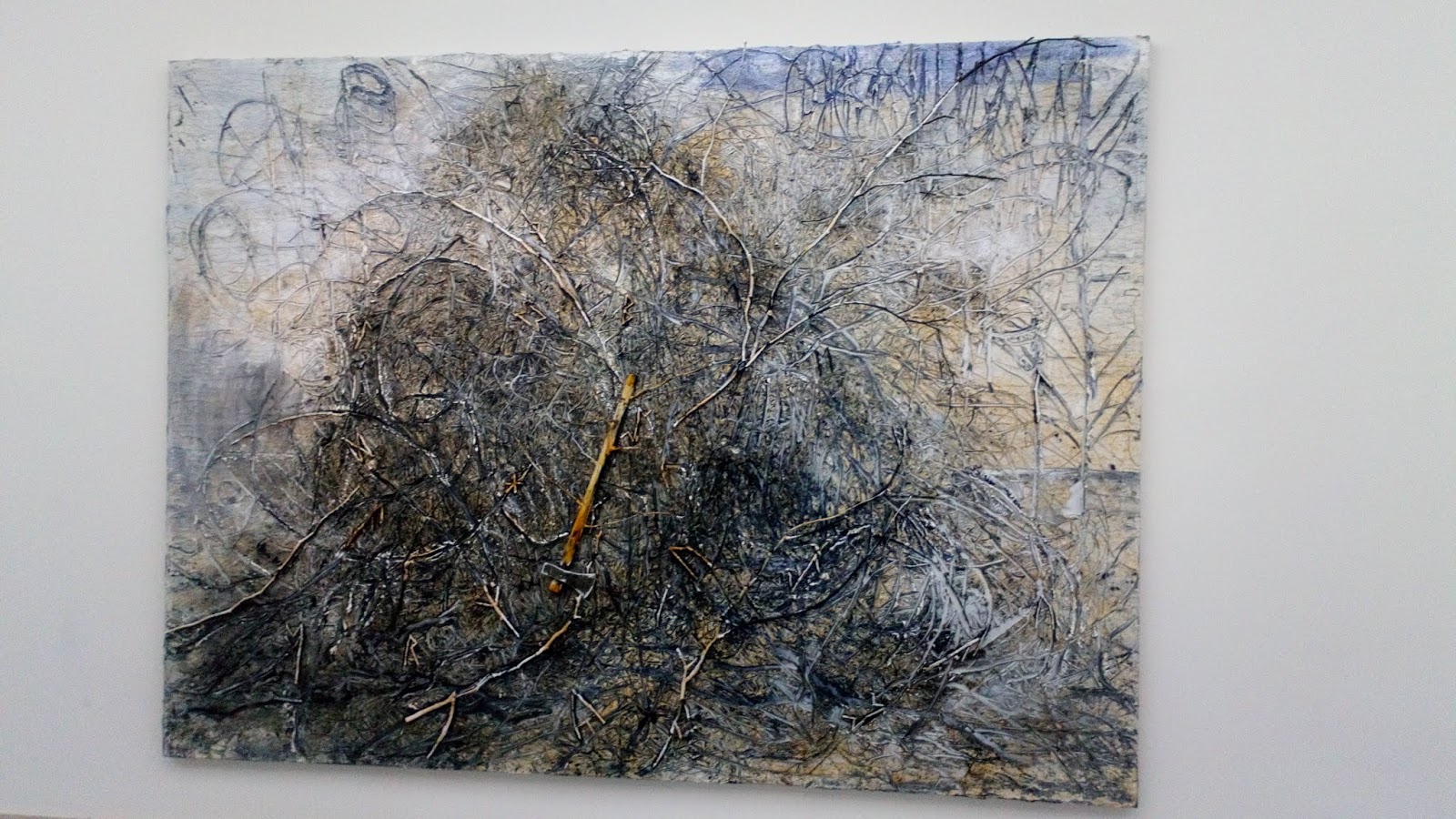
The tangled, broken, cascading canvases and masses of wires weren't quite as enthralling to me as Kiefer's exhibition Walhalla, also at White Cube a few years ago, or the retrospective at the Royal Academy which introduced me to his work - although this was still excellent. This exhibition also seemed a little less poetry-influenced. But poetry was still there: one canvas took inspiration from Georg Trakl, another from the Kalevala, a work which brings together traditional poetry about Finnish mythology. In one of the books accompanying the exhibition, Kiefer referred to Ingeborg Bachmann's poem 'Bohemia Lies By the Sea'.
The painting below, one of the Gordian Knot series which featured axes, seemed slightly more optimistic than most of the other works in the exhibition (which probably tells you something about how "optimistic" it was overall: Kiefer is pretty shattering, almost literally.) I don't quite know what it was - perhaps the colours. I just knew that I felt a slight lifting of the heart. But it also reminded me of Paul Celan's poem 'I hear the axe has flowered'. You can read this poem in full, along with a few others, in translation by Ian Fairley on this link: https://www.guernicamag.com/four_new_translations_of_paul/
Tuesday, 17 July 2012
Georg Trakl's 'Decline' and Earle Birney's 'David': "O My Brother We Climb..."
DECLINE (Georg Trakl - translation by Leif Hendrik)
(to Karl Borromaeus Heinrich)
Over the white pond
The wild birds have drawn away.
An icy wind sheers from our stars at evening.
Over our graves
The shattered brow of night inclines.
Under the oaks we rock in a silver skiff.
The white walls of the city resound continually.
Under arches of thorn
O my brother we climb, blind clock hands toward midnight.
UNTERGANG
(An Karl Borromaeus Heinrich)
Über den weissen Weiher
Sind die wilden Vögel fortgezogen.
Am Abend weht von unseren Sternen ein eisiger Wind.
Über unsere Gräber
Beugt sich die zerbrochene Stirne der Nacht.
Unter Eichen schaukeln wir auf einem silbernen Kahn.
Immer klingen die weissen Mauern der Stadt.
Unter Dornenbogen
O mein Bruder klimmen wir blinde Zeiger gen Mitternacht.
Translation from German © Leif Hendrik, 2012. Used by permission.
I'd like to thank Leif Hendrik for letting me use his translation, which also appears on his excellent Nordic Mountain blog, along with other translations and literary discussion. I have included Georg Trakl's original poem in German, for anyone who knows German, or who would like to try comparing.
I have only read a few of Georg Trakl's poems, so far, but the despair and darkness that radiates from them is palpable almost immediately. He was an Austrian poet of the late nineteenth and early twentieth centuries, clearly influenced by Baudelaire and Rimbaud, and he lived haunted by mental illness and drug addiction. Traumatized by experiences in World War I, he died in Krakow of a drug overdose which may or may not have been deliberate.
I read 'Decline' and froze when I came to the last line: "O my brother we climb, blind clock hands toward midnight." The implied dialogue between the dead young men in this poem is almost unbearable. This is the terribly sad scenario which the sensitive imagine when they have left the gravesites of their loved ones.
I realised that the poem was making me think of the fate of some who pursue extreme mountaineering. Perhaps this was because I read it just a few days after the recent disaster on the Mont Blanc massif. Nine died in an avalanche on the notorious Mont Maudit, and shortly afterwards, two more climbers died after being stranded in bad weather. I have been deeply fascinated by extreme mountain climbing for years - apparently, a combination of having read James Ramsey Ullman's Banner In the Sky, a novel for children based on the first ascent of the Matterhorn, when I was young; and much later, reading Joe Simpson's gut-wrenching Touching the Void, and then moving on to his other books, including The Beckoning Silence, and works by other mountain writers. It's so far from what I've experienced personally, but the visceral nature of these books and the experiences they describe transports me completely outside of myself. It's the ultimate in living vicariously. You begin to understand the dangerous philosophy that these men (and sometimes women) pursue - of living so close to death that you feel more and more alive.
Images in 'Decline' must have made me think of climbing. The icy wind, the radiant stars; and "Over our graves/The shattered brow of night inclines" conjures up a stark image of the European mountains' great north faces leaning over their dead. "The white walls of the city resound continually": this could be an image of avalanche. And finally, the twin hands of the clock climbing towards zero hour; a climb, but a deathly one.
I think that this intense association which came at me out of the poem also had to do with the fact that I'd just read Earle Birney's famous Canadian poem 'David'. Here is a link to the poem, reproduced on the University of Toronto Libraries' website:
DAVID (Earle Birney)
In a sense, these poems couldn't be much more different. 'David' is lengthy, and specific, while Tralk's poem haunts and implies and stays just out of reach in a few lines. 'David' conjures up a sense of striving and freedom and love of nature and intense friendship between two young men, and then ends it in a shattering, devastating experience. The terrible climax of the poem (or the end of the climax, you might say) is the only thing not really spelled out, hinting at the extreme trauma suffered by the narrator. There are lines here which could almost echo Trakl, at least in their horrified intensity - if not 'Decline' specifically, then perhaps another poem:
[...] At last through the fanged
And blinding seracs I slid to the milky wrangling
Falls at the glacier's snout, through the rocks piled huge
On the humped moraine, and into the spectral larches,
Alone. By the glooming lake I sank and chilled
My mouth but I could not rest and stumbled still
To the valley, losing my way in the ragged marsh.
I was glad of the mire that covered the stains, on my ripped
Boots, of his blood, but panic was on me, the reek
Of the bog, the purple glimmer of toadstools obscene
In the twilight. [...]
I suppose that this entry is more about the connections that I make while reading poetry than about one poem or the other, in the end; but the train of thought seemed worth following, and I wondered again if the loss of life so often risked in these endeavours is worth it.
The photograph at the top of this entry was taken by me at the famous Eiger Window on the Eigerwand, the mountain's legendary north face. My brother and I took a train trip up to the Jungfrau a few years ago, and I lived one of my dreams, of seeing the Eiger and even setting foot on (in?) it. Looking out of that window was a sobering experience - it was like being in a low-flying airplane, and it's only about halfway up the face. It was unforgettable.
Subscribe to:
Posts (Atom)