Showing posts with label Anselm Kiefer. Show all posts

Wednesday, 29 January 2020

Alice Oswald's Nobody at Kings Place, and Anselm Kiefer at White Cube


In the past couple of weeks I went to two events which were either poetry, or poetry-adjacent ("adjacent" is my current overused word) and wanted to write a little about them here.

Alice Oswald, who is definitely "the great Alice Oswald" and is also now the first woman Oxford Professor of Poetry (though not the first to be elected - that was Ruth Padel), performed at Kings Place on 17 January with live music by Ansuman Biswas. Oswald does specifically "perform" rather than "recite" or "read" - even her more conventional appearances involve her almost chanting her poems off by heart, unforgettable performances unlike anyone else's. I have written about seeing her a couple of times before, and this was one of the less conventional appearances. It started with a "sound calendar" or seascape by Chris Watson, and the actual performance was mostly in total darkness, although there was partial lighting for sections of it.

Oswald was performing Nobody, her most recent book, based on stories of water, humans and gods from Greek mythology. I'm only superficially knowledgeable about the Odyssey and related works, so I appreciated Nobody more from a sea-perspective, but the tales that washed in and out sometimes had an odd familiarity. Ansuman Biswas performed on the aquaphone, which reminded me of sea sounds washing into a cave, and also an enormous gong, which was overwhelming to the point of being almost distressing at certain points. The whole performance was mesmerising, thrilling and absolutely haunting.

Last weekend I went to Anselm Kiefer's new exhibition Superstrings, Runes, The Norns, Gordian Knot at White Cube in Bermondsey. I got in just under the wire - the exhibition had been on for a few months but was in its final hours when I went. I was very glad that I did make it, as I've found that Anselm Kiefer is one of the very few contemporary artists who I really connect with. I've written about him on this blog before, as my way into his work was through the poetry of Paul Celan, one of his greatest inspirations (and mine...)

The tangled, broken, cascading canvases and masses of wires weren't quite as enthralling to me as Kiefer's exhibition Walhalla, also at White Cube a few years ago, or the retrospective at the Royal Academy which introduced me to his work - although this was still excellent. This exhibition also seemed a little less poetry-influenced. But poetry was still there: one canvas took inspiration from Georg Trakl, another from the Kalevala, a work which brings together traditional poetry about Finnish mythology. In one of the books accompanying the exhibition, Kiefer referred to Ingeborg Bachmann's poem 'Bohemia Lies By the Sea'.

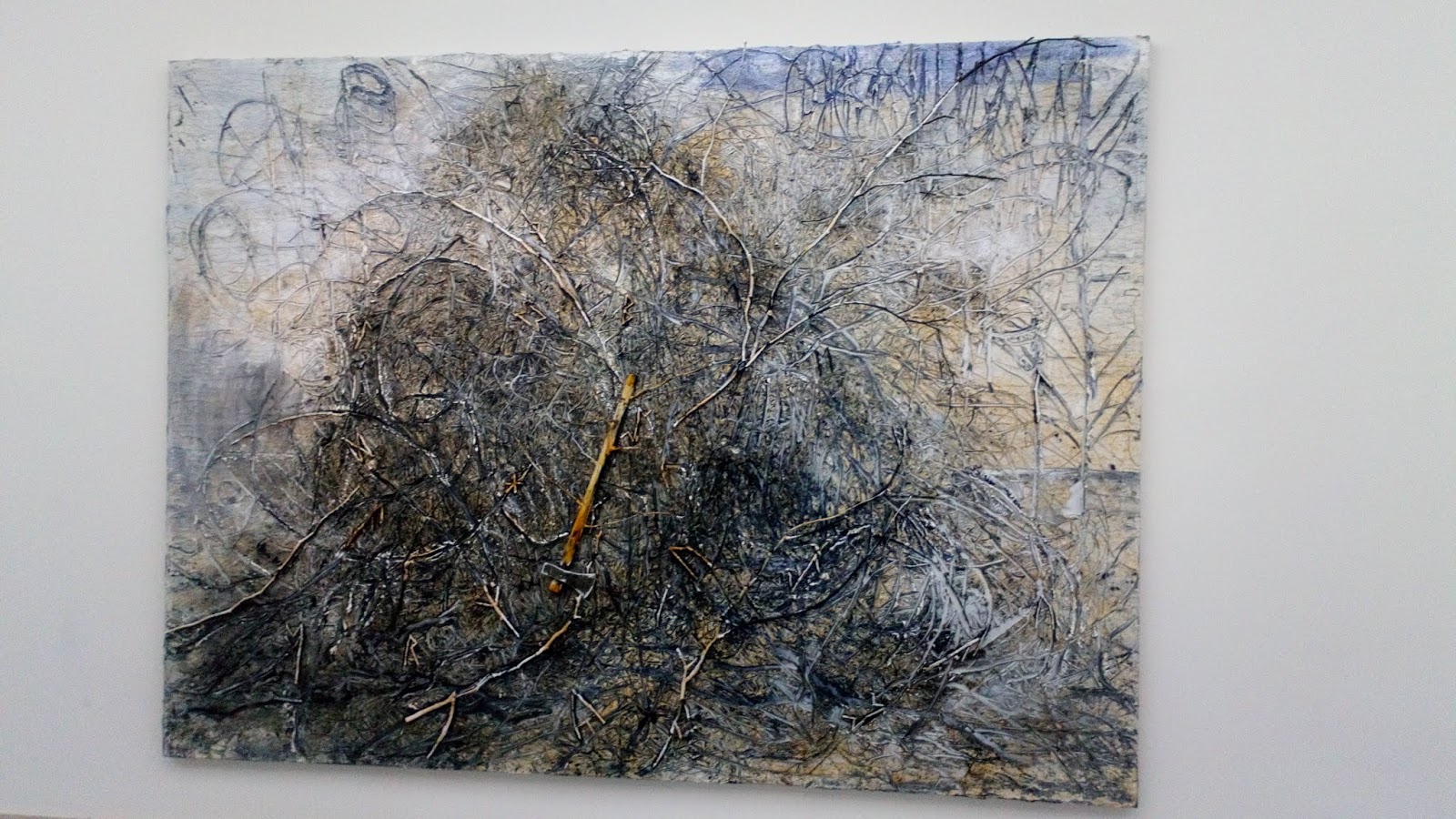
The painting below, one of the Gordian Knot series which featured axes, seemed slightly more optimistic than most of the other works in the exhibition (which probably tells you something about how "optimistic" it was overall: Kiefer is pretty shattering, almost literally.) I don't quite know what it was - perhaps the colours. I just knew that I felt a slight lifting of the heart. But it also reminded me of Paul Celan's poem 'I hear the axe has flowered'. You can read this poem in full, along with a few others, in translation by Ian Fairley on this link: https://www.guernicamag.com/four_new_translations_of_paul/


Saturday, 7 January 2017

Anselm Kiefer's Walhalla and Paul Celan Encounters


A few weeks ago I went to the Anselm Kiefer exhibition at White Cube Bermondsey, near London Bridge. This new exhibition, called Walhalla, runs until 12 February and it's free.

Anselm Kiefer, the German artist who was born just as World War II ended, produces art which is in a continual dialogue with Germany's history, with poets and philosophers, and with the times of rupture that we are living through. I went to his retrospective exhibition at the Royal Academy a couple of years ago and was blown away - which is a rare occurrence for me with contemporary art. You can read my thoughts about that exhibition here.

Kiefer's work feels shocking in the way that visiting the site of a concentration camp shocks. It's not so much what you see before your eyes as what seems to be in the air. It's a feeling of living in aftermath. The first thing I saw at White Cube was a long, dark hallway of hospital beds dressed with lead sheets. There was a warning not to touch the installations, as the lead could be dangerous.

Huge paintings of burning, crumbling towers - a spiral staircase draped with robes - a library-cum-apothecary bleeding film reels and pages... I found, as with the previous exhibition, that I was having an almost physical reaction to Kiefer's work. It seemed as though the world around me was going in and out of focus in a very unsettling way.

I went to that 2014 exhibition at the Royal Academy mainly because I had read that Kiefer was strongly influenced by Paul Celan. I wasn't disappointed, because there were works specifically inspired by Celan's poems. In Walhalla, the influence wasn't signalled quite so clearly. But then, in the cluttered room of giant drawers and film reels, I saw this:


Mohn und Gedächtnis (written on the bottom drawer) means Poppy and Memory, and it is the title of Celan's second book of poetry. In an installation which reminded me very much of some crazed, broken apothecary, and in an artist's work which continually tries to deal with the worst of memory, it seemed very appropriate.

Later, on another work, I saw this:


I had an eerie feeling when I saw this piece of writing. I don't actually speak German, but I was sure I recognised the words. I was sure I knew the poem and the exact lines it referred to. And when I checked later, I found I was right:

bone-Hebrew
ground into sperm
ran through the hourglass
through which we swam, two dreams now, chiming
against time, in the squares.

(from 'In Prague', translated by Michael Hamburger)

This happens to be one of my favourite poems by Celan, and the shock of recognising lines from it on the side of a work of art, in the original German, was considerable. I have to read his poems in translation, but usually I do so with the original on the facing page, and I do try to read and compare both. I was of course looking out for references to poetry and particularly to Celan, but it was a moment which brought home to me the intensity of my relationship with Celan's work.

You can read another review of Walhalla and find some good photos here: https://www.theguardian.com/artanddesign/2016/nov/21/anselm-kiefer-review-walhalla-white-cube-bermondsey


Thursday, 11 December 2014

Anselm Kiefer and Paul Celan at the Royal Academy


In recent weeks I've been reading Paul Celan again. I move in and out of the Celanian moments in my life (when I say "moments", these can last for weeks or months). I don't find it possible to read Celan all the time - I get tired and sad if I go on for too long, though his work can also be very clarifying in the right proportion. I have never been able to forget the comment by Michael Hamburger, one of Celan's most dedicated translators: "From the first my engagement with the work of Celan had been difficult and sporadic. Had it become a full-time occupation and specialisation, it could have driven me into suicide, as it did his friend and interpreter Peter Szondi."

Anyway, I have been reading John Felstiner's wonderful translations, and I have also finally started reading Felstiner's biography Paul Celan: Poet, Survivor, Jew. I'm also about to dip (or dive) into Pierre Joris's new translations of Celan's later works, Breathturn into Timestead. But I came back to Celan this time most notably through the Anselm Kiefer exhibition currently showing at the Royal Academy in London, which will end in a few days.

For someone (me) who is mostly drawn to art created one hundred years ago or more, Kiefer's work seemed a bit alien and intimidating. In a post-World War II Germany he created controversial works touching provocatively on Nazi symbolism, and has otherwise explored the threads of German history, its influences, and its own influence on the world. Many of his works are massive in size, overwhelming. My way in, and my main reason for going to the exhibition, was the influence of Paul Celan's works.

Kiefer has many artworks directly inspired by Celan's poems and several of them were in the exhibition. The paintings Margarete and Sulamith, directly inspired by 'Deathfugue', appeared side by side. Next to them, on the wall, was John Felstiner's translation in full of 'Deathfugue' - this translation is particularly famous for how it daringly and effectively weaves lines of the original German in with the English translation. I was glad to see other people reading the poem attentively.


Black milk of daybreak we drink you at night
we drink you at midday and morning we drink you at evening
we drink and we drink
a man lives in the house your goldenes Haar Margareta
your aschenes Haar Shulamith he plays with his vipers


I really loved For Paul Celan: Stalks of the Night, among others. One of the "lead book" works, Black Flakes, I also found especially striking:


Anselm Kiefer, Black Flakes. Private collection, c/o Museum Kuppersmuhle fur Moderne Kunst. Photo Privatbesitz Famille Grothe/copyright Anselm Kiefer


This painting is embedded with an enormous lead book and it features lines from the poem 'Black Flakes', a particularly heart-wrenching poem Celan wrote after the loss of his mother, from which he never recovered.


Autumn bled all away, Mother, snow burned me through:
I sought out my heart so it might weep, I found - oh the summer's breath,
it was like you.
Then came my tears. I wove the shawl.

(translation by John Felstiner)


I find it difficult to write about visual art, and you will find far more thorough reviews of the exhibition elsewhere. But there were a couple of things I thought particularly worth noting.

The size of many of these works is such that it has a very immersive effect. With works such as Black Flakes, I had a feeling that Kiefer had directly transferred the broken, scratchy, beautiful images in his mind directly onto the canvas. I find it very interesting to think about the pictures in others' minds, and I have sometimes asked people to describe how they "see" their consciousness, the mind's eye, the film inside your head, however you want to describe it. Mine is a mix of constant palimpsest film-reels, often with music or with words faintly (or clearly) heard, sometimes with the written words themselves. Perhaps nothing unusual, but I have a feeling that this is different for everyone. These works were so enveloping that I seemed to be seeing behind the artist's eyes. This was an especially fascinating impression because of my feeling that Celan's poems are transferring the images in his mind directly onto the page, in a way that few other poems achieve.

The other thing is that some of Kiefer's works produced a strange aural impression on me. The gallery wasn't empty and it was far from silent in there, but when I looked at some of the canvases, including the Celan works, I seemed to hear a rustling. I don't know why and I wouldn't say it necessarily represented anything, but it is very unusual for me to have aural impressions when I look at works of art. I had a confused feeling that the rustling I "heard" was something to do with the sounds of silence.