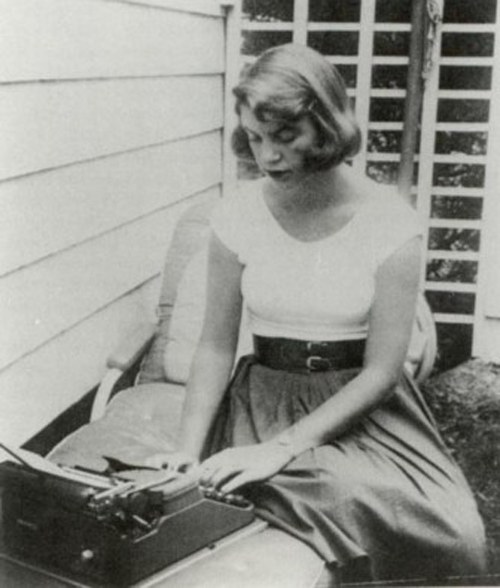
"Poetry searches for radiance, poetry is the kingly road that leads us farthest" (Adam Zagajewski)
Showing posts with label Sylvia Plath. Show all posts
Wednesday, 8 March 2017
Poems for International Women's Day
Anna Akhmatova, portrait by Kuzma Petrov-Vodkin. 1922
People are writing all sorts of interesting things for International Women's Day. I thought, belatedly, that I would simply share a few poems that seem appropriate.
I COULD NOT TELL (Sharon Olds)
LADY LAZARUS (Sylvia Plath)
WILLOW (Anna Akhmatova, translated from Russian by Jennifer Reeser)
Thursday, 6 October 2016
National Poetry Day 2016: Messages
Today is National Poetry Day. I seldom manage to do much for this occasion, but, well, I'm thinking poetry. There are many events taking place around the UK, which you can discover by visiting the website, or just with a bit of online browsing.
This year's theme is 'Messages'. This is once again a theme which could encompass every poem, but these two seemed appropriate. Enjoy!
THE LETTER ALWAYS ARRIVES AT ITS DESTINATION (Niall Campbell)
THE LIGHTKEEPER (Carolyn Forché)
Tuesday, 14 January 2014
"Oh Sherlock, Sherlock, He's In Town Again": Sherlock Holmes in Poetry
Sherlock Holmes and Dr John Watson as portrayed by Sidney Paget
If you have any interest in detective/spy stories and shows, television, modern updates of old stories, popular culture, or just a famous character named Sherlock Holmes, you may have heard that the latest series of the BBC's Sherlock series has just wrapped up. As Sherlock's big brother Mycroft once said to Watson, "I hear of Sherlock everywhere since you became his chronicler": the current Watson's chronicles appear in blog form, not in the Strand magazine, but not a lot has really changed. Sherlock Holmes is once again the talk of the town, but for me he never really goes away; he and Watson are always around, just a little more in or out of focus at different times. While Jeremy Brett, along with his Watsons David Burke and Edward Hardwicke, will probably always be my favourite screen Holmes and Watsons, Benedict Cumberbatch and Martin Freeman are superb and entertaining and the modern update is incredibly clever. (And yes, in case you're wondering - I totally heart Benedict.)
I have devoted quite a few conscious and subconscious hours to the mystery of why Sherlock Holmes is so important to me and I have essentially concluded that I am a bit too close to him to ever be able to really puzzle it out. I suppose we have some early influences that become so deeply woven into our lives that there's no way to really discern their exact nature, and in my case some of those influences were always going to be literary. I think I was seven when Holmes entered my life, both in the original stories and in Jeremy Brett's version. I was particularly obsessed through my teens, and it's all returned full force with years of living in London and with his recent upsurge in popularity; it's kind of nice that more of my friends "get it" at the moment. I know that when I was younger I both identified with Holmes (perhaps the fate of a few angsty misfit teenagers with a love of English literature) and had a crush on him; later on I realised that I actually identified more with Watson - less hyper-intelligent, emotionally locked up and rude; more loyal, anxious and both down-to-earth and adventurous. However, I think even now I probably alternate between identifying with Holmes and identifying with Watson, depending how I'm feeling. (Watson is the healthier option.) They could represent two sides of one personality, I suppose.
I do know that my Holmes is very much the guardian spirit of a place, London. Even when he goes out to the countryside, which he often does, he somehow represents London. I suspect that the intensity with which Holmes has remained in my life has a lot to do with place, perhaps more than anything else. The success of the current series, set very firmly in our modern day but also in London, tells me that place is more important for Holmes and Watson as convincing characters, than time. "It is my belief, Watson, founded upon my experience, that the lowest and vilest alleys in London do not present a more dreadful record of sin than does the smiling and beautiful countryside," Holmes comments one lovely morning as they head out to the countryside to investigate the sinister Copper Beeches (thus totally ruining Watson's fun day out on the train.) Spoken like a true Londoner, is all I can say.
Rather to my surprise, I've gradually realised that although there is a fair amount of cute-but-painful Holmes-related doggerel out there, there is also some genuinely beautiful and thought-provoking poetry inspired by the great detective, as well as some that is really funny and clever. I wrote some time ago about T S Eliot's 'Macavity, the Mystery Cat', which is a real classic and based on Holmes's arch-enemy Professor Moriarty. A less-known but also extremely funny work, written for Holmes's original miraculous return from the dead more than 100 years ago, is P G Wodehouse's 'Back to His Native Strand' (1903):
Oh Sherlock, Sherlock, he's in town again,
That prince of perspicacity, that monument of brain.
It seems he wasn't hurt at all
By tumbling down the waterfall.
That sort of thing is fun to Sherlock.
(from 'Back to His Native Strand', P G Wodehouse)
As a relative latecomer to the delights (if that's the right word) of Sylvia Plath, I was astonished to discover not that long ago that one of her poems, 'The Detective', refers to Holmes and Watson. I read it as a poem about metaphorical death, perhaps due to emotional cruelty by someone close to the victim. Ominously, it concludes:
Then the dry wood, the gates,
The brown motherly furrows, the whole estate.
We walk on air, Watson.
There is only the moon, embalmed in phosphorus.
There is only a crow in a tree. Make notes.
(from 'The Detective', Sylvia Plath)
Much more recently, I found out that Jorge Luis Borges wrote his own absolutely amazing 'Sherlock Holmes', a meditation on the relationship between the creator and the created, among other things. In this translation by Willis Barnstone, it opens:
Not of a mother born, no elders known,
he was like Adam and Quijano. He
is made of chance. Near or immediately
the whim of varied readers guide his tone.
It isn't wrong to think that he was born
a moment when the Other One may tell
his story, and he dies with each farewell
of memory in us who dream him.
(from 'Sherlock Holmes', Jorge Luis Borges, translated from Spanish by Willis Barnstone)
And I also discovered this beautiful poem by Susan Fromberg Schaeffer, 'Sherlock Holmes', where the poet uses the figure of Holmes to meditate on certainty versus uncertainty and ambiguity.
SHERLOCK HOLMES (Susan Fromberg Schaeffer)
I wanted to conclude with this most famous of Holmes poems, Vincent Starrett's '221B'. Although it isn't poetically quite in the class of the above works, it is beloved of Holmes fans and it represents a lot of what we love about the stories and the characters. (I've been advised that copyright in Vincent Starrett's estate is sufficiently murky that I shouldn't worry about reproducing the poem, but if anyone wants to hunt me down with an air gun like Moriarty's henchman Colonel Sebastian Moran, please think about just dropping me a line, first.)
221B (Vincent Starrett)
Here dwell together still two men of note
Who never lived and so can never die:
How very near they seem, yet how remote
That age before the world went all awry.
But still the game's afoot for those with ears
Attuned to catch the distant view-halloo:
England is England yet, for all our fears -
Only those things the heart believes are true.
A yellow fog swirls past the window-pane
As night descends upon this fabled street:
A lonely hansom splashes through the rain,
The ghostly gas lamps fail at twenty feet.
Here, though the world explode, these two survive,
And it is always eighteen ninety-five.
Thursday, 2 August 2012
Lost In Translation, Japan and Poetry of Place
I first watched Lost In Translation shortly before visiting Japan in 2004. Although I've seen it several times since then, I watched it for the first time in years about six or eight months ago, and it hit me rather hard. I realised that it reminded me of a lot of things from the past ten years, one way or another. The middle-aged actor Bob (Bill Murray) is there to promote Suntory whiskey when he meets Charlotte (Scarlett Johansson). On my first visit, in 2004, I brought back some Suntory whiskey for the friends in Dublin who had made me sit down and watch Lost In Translation before I left - that went down rather well. On my second visit, in 2010, I bought a miniature bottle of Suntory for someone in London who, in the end, I never gave it to.
Lost In Translation is definitely a film which polarises people - almost everyone I know who has seen it either cites it as one of their favourite films (that's me), or says it was bland or insipid or boring or words to that effect. I just found it incredibly realistic and rather moving, in terms of the characters in their interactions. I wouldn't say that it offered a lot of insight into Japanese culture, though the glimpses are entertaining and fascinating - the main characters don't make that much effort to really engage with the culture around them, so they remain outsiders. Not that it is a culture where it is particularly easy to become an insider.
But Japan is one of my favourite countries, after two visits to see one of my (Western) friends and her (Japanese) husband. It is a country where you can have so much fun, exploring the old and beautiful history, art and architecture, or running through the modern playgrounds of the cities and the futuristic technology. And everything works smoothly and everyone is so polite... My shining memories tend to surround the time I spent with my friend, and with her delightful friends, and marveling at the beauty of the castles, like the airy Himeji, and the gardens of Kyoto, and the otherworldly Ursula Le Guin archipelago of Okinawa. Oh yes...and shopping a lot, and sampling all of the amazing food that I possibly could. (Japan is my number one culinary destination.)
Returning to Lost In Translation, I see this above all as a movie about dislocation and feeling isolated (which can happen anywhere - even at home) and about the place where you are reflecting your state of mind. The latter is particularly interesting, and relates to poetry. I've consistently found that when I write poems about places - which I often do - the place (usually a city) ends up acting as a mirror and as an excavator; it reflects my state of mind and my preoccupations, and uncovers more. Every city reveals something different, of course. With other human beings, you have a different chemistry (in any kind of relationship) and thus a different way of relating to everyone; cities are like this as well because they all have a differing energy. I know sometimes that my experience of a city could have been quite different if I had visited in different company; or alone; or happier; or sadder. I remember that Tokyo, which I only visited in 2004, struck me as fascinating, but cold. I was living in Ireland and having a hard time when I took that trip, and while in Tokyo I was either alone, or with people I didn't know that well. I am not sure if I would have found Tokyo exactly warm under different circumstances, but it would not have been the same, I'm sure.
I thought of this in relation to poetry partly because of the workshop I took with Kapka Kassabova at Poetry Parnassus, which was about poetry of place and travel. One way to approach this is by allowing the place to tell a story about your state of mind, or a process you are going through in your life, or something similar. This is often where I turn out to be coming from when I write these poems, although it can be an unexpected result. Among others, we looked at the poem 'Finisterre' by Sylvia Plath, and Kassabova's own wonderful poem 'How to build your dream garden'; these are great examples. In 'Finisterre', Plath's lonely and morbid state of mind surges overwhelmingly out of the poem's imagery:
The cliffs are edged with trefoils, stars and bells
Such as fingers might embroider, close to death,
Almost too small for the mists to bother with.
(from 'Finisterre', Sylvia Plath)
I feel like I should revisit some of the places I've been to but have not yet written about, and explore them again through poetry.
Japanese poetry is a largely unknown world to me as yet, but I found this beautiful translation of a Kobayashi Issa haiku, by Robert Hass. It also strikes a poignant note as it involuntarily brings up thoughts of the 2011 tsunami.
The snow is melting (Kobayashi Issa, translated by Robert Hass)
Saturday, 11 February 2012
Sylvia Plath and 'Ariel': "And I Am the Arrow"
49 years ago, on 11 February 1963, poet Sylvia Plath was found dead in her London flat. It had previously been the home of W B Yeats, which had pleased Plath when she moved in a few months earlier. The circumstances of her suicide at the age of 30 are well known. Her marriage to Ted Hughes had come to a painful end, she was suffering from severe depression, living alone with their two small children, and it was one of the coldest winters on record in the UK.
I had not read much of Plath until very recently, or at least not while paying much attention. 'Daddy' and 'Lady Lazarus' had popped up from time to time over the years, as they are considered such iconic poems, and I didn't care for either of them. Especially 'Daddy'. I didn't understand Plath's fixation on Holocaust themes and her demonizing of a dead father who was not actually a Nazi. I just found it tedious, melodramatic, and unpleasant.
I think I may have had a bit of an early reaction against Sylvia Plath because of the ever-present suggestion that, as a girl and now as a woman, I should love her work and should not enjoy Ted Hughes's, because of their terrible history. Perhaps it was more than a suggestion; I may have had a faint niggling feeling that I was letting down the side by preferring Hughes to Plath. Apparently this is one of those literary areas where you are supposed to pick a side. I've enjoyed Hughes's poetry for years - though not all of it, by a long shot - and just could not be bothered to come back to Plath. To be honest, because of the trappings and because of my own teenage experiences, she made me think of extreme political correctness and a particular brand of feminism.
I grew up on the West Coast of Canada, one of the most politically correct regions of an extremely politically correct country, and in my late teens I attended what may very well be the most politically correct university in the world. As fond as I am of my university and as good as my experiences there generally were, I don't count it as a plus that they had an "ombudsperson" rather than an ombudsman, and that my brother was once told by the university paper that the CD review he'd written was excellent but that the word "craftsmanlike" had to be replaced by "craftspersonlike". (Every European who I've shared this story with has laughed in disbelief, which is interesting in itself. To be fair, some people from other parts of Canada have laughed, too.) Gender-specific language? Tut tut.
I was left with an impression of this type of feminism as a question of PC gone crazy, of semantics, of the inevitable person in every class who would rant on about the patriarchy, phallic symbols and oppression. I don't happen to believe that any of this is useful and that making silly changes to words is going to make a difference to people's attitudes. I have never understood what good it does to characterize 50% of the human race as cruel and oppressive due to their gender, when it would be better to address the questions of why human beings generally have a hard time treating each other decently, honestly and respectfully, and why so many people (a majority being men, throughout history - but both genders are implicated) are obsessed with seeking out an imbalance of power and abusing it. Surely equal, healthy and happy relationships (of any kind) are more desirable than just telling men why they are wrong.
To a certain extent, I understand why Plath was adopted as a feminist icon. She had a disastrous relationship with a man whose subsequent lover also eventually committed suicide, and who ultimately became a poster boy for male oppressiveness. I may not be a big fan of 'Daddy', but its rage and power is undeniable. Many of her poems bristle with anger and pain and the agonizing desire to be heard, to have a voice. But I doubt that she considered herself a feminist, or purely one, as some seem to want to characterize her. Not everything in her poetry is about fighting against male dominance, or about rejecting the roles imposed upon her. She was also suffering from mental illness, in a very debilitating manner, and this was the case even before she met Hughes. The language of her poems invests the world around her with hostility and agony. Colours and sounds seem to trouble her greatly, and there is a traumatized focus on physical details in so many of her poems. This is an area which I find interesting (although painful), more so than the feminist angle.
The tulips are too red in the first place, they hurt me.
Even through the gift paper I could hear them breathe
Lightly, through their white swaddlings, like an awful baby.
Their redness talks to my wound, it corresponds.
(from 'Tulips')
The moon is no door. It is a face in its own right,
White as a knuckle and terribly upset.
It drags the sea after it like a dark crime; it is quiet
With the O-gape of complete despair.
(from 'The Moon and the Yew Tree')
Sylvia Plath was a woman and person in her own right, not just a woman whose life went very wrong in large part because of a man. It doesn't seem fair to imply that she would have had nothing to write about had Ted Hughes (or another man) not treated her badly, or had she not been raised as a traditional American girl and found herself caught between conflicting impulses and attitudes as a creative woman and a strong personality at a time when societal attitudes were shifting. I think that she was more talented than her circumstances.
I decided to start reading Plath more closely because of a recent encounter with the poem 'Ariel', which can be found on this link:
ARIEL (Sylvia Plath)
At least in its most literal sense, the poem is about Plath riding her horse Ariel. It is a rush of giddy images, of exaggerated sensual details which work perfectly in the context of the poem. It is about pure feeling moving to something on a more transcendent level - release from physical constraints and mental or emotional burdens. Poet and critic A Alvarez, who was also friends with Sylvia Plath, commented: "You are made to feel the horse's physical presence, but not to see it. The detail is all inward. It is as though the horse itself were an emotional state." To me, despite its somewhat catastrophic imagery, this is a rare example in Plath's poetry of the physical world being invested with something exultant and joyful, rather than anger and suffering.
And I
Am the arrow,
The dew that flies
Suicidal, at one with the drive
Into the red
Eye, the cauldron of morning.
(from 'Ariel')
I love this poem, and it is enough to make me want to explore Plath further. I have wondered why my literary preferences - certainly in the realm of poetry - seem to be heavily weighted toward male rather than female writers. The subjects of my blog posts so far are enough to reveal that - there have hardly been any women. I have yet to determine whether this is more than coincidence. Perhaps I really have just been brainwashed by the patriarchy and all those dead white guys. Perhaps I'm looking for the male perspective, given that I am a woman with a pretty good sense of my own identity (thus not feeling the need for a lot of help with female identity) and that the majority of my friends are female. Perhaps I prefer the male voice for some reason I have not identified (though the example of Ted Hughes is surely enough to make me look very cautiously at the whole Manly Man thing). Or perhaps it is just a numbers game, since until recently men have had a lot more opportunities - and in many areas this is still how it is. In any case, I feel that I have something to gain from reading Sylvia Plath.
Saturday, 14 January 2012
The Dark Poetry of Spain
In December, I spent two weeks in Andalucia, Spain with a friend. In terms of sheer well-rounded pleasure it was among the best holidays I've had. Years of living on chilly northern islands have definitely convinced me that there are advantages to chasing the winter sun. Here, it wasn't exactly hot (except for some particularly pleasant hours in the sun), but it was mild to warm and there were blue skies for at least part and often all of every day.
We stayed in Jerez de la Frontera, a little over an hour by train from Seville. It proved to be a perfect base - a lovely, friendly town well placed for day trips elsewhere; not too big and not too small; and home to the Royal Andalusian School of Equestrian Art, where I spent several happy hours both at a show and on a training day, watching exquisite dancing horses and handsome caballeros. It really does not get much better. Elsewhere, we wandered Seville's ornate shopping streets; sat by the vast blue reaches of water on Cadiz's shores; had one of the best meals I've ever had on holiday, a stunningly artistic selection of tapas, in Puerto de Santa Maria; admired the vistas from Arcos de la Frontera, a medieval dream of a town; and drank a lot of delicious coffee.
I hadn't previously spent a lot of time in Spain, although I speak the language up to a point (I was pleased at how much I was able to use it on holiday, and how well I was generally able to get by) and have had some excellent friendships with Spanish people. I had already spent a week in Mallorca, but although there are flashes of Spanish culture, it is pretty touristy and you don't always know where you are. In 2010 I spent a few days in Madrid and a day trip to Toledo, and loved both. Madrid's Prado is hands down one of the finest art galleries I have ever visited, and I finally caught a tantalizing glimpse of the mystery of Velazquez's Las Meninas. Madrid is monumental but beguiling, dark but fun-loving - definitely a city I could revisit any time. And Toledo, a gemlike town, is truly the stuff of fantasy.
It may have been mere holiday-fuelled musings, but I concluded that Spain was probably where I'd chose to live if I had to go somewhere in southern Europe. I love the south of France but it is somehow a bit too Mediterranean for my taste. Italy is enchanting and rich and beautiful but I don't feel at all at home there or with the people. Spain has something in common with both but perhaps there is a little more darkness and solemnity, which has a certain appeal. Ted Hughes wrote of Sylvia Plath's reaction to the country:
Spain frightened you. Spain
Where I felt at home. The blood-raw light,
The oiled anchovy faces, the African
Black edges to everything, frightened you.
Your schooling had somehow neglected Spain.
The wrought-iron grille, death and the Arab drum.
(from 'You Hated Spain', Birthday Letters)
I know that my experience of Spain is still fairly limited, but this seems pretty accurate: especially "Black edges to everything." The Spanish friend who took me to Madrid refused to go to the Prado with me; with a shudder, she said "Oh, I hate Spanish art...it's so dark." It's hard to argue with her "dark" assessment.
I knew that Spain had a rich literature, most of it not very familiar to me. But I was really delighted to find that they love and honour their poets. In Seville especially, and in other towns too, I came across many plaques dedicated specifically to poets. This one is dedicated to José María Blanco White - "a life dedicated to fighting intolerance." He moved to England and wrote a sonnet, 'Night and Death' (in English), which was dedicated to Samuel Taylor Coleridge and has achieved some fame.
I certainly realised that I don't know very much about Spanish poetry. I bought a book of Antonio Machado's poems, which seems beautiful, but reading poetry in Spanish is bound to be a slow project for me.
Federico García Lorca is one of the greats, and an Andalucian as well. From dipping into his poems a little, they immediately seem profoundly Spanish with their imagery of death, horses, idealised women, winding roads through dry landscapes, and music - this is a deeply and passionately musical nation. This poem, 'Romance Sonambulo', chilled me to the bone with its morbid imagery and references to the Civil War - a tragic event which ultimately caused his death, as with so many others. You can find it on this link both in English translation and in the original Spanish:
ROMANCE SONAMBULO (Federico Garcia Lorca)
I'm glad that Spain loves its poets. Another good reason to return and try to uncover a little more of the mystery.
Subscribe to:
Posts (Atom)