"Poetry searches for radiance, poetry is the kingly road that leads us farthest" (Adam Zagajewski)
Showing posts with label Seamus Heaney. Show all posts
Wednesday, 18 December 2019
Seamus Heaney Reminds Me of Everything
A month ago I went to a Seamus Heaney tribute event at Kings Place which featured discussions and readings by Glenn Patterson (director of the Seamus Heaney Centre), Irish historian Roy Foster, poet Vona Groarke and actor Bríd Brennan.
The poems read included 'Two Lorries', among others, and there were discussions about Heaney's views on Britain and Ireland, how these contextualised his work and assured his importance - as well as his detailed and intimate observations about family life, rural living and so forth. To be honest, I wish I had taken notes, because I don't remember a lot of detail from the evening. I arrived a little late, and had in any case been feeling very stressed for several days. The most noteworthy thing of all was that the moment I started listening to Heaney's words, my stomach unknotted and my stress seemed to evaporate. It was this, more than anything else, that made me think about the place of Heaney's poetry in my life.
During the evening, photos of Heaney at different ages appeared on the large screen over the stage. His face filled me with affection and sadness, but sometimes the backgrounds were even more evocative; for example, the poet standing on a beach that was likely Dublin, bleak and beautiful with the shallow pools and flotsam of low tide. U2, one of my most important bands, admired and even referred to Heaney in their work, and that particular photo reminded me a little humorously of some of their more awkward photo shoots from their younger years. And then I started to think of the heady cocktail of Yeats and U2 that fuelled my earliest obsession with Ireland and, in part, led me to live there for three years.
As much as I love Heaney, I'm not sure I've ever obsessed over him the way I did over Yeats and U2. They're more responsible for my few years in Ireland, before London. But he's been around in my life for a long, long time. The shock and amazement of reading poems like 'The Tollund Man' and 'Punishment', at a young age (probably junior high), was considerable and has never quite left me. I had not known that poetry could be like that, especially the way he doubled past and present and folded them over each other. His collection District and Circle was released in 2006, shortly after I moved from Dublin to London, and it is entwined with that early time in London; my (then) romantic obsession with the Underground, the possible echoes of the 7/7 terrorist attack (only a couple of weeks before I moved to the city) in "blasted weeping rock-walls. Flicker-lit." 'Out of Shot' and 'Höfn' appeared in the Guardian back when we still all bought papers: I cut them out and stuck them up on my bedroom door. I actually saw Heaney read a few times in the few years before he died, one of those occasions being at Poetry Parnassus in 2012, which was a particularly significant event for me in terms of learning about international poetry. And it goes on.
There's art that we recall as, or that calls up, moments in time. Other authors, bands, books, poems seem to remind us of everything. Some can do both, and perhaps they are the most special of all. Seamus Heaney is in that category, for me.
Photo: Seamus Heaney by Burns Library, Boston College. Photo used under CC BY-NC-ND 2.0 license
Saturday, 13 July 2019
Review: David Howard - The Ones Who Keep Quiet
New Zealand poet David Howard, who lives in the South Island city of Dunedin, has held residencies as close to home as the University of Otago and as far away as Prague; his next residency will be in Ulyanovsk, Russia. His most recent collection, The Ones Who Keep Quiet (2017, Otago University Press), is equally connected to New Zealand, the South Pacific and cities of the Northern Hemisphere, through the shifting figures of Auckland businessmen, alleged spies, and others.
It's an ambitious comparison, but The Ones Who Keep Quiet has something in common with TS Eliot's Four Quartets in that its poems are typically grounded in real-world places, with an almost overwhelming level of historical detail (a couple of the poems have end notes to rival Eliot's The Waste Land), but they feel internal, intellectual, mystical. If anything, they seem to depict the movement of the human mind, with its blend of the abstract and the concrete, and often under great pressure. In some cases, the pressure takes the most final form, death.
The first piece in the book is a long poem written in sestains. 'The Ghost of James Williamson 1814-2014' is about the Belfast businessman's youth on his father's ships and his eventual existence in New Zealand - both before and after his death on 22 March 1888. Appropriately, the sestains flow down the page in shapes suggesting waves, or brainwaves. There are also the tides of belief, their ebb and flow:
...Our fall into Paradise shows
God is an ironist
who gives the knife another twist -
pointed refusal to disclose
proof He's the first cause.
There is, perhaps, also an echo of the famous ship appearing at Clonmacnoise in Seamus Heaney's 'Lightenings' (viii), when "stunned under the Gothic/arch of a monstrous swell", James Williamson declares: "the unreal becomes our last port of call". As with most poems in The Ones Who Keep Quiet, the writing is very dense and allusive, with occasional leaps which seem almost random but are carefully calculated. This poem concludes on a very odd and ironic note of "sex, drugs and rock'n'roll", which at first seemed entirely incongruous to me based on its protagonist's life in the 19th century: however, it succeeds in giving the impression that the ghost is floating freely in time, but also trapped.
Throughout, and with rare exceptions, I was more enthralled by the collection's long poems than by the shorter lyrics, as Howard's work seems to excel when it has more leisure to establish a voice and to sink into a story or a train of thought. 'The Speak House' is another centrepiece of the book, a dive into the mind of Robert Louis Stevenson in the last few hours of his life. The poem is full of very specific references to Stevenson's life and work and had a slightly overwhelming level of end notes, but the most rewarding moments are often those of sudden clarity: "Starlight strikes the dead and the living/with equal intensity, flesh being what it always was" and "breathless/running after my shadow: that is what writing is." After the demands of 'The Speak House' I turned with some relief to one of the best shorter poems (well, two pages), 'The Vanishing Line', a self-scrutinizing poem with an unfolding/enfolding structure and echoes of Paul Celan: "Between, that is where the poem grows/between the visible, the invisible."
Howard touches on family history, on love, and dedicates a beautiful poem ('L'Histoire du Soldat') to Russian poet Tatiana Shcherbina. Particularly intriguing, though, is the long poem 'Prague Casebook' which, as Howard says in the end notes, "circles the character of the New Zealander and alleged spy Ian Milner (1911-1991)". A Rhodes scholar and friend of Miroslav Holub, Milner was eventually identified as a spy who passed information to the Soviets while working for the Australian Department of External Affairs in the Post-Hostilities Division during the 1940s. He defected to Czechoslovakia, but denied having been a spy. Milner's case is still controversial. His voice in 'Prague Casebook' is ironic and elusive, sliding away, providing excuses or perhaps simple facts: "Poetry's half a meal. Don't go hungry." Milner seeks kinship with Russian poets Mayakovsky and Mandelstam - "Sing/Vladimir, sing Osip, to show we are still men among men", but no doubt also recalls their troubled or fatal relationships with the Soviet authorities. Addressing God in the closing lines of the poem, Milner could be admitting to guilt, or defining himself as a victim, or both: "Your paradise was a short ride in a fast car, I got out/on the wrong side, that's clear as ice on the highway at first light."
The Ones Who Keep Quiet isn't a perfect collection: I found that its self-consciousness could occasionally be stifling, and Howard succeeds noticeably better with male voices and characters than with female perspectives. However, it is an exceptionally skilled and ambitious work which will reward rereading, as it offers so many layers to explore. Readers who appreciate psychology, flair and challenge in their poetry will enjoy The Ones Who Keep Quiet.
Review copy courtesy of Otago University Press
Monday, 23 July 2018
Seamus Heaney: 'Miracle'
I was recently reading the accounts in Luke 5:17-26 and Mark 2:1-12 describing how Jesus healed a paralyzed man after he had been lowered through a gap in the roof of the house. I was reminded of the poem 'Miracle' by Seamus Heaney, inspired by these accounts, which appeared in Human Chain, Heaney's last collection in 2010. Heaney also referenced this event in 'The Skylight', part of his 'Glanmore Revisited' sequence.
'Miracle' was, I think, my favourite poem from Human Chain. It can be read from either a spiritual or a secular perspective, as it describes a miraculous occurrence, but focuses on the friends of the suffering man and all that they do to help him. Their "slight lightheadedness", caused both by their physical exertions and by the wonder of what they've witnessed, is so human. The poem is partly a tribute to Heaney's own friends who helped him after he suffered a stroke in 2006, and it reminded me that in small or large ways, we can play our own part for good and help to make things greater than ourselves come about.
Photo: Ramp up to the Rafters by Paul Sableman. Used under Creative Commons license
Thursday, 13 July 2017
U2 and Poetry: The Joshua Tree 2017 Tour
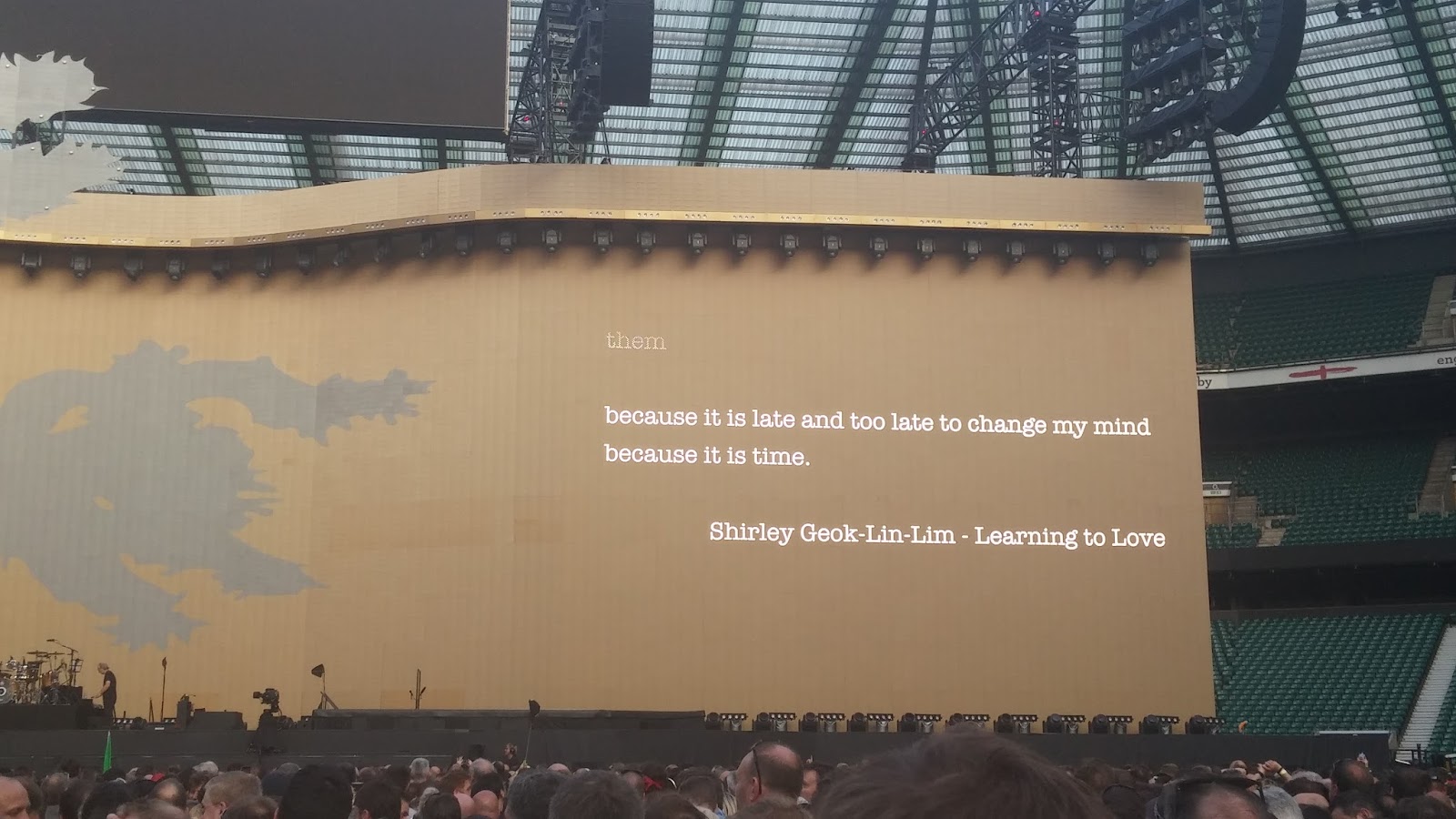
U2's current world tour is, unusually, not to promote a new album - it's for the 30th anniversary of The Joshua Tree and they are playing this album in its entirety, along with other songs before and after. I saw them last Sunday at Twickenham Stadium in London. It was a remarkable show for many reasons, not least of which was the screening of poems on the stage backdrop just before the show actually started.
I have a long history with U2, which sort of started close to 30 years ago when my brother bought The Joshua Tree. But it really started a few years later when I bought War, Under a Blood Red Sky, The Unforgettable Fire and later their other albums, when I was about 14. Those albums feature very prominently in my mental and emotional timeline from my early teens. I discovered those albums for myself, and the obsession was like falling in love. My relationship with The Joshua Tree is probably a bit harder to define, as I first encountered it through my brother and through the radio when I was younger. I was always impressed, but I also regarded the album with a slightly detached sense of awe which I've never quite shaken. I think it's their best record, but I'm not quite as closely bonded to it as I am to albums like War and Unforgettable Fire. I'm perhaps closer to its individual songs than I am to The Joshua Tree as a whole.
Before seeing U2 play on Sunday, I was already aware that they were scrolling poems on the big screen during the intermission between the opening act and the start of the main show. There was a fair amount of media coverage in Canada when one of the poems chosen was by Canadian poet laureate George Elliott Clarke. However, most (if not all) of the other poems chosen are by Americans, and it seems that different poems have been used at different shows. The poems that I saw were:
Elizabeth Alexander - 'Praise Song for the Day'. This poem was read at Barack Obama's inauguration.
Walt Whitman - a selection from Leaves of Grass
Sherman Alexie - 'The Powwow at the End of the World'
Robinson Jeffers - 'Juan Higera Creek'
James Dickey - 'The Strength of Fields'
Shirley Geok-lin Lim - 'Learning to Love America' (this is actually the poem's full title, although it said 'Learning to Love' on the screen).
Pedro Pietri - 'Puerto Rican Obituary' (I didn't get a picture of this one, as the show was starting just as the poem finished...)
This U2 website has detailed more of the poems which were included on other shows (or perhaps I missed others when my friend and I were wandering around after the opening act.) Many of these poems will also be available to read online: http://www.u2songs.com/news/the_joshua_tree_tour_poetry
Personally, I was especially surprised and happy to see the Robinson Jeffers poem 'Juan Higera Creek'. Jeffers has been a bit of a well-kept secret for a long time, but in the current socio-political-environmental climate he seems to be enjoying something of a renaissance. I also love the James Dickey poem, 'The Strength of Fields'.
I don't know who was involved in selecting the poems, but to accompany (or precede) The Joshua Tree, they seemed to me exceptionally well chosen. In them, I saw the following which I also find in The Joshua Tree:
A variety of voices and experiences, including those of minorities and immigrants. The poems are by Native Americans, African Americans, Asian Americans and Hispanic Americans, among others. U2 composed The Joshua Tree in part because they'd fallen in love with America, and as Irish musicians they were well aware of their country's close links to America and of the huge numbers of Americans who are descended from Irish immigrants.
American landscapes. The landscapes of The Joshua Tree are dual (at least), as in poetry's landscapes. When U2 played 'Where the Streets Have No Name' ("I'll show you a place high on a desert plain, where the streets have no name"), the huge backdrop screen sent us flying along an American desert highway. The song was also partly inspired by Bono's humanitarian work in Ethiopia and by the divisions in Northern Ireland when he was growing up; finally, it seems to be about the speaker's spiritual quest (continued in 'I Still Haven't Found What I'm Looking For'. There seems to be something of this in 'The Strength of Fields'.) But the imagery of the album's lyrics often evoke idealised American landscapes, especially in the song 'In God's Country'. These poems also travel all over a real and figurative America.
Stories of oppression. 'Puerto Rican Obituary' came out of Pedro Pietri's experiences in advocating for civil rights along with fellow Puerto Ricans in America, and it tells a series of tragic stories. The songs 'Bullet the Blue Sky' and 'Mothers of the Disappeared', in particular, are about US military intervention in Latin America and about los desaparecidos in countries such as Argentina, Chile and El Salvador. There is a strong duality in The Joshua Tree between a mythical America and a violent one, whether internationally or closer to home (the song 'Exit' is about gun violence, and apparently the line "The hands that build can also pull down" also comments on the dual nature of US interference abroad).
The language of the poems may at times be prosaic, but the impression is often prophetic and spiritual, even shamanistic. This is also very reminiscent of U2's (Bono's) lyrical approach. Bono often includes literary references in his songs, and this was definitely a factor in my affection for U2, especially given that I was falling in love with U2 and with the poetry of WB Yeats at the same time in my early teens. Here are some of the notable poetry references in U2 songs:
- "Into the half-light" - from 'Bad' (The Unforgettable Fire), also a reference to 'He Wishes for the Cloths of Heaven' by Yeats
- 'A Sort of Homecoming' (The Unforgettable Fire). The title of one of my favourite U2 songs is taken from the quotation "Poetry is a sort of homecoming" from Paul Celan's 'Meridian' speech. When I learned that Bono had been influenced by Celan's writings in this song, I went to find Celan in the library, meaning that U2 are directly responsible for introducing me to his work. Also in 'A Sort of Homecoming', Bono sings 'O come away, o come away' which is a likely reference to 'The Stolen Child' by Yeats.
- "In the world a heart of darkness, a fire zone/where poets speak their heart then bleed for it/Jara sang his song, a weapon in the hands of love/You know his blood still cries from the ground" - from 'One Tree Hill' (The Joshua Tree). Victor Jara was a Chilean songwriter, poet and political activist who was murdered under the rule of Pinochet. His last lyric was 'Estadio Chile' and it was written just before his violent death in the Chile Stadium (which has been renamed after him.)
- "See the stone set in your eyes" - from 'With Or Without You' (The Joshua Tree). This reminds me of "The stone's in the midst of all", from Yeats's 'Easter 1916', but I admit this may be a long shot on my part.
- "In dreams begin responsibilities" - from 'Acrobat' (Achtung Baby). This is adapted from the epigraph to the Yeats collection Responsibilities.
- "Hope and history don't rhyme" - from 'Peace on Earth' (All That You Can't Leave Behind), a song partly based on the Omagh bombing of 1998 by the so-called Real IRA. This line is adapted from a famous quotation in Seamus Heaney's The Cure at Troy, a version of Philoctetes by Sophocles. Bono spoke here of his love for Heaney's work: https://www.theguardian.com/books/2013/sep/01/bono-seamus-heaney-tribute-poetry
There are plenty of other literary references in U2, but I suppose it comes down to this: Sunday's concert was one of the best of my life (the fact that we had hard-to-come-by standing tickets helped a lot), and The Joshua Tree has more than stood the test of time. It was lovely to see some great poetry projected on the screen for all to read, and to reflect on how both poetry and U2 have accompanied me, and often intersected, for a very long time.
Photos: The Joshua Tree Tour - Twickenham, July 9, 2017. Taken by Clarissa Aykroyd
Sunday, 11 June 2017
Poets and Spies at London's City Lit
City Lit, London, 1940
Earlier this year, I took an InDesign course for my work. It was at City Lit college in central London, near Holborn station. I hadn't thought much about the type of institution where I'd be brushing up my InDesign skills for a few weeks - but when I arrived for my first class, I was impressed at the range of classes taking place at the same time as mine, and also a little jealous of the people who were taking Basic Danish or Biblical Hebrew. The floor where my classroom was located seemed to have a good deal of painting and sculpture going on.
When I looked up further details about City Lit (mainly in the history section of their website) I discovered that they had originally been established in 1919 by the London County Council as a "literary institute", along with several others around the city. Essentially, these were non-vocational colleges (but not universities) where students could take humanities courses and the like, without committing to something like a degree program.
The website provides more details about the fascinating history of this institution, but I was very taken with the fact that their teachers and lecturers included the likes of Edith Sitwell, TS Eliot, Cecil Day-Lewis and Dylan Thomas, among others. When their new building opened in 1939, John Masefield (then Poet Laureate) did the honours.
The moral of the story is that in London, if you scratch just the tiniest bit beneath the surface, you'll probably receive disproportionate rewards, and they might include poetry. I also ran into a bit of synchronicity at this point. Around when I was taking the InDesign course, I was reading A Colder War, the second volume of a trilogy by spy novelist Charles Cumming. The trilogy features disgraced spy Thomas Kell, who desperately wants to "get back in the game" but has found himself with some time to kill. At one point, he thinks "of the long afternoons he had spent brushing up his Arabic at SOAS, the solo holidays in Lisbon and Beirut, the course he had taken at City Lit in twentieth-century Irish poetry." In other words, when all you think you're doing is taking a desktop publishing course, there are probably some bored spies just around the corner in the same building who hope that poetry might help to fill the slow hours. It also turns out that Thomas Kell enjoys reading Seamus Heaney's The Spirit Level and that he especially likes the poem 'Postscript' (so do I).
Sunday, 26 March 2017
In memory of Derek Walcott, 1930-2017
Derek Walcott, poet and playwright of Saint Lucia, died on 17 March at the age of 87.
I think I recall my first Derek Walcott poem. It was 'The Season of Phantasmal Peace' and I encountered it in a literary criticism class at university. I would have been 18 or 19. I don't remember what we said about this poem, or which angle we approached it from, but I do remember how it looked in my mind and I have some recollection of the sensation. It was a vision of a murmuration of starlings - those strange, almost supernatural flock movements - and the poem came with a sensation of power and lift-off that I found unusual and exhilarating.
I've read Derek Walcott on and off since then. I was at the 2010 TS Eliot Prize readings when he won for White Egrets, but sadly he wasn't present to read (Seamus Heaney was there to read from his own nominated collection, though. How amazing would it have been to see them on the same stage...). I correctly picked him as the winner out of an especially strong field, though. Amongst 20th century poetry, his work just might be the most outstanding example of how to unite far-flung influences. Walcott was mixed-race and as with his background, his writing brought together Caribbean culture, classical literary influences, and the various legacies of colonialism. I think of his poems as being like Rembrandt's paintings, or a seemingly effortless and flawless work of architecture. The craftsmanship is almost too good to be grasped. You just experience something of exceptional depth, beauty and clarity - which also stands up to extremely close analysis, if you want to go there.
Walcott was every bit as good as TS Eliot or Elizabeth Bishop or Seamus Heaney; often better, I think. He is the poet who reminds us that constant attention to craft and openness to the world's variety are powerful things.
Here are a handful of poems to start with, or to go back to.
THE SEA IS HISTORY
THE FIST
SEA CANES
SEA GRAPES
Photo: Derek Walcott, VIII Festival Internacional, 1992. By Jorge Mejia Peralta. Used under Creative Commons license
Saturday, 11 July 2015
Lost People: Derek Mahon's 'A Disused Shed in Co. Wexford'
We are closed (and do not open tomorrow) by Sten Dueland. Used under Creative Commons license.
The 20th anniversary of the Srebrenica massacre, which took place in July 1995 during the Bosnian war, has made me think of the poem 'A Disused Shed in Co. Wexford' by Derek Mahon.
A DISUSED SHED IN CO. WEXFORD (Derek Mahon)
'A Disused Shed in Co. Wexford' has always seemed to me to be a totally unique work of art, and one of the greatest poems of the last century. Recently it was on the shortlist for the RTE-sponsored A Poem for Ireland competition, and although it lost out to Seamus Heaney's 'When All the Others Were Away at Mass', I think it would have been a worthy winner.
This is the ultimate microcosm poem; millenia of hardworking, suffering and lost human beings are drawn down to a sad little colony of mushrooms in a quiet corner of a small Irish county. The construction of the poem is extremely subtle, I think. It opens with a broader view - "Even now there are places where a thought might grow" and glimpses of a "Peruvian mine" and "Indian compounds". But then the view narrows to such an extent that it's as though you are in the shed with the mushrooms.
A thousand mushrooms crowd to a keyhole.
This is the one star in their firmament
Or frames a star within a star.
Ominously, the shed is actually part of a "burnt-out hotel". Is this a glimpse of some post-apocalyptic near future, or at least some local catastrophe?
As I read the poem there is a sense of advancing down a path, increasing clues as to the true nature of the poem. Words such as 'civil war', 'deaths', 'nightmares', 'regime' and 'firing-squad' multiply. The poignancy of the scene is immense, even before the last stanza, when the nature of its message becomes plain.
'A Disused Shed in Co. Wexford' is not just about genocide or man's inhumanity to man; it is more generally about the sadness of human loss and the fact that most human accomplishments, and most individuals, are utterly forgotten. I thought of the poem today, though, because of the line in the last stanza: "Lost people of Treblinka and Pompeii!" This is a terrible cry, wrenched painfully from the speaker, and seeming to sum up so much of the pain of Europe and the world. It's what echoes in my mind as this extraordinary poem draws to a close.
Sunday, 28 June 2015
Poetry and Beyond in the Czech Republic
Prague, May 2015. All photos by Clarissa Aykroyd
A little over a month ago I was in Prague with my brother - we had almost a week together and also visited the nearby towns of Kutna Hora and Plzeň. It was my first time back in the Czech Republic after eleven years. In 2004 my brother was there working with the World Hockey Championships (er, that's 'ice hockey') and we were there for the same reasons again this year. So hockey was on the menu (including Canada slaughtering Russia 6-1 for the gold medal), as well as fairy-tale-like castles and Art Nouveau buildings, all the meat and dumplings I could eat, and even beer (which normally I never touch because I don't like the taste.)
Poetry is never off the menu, and that's especially so in a country like the Czech Republic. We had a tour one day with a man named Milos Curik, who turned out to be absolutely one of the most interesting people I have ever met. He showed us some beautiful and fascinating hidden corners of Prague, which was a good thing because as lovely as Wenceslas Square and Charles Bridge are, they are insanely rammed with tourists. Milos was part of the Beat generation and knew the American poetic icon Lawrence Ferlinghetti, as well as having met Allen Ginsberg and many others. He'd done everything in his life from organising Velvet Underground concerts in Czechoslovakia to studying funerary art - interspersed with many run-ins with the police during Prague's complex history - and he had evidently done it all with panache. Milos showed us a street where Ginsberg had stayed in Prague and told us about how Ginsberg had written the poem 'King of May' after being honoured as such by Czech students in 1965. (He wrote the poem on his flight from Prague to London.) Milos specialises in arts and music tours of Prague, and told us that later this year he will be showing around some poets on a tour of Prague taking in sights related to Seamus Heaney's visits to the city. (Heaney had very strong connections to Central and Eastern European poetry, and I came across this interesting article: http://radio.cz/en/section/books/a-certain-parallel-seamus-heaney-and-the-czechs)
Here are a couple of photos from that tour. The first is of that street where Ginsberg stayed, a semi-hidden but lovely area near the castle:
This is a table and chairs, attached to a tree, featuring a quotation from Vaclav Havel. There are a number of these in different cities now, known as 'Havel's Place'. Of course, Havel was one of the architects of the Velvet Revolution and was the first president after the fall of Communism, but he was also a playwright and, less famously, a poet.
In Kutna Hora, we saw a cathedral with a very unusual 'tent' roof, went down a silver mine, and emerged subdued from the eerily strange Sedlec Ossuary, or bone church. Over the years, Kutna Hora has attracted many poets, writers and artists because of its spooky, romantic atmosphere, and it now has a poetry festival in September. The poet-author of the Czech national anthem was born in this town. Here's a photo of the cathedral:
Plzeň was a real working town with a very interesting depth of history. I was pretty much forced to drink beer there, because of the Pilsner brewery, in whose icy depths we spent some time. We also saw this remarkable mural featuring many famous figures associated with the town's history. In this detail, the young man on the left in the cape is Josef Kajetan Tyl, who lived in the first half of the 19th century. He was another playwright who was also a poet. (Rather wonderfully, it often seems in the Czech Republic as though everyone is also a poet.) Rainer Maria Rilke apparently acknowledged Tyl's influence.
In Plzeň I was also very happy to see this set of characters in the wonderful Puppet Museum (puppetry is very important to the culture of Bohemia.) They were for a Hound of the Baskervilles puppet show, and yes, that's Holmes and Watson at the top!
With thanks to Czech Tourism
Thursday, 9 April 2015
Keith Douglas: 'Caravan'
In a rather tired state, but still wanting to post something tonight, I thought I would share this poem written by Keith Douglas at the age of fifteen. It made an impression on me surpassed only by his much later work.
'Caravan' reminds me of the following: the song 'Secret Journey' by The Police, the poem 'The Disappearing Island' by Seamus Heaney, and some of the more allegorical work of Ursula Le Guin.
CARAVAN (Keith Douglas)
Going beyond the gate they found these men
Sitting in the last light and regarding the great sun
With understanding. And one spoke to them presently,
Saying he had discovered the soul of music
At one time. And another said, that when
The birds flow southwards, heading across the continent,
Then the wild sea, under the always rhythmic
Shutter of wingtips, only suggests to spent
Eyes slanting, the slope of green and mountainous moving
Country; familiar, only no priests in the cities
Handling the cold bronze, counting. The stones in panic
Chilled, the bright dust reflecting the heavens' faces.
Thus he revealed the perfect sources, the lost
Wisdom, seeing only the loved existent;
The clouds flying, Earth stretching in silence
Chameleon, the colours limited, dyes all lost.
All this he told them, speaking the tongue of the swallows.
But they not knowing the words, nor in his hands
Seeing the meaning, went thence over the sands.
1935
Thursday, 22 January 2015
'The Marvel' by Keith Douglas: Ways of Seeing
Wave Curl by Simon Turkas. Used under Creative Commons license
THE MARVEL (Keith Douglas)
A baron of the sea, the great tropic
swordfish, spreadeagled on the thirsty deck
where sailors killed him, in the bright Pacific
yielded to the sharp enquiring blade
the eye which guided him and found his prey
in the dim country where he was a lord;
which is an instrument forged in semi-darkness
yet taken from the corpse of this strong traveller
becomes a powerful enlarging glass
reflecting the unusual sun's heat.
With it a sailor writes on the hot wood
the name of a harlot in his last port.
For it is one most curious device
of many, kept by the interesting waves -
and I suppose the querulous soft voice
of mariners who rotted into ghosts
digested by the gluttonous tides
could recount many. Let them be your hosts
and take you where their forgotten ships lie
with fishes going over the tall masts -
all this emerges from the burning eye.
And to engrave that word the sun goes through
with the power of the sea,
writing her name and a marvel too.
Linney Head, Wales, [May] 1941
In 1991, Seamus Heaney gave a lecture on Keith Douglas at Poets House in New York. Not only that, but you can listen to a full recording of the lecture here. I am only slightly exaggerating when I say that I nearly fell over when I discovered this recording - one of my most beloved poets speaking about one of my other most beloved (and much less famous) poets...
Early in the lecture, Heaney reads 'The Marvel' and calls it a poem "which seems to arrive from nowhere". After reading it he says "It has a certain Noli me tangere stride to it... It just walks in." I love that, and what a compliment! He also comments on the tension in the poem between the intellectual and the visceral, between aristocracy and brutality, which is very Douglas. The whole lecture is wonderful and if you appreciate Heaney, or Douglas, or especially both, you must listen to it.
My own take on this poem is that it's another riff on Douglas's obsession with seeing. I suppose that ways of seeing are the currency of poets. A poet is always looking for an alternative angle. But the array of angles and perspectives in 'The Marvel' is dizzying. In the space of a few lines, Douglas sees (most literally) through the eye of the great fish hunting its prey; through the written word and the implications of the sailor using the eye as a magnifying glass to write the "harlot's" name on the deck; through the eye of the sun itself and the power of the natural world; through the gaze of the drowned at "fishes going over the tall masts"... There is something hallucinatory but also very concrete about it.
This may be a strange comparison but when I re-read the poem this time I was suddenly reminded of Las Meninas, the painting by the great Diego Velázquez. The subjects of the poem and the painting may have nothing in common, but they are both masterpieces about physical and spiritual angles on vision, and the relationships between the viewer and the viewed.
Tuesday, 25 March 2014
In Print: Pre-Raphaelite Poetry and The Gathering Poem
Edward Burne-Jones, The Beguiling of Merlin, 1874.
I've recently had a couple of poems (or lines, as you'll see) published in print, which is a special thrill undiminished by all the amazing things poetry is doing on the Internet these days.
Some time ago I entered the second Pre-Raphaelite Society Poetry Contest, and while I didn't win anything, my poem was selected as one of a number of entries to appear in a collection, Pre-Raphaelite Poetry II. It is a poem called 'Merlin' which I wrote when I was about 21 and which was based on The Beguiling of Merlin by Edward Burne-Jones - which also happens to be the painting which I chose as the logo for this blog. My Arthurian obsession, which has since receded somewhat, was still at its peak then. I feel as though things have come full circle with the publication of this poem. You can read more about the collection and buy it here.
The other publication, though my contribution was small, is quite exciting. In 2013, Irish tourism institutions organised The Gathering, a year-long celebration of Irish culture in Ireland which also encouraged those with Irish roots, or a love of Ireland, to visit the country. I am not doing particularly well in that respect these days because although I have a partly Irish background and used to live there, I haven't visited for several years. However, I was interested to learn of The Gathering Poem, an initiative to create a poem "about Ireland and by the people of Ireland" by collecting contributions of lines of poetry and then editing them into a single poem. I submitted a few lines and to my delight, two lines were among those chosen. While there were thousands of submissions, the final poem was only fifty lines long and there were fewer than forty contributors, so it was quite an honour to be chosen. It has now been published in a beautiful little book, which also includes other selected lines, comments about the project and so on, and you can buy it on the website. Only a few months before his death, Seamus Heaney called the idea of The Gathering Poem "a vision with vision". It's nice to have given something back to Ireland, especially in poetry form.
Sunday, 24 November 2013
The Saison Poetry Library Open Day: Poetry in Performance
With permission of The Saison Poetry Library
A week ago I went to this year's Open Day for the Saison Poetry Library at London's Southbank.
The theme was Poetry in Performance, and the organisers brought together some fascinating strands of that theme: not just the concept of poetry readings, but permutations such as poetry as music (focusing on the work of Leonard Cohen), historic recordings of Tennyson and Browning (here referred to as "The Victorians: Those Gods of Slam"), automatic writing, books and poetry as art, actors reading poems...the list goes on.
The displays made a great space for browsing, leafing, listening and enjoying. I signed the Seamus Heaney book of condolences, pored over a wonderful-looking long poem from 1981 called Fox Running by Ken Smith, and marvelled at the very crackly recording of Tennyson reading 'The Charge of the Light Brigade'. Although no recordings of Gerard Manley Hopkins were ever made, librarian Chris McCabe pointed out in his writeup: "Hopkins' art was led by his instinct and an inversely atavistic desire to listen to what poetry from the future might sound like. Through listening to himself he was expressing all that he strongly felt that poetry could be." In the section on Comedian Poets, digital co-ordinator Chrissy Williams noted: "It's often prompted by deliberately boisterous or comical performers, but we've heard distinguished poet Geoffrey Hill's banter between poems drawing hearty laughter in the past."
There was also a very interesting section on the ghazal, the great Persian/Arabic/Indian form, which has arrived in the West through writers such as Adrienne Rich, W S Merwin, Marilyn Hacker and Mimi Khalvati, and stayed closer to its origins in the work of the great twentieth-century Pakistani poet Faiz Ahmed Faiz. Finally, I saw collections and books which pushed the poetry-as-visual-art to its utmost limits, bringing in daring reflections on censorship and design.
In the evening, there were readings by Claire Crowther, Charlotte Higgins and Linus Slug: Insect Librarian, all of which were adventurous with the poetry-in-performance concept, whether sonically, or in terms of theme or style.
I'm already looking forward to next year's Open Day. Here are a few photos:
Ron King, ‘Alphabeta Concertina’ (Circle Press, 2007), with permission of The Saison Poetry Library
Mette-Sofie D. Ambeck, ‘Dust to Dust’ (Ambeck, 2012), with permission of The Saison Poetry Library
With permission of The Saison Poetry Library
Sunday, 13 October 2013
Spain and Poetry 3: Cosmopoética: Almost Attending Cordoba's International Poetry Festival
This post is something of an addendum to the previous post.
While the poets of past decades and centuries make for wonderful encounters while travelling, it's good to know that contemporary poetry is also alive and dynamic. This happened to me quite unexpectedly in Cordoba.
M and I were crossing the Roman Bridge in Cordoba, and looking back at the wonderful views of the Mezquita and city, when we came across this:
Imagine my delight when it turned out that this lovely man with an umbrella was advertising Cosmopoética - "Poets of the World in Cordoba". The next day, we found this at what I think may have been one of the festival's venues:
Our time in Cordoba was quite short (and we were distracted by things like unexpected horse shows and The Street of the Handsome Waiters), and sadly I didn't have time to actually check out the festival. It started in 2004 and has not only featured outstanding Spanish poets, but also the likes of Dario Fo and Seamus Heaney. The festival focuses on poetry, but also features a great deal of music, theatre, flamenco, and other artistic disciplines. It sounds great, and I'm both happy that I stumbled across the man with the umbrella, and sad that I couldn't take part.
When I returned to England and checked out Cosmopoética's Facebook page, the festival was in its last few days. Right at the end, I noted that at least one event had been held in the Hall of the Mosaics, in the city's Alcazar, which we had visited. Seeing poetry enthusiasts in a room where we'd marvelled at ancient Roman mosaics a short time previously gave me the feeling of belonging to an international poetry community.
All photos © Clarissa Aykroyd, 2013
Monday, 2 September 2013
Beyond Silence Listened For: Seamus Heaney 1939-2013
Seamus Heaney at University College Dublin, 2009. Photo by Sean O'Connor
When on Friday I saw the news on my Facebook feed that Seamus Heaney had died, I first thought I'd seen wrong, then felt shock, then realised I was going to cry. All day on Facebook and elsewhere I saw similar responses from poets and poetry lovers, along with countless news stories from around the world, comments from students who said that Heaney had kindled in them a love for poetry or that they didn't really like poetry but they hadn't minded studying his - and on, and on. His death was one of the top stories on the Guardian and BBC websites. In Ireland, as well as worldwide, many public figures commented on their sense of sadness and shock, along with the general public. There was a good deal of shock; he was only 74 and while the last time I saw him read was over a year ago, some had seen him at events only a week or two ago. And there were so many poets, students and others who'd had personal encounters, and long-time friends - everyone so sad, especially friends, even those who didn't know him personally.
So much has been said already but I just wanted to say a little about Heaney's importance in my poetic life. He may very well have been the first contemporary living poet who I remember knowing of by name. I remember reading 'The Tollund Man' when I was fairly young - I would guess, between 12 and 14. At the time I think it was unlike any other poem I had read and it still carries this sort of aura, of at least a faint astonishment of my young self. It was at one and the same time personal and historical, physically evocative and disturbing, and relatable. There was just something that was different about it. I had similar experiences with 'The Otter' and 'The Skunk', though with their very different subject matters.
Later, my favourite Heaney poems have included 'The Toome Road', 'The Strand at Lough Beg', 'Act of Union', 'District and Circle', and of course 'The Underground'. Some of his poems gave me a further insight into the beauty and wounds of Ireland, my adopted country for a few years. Others left lines echoing through me, lines which continue to do so regularly, for years: "Let me sleep on your breast to the airport" ('Wedding Day'), "Lost for its sunlit hills" ('Out of Shot').
I was able to go to his readings three times. In fact, I attended the T S Eliot Prize reading where he was nominated (and won) for District and Circle, but he was unable to appear due to his recent stroke, which was disappointing and worrying. I finally saw him in 2010 (I think?) at Southbank for the release of Human Chain, again at the readings for the 2010 T S Eliot Prize (at the start of 2011), and finally at Poetry Parnassus a little over a year ago. His reading voice was beautiful and unpretentious. He was low-key, interesting and very witty, with a very kindly air. The first time I saw him, he concluded with 'Postscript' and I think I cried. I so badly wanted him to read that poem, possibly my favourite of his works. I just regret that at none of these readings I queued up or tracked him down for a book signing, though I think the T S Eliot reading might have been the only opportunity. Even a very short meeting would have been nice. Like so many, I think I assumed that I would have another chance, that he would be around for much longer. Everyone who ever met him has spoken of his kindness, including a friend who randomly spoke with him in Belfast years ago and only later found out that he was a famous poet.
All I really wanted to say was this: Seamus Heaney, your poetry changed our lives, for a lot of us at least a little, for some a lot. I'm so glad I was able to attend your readings three times but I'm sad that I never met you and I'm very sad that you're gone. We will miss you a lot and it's wonderful that your amazing verse is still with us.
Here is 'Postscript', a poem which will always be in my heart - a heart this week "caught off guard and blown open."
POSTSCRIPT (Seamus Heaney)
Monday, 14 January 2013
The T S Eliot Prize for 2012: Same Shirt, Different Trousers
On Sunday night, I attended the T S Eliot Prize readings for the best 2012 poetry collection, at the Royal Festival Hall on London's Southbank. Apparently there were over 2000 in attendance.
I thought that this year's lineup was exceptional, and I will write more about that, and about the evening. First, though, I started to reflect on my own history (such as it is) with the T S Eliot Prize. It turns out that I have now attended the readings five times, in my seven and a half years in London. This will be the twentieth time that the prize has been awarded.
The first two readings which I attended were in 2007 and 2008, and they were still at the Bloomsbury Theatre, which meant that attendance would have been around 500. Three years ago, the T S Eliot Prize took an enormous leap forward when it took over the Royal Festival Hall for the readings, and (so far) they have been there ever since. I'm not sure what happened in the interim; poetry became much more fashionable, or the 2011 reading with Seamus Heaney in attendance gave the event a big push...or something. I have mixed feelings about the change. Basically it is a wonderful thing for poetry, but those first two times at the Bloomsbury felt like something truly unique and special, as though I'd been admitted to an exclusive club. (I realise that saying this won't help with the niche/ivory tower reputation of poetry consumption, but it's still true.) This was even though at the time I didn't quite realise how significant the T S Eliot Prize was. Many consider it to be the world's most important poetry prize.
My first T S Eliot Prize reading was in January 2007, for the 2006 collections. This was the year that Seamus Heaney won for District and Circle, but sadly he couldn't be in attendance as he had just suffered a minor stroke. I remember being quite disappointed by that (and worried!), but I have since managed to see him read three times; once when his collection Human Chain was released, once for the 2010 prize (when he was beaten by Derek Walcott's White Egrets, one of my favourite collections by anyone ever), and once at Poetry Parnassus in 2012.
I certainly have a few piercing memories of the evening, though, one of which is of Sean O'Brien reading Eliot's 'Marina' ("What seas what shores what grey rocks and what islands..."). I wasn't very familiar with the poem at the time and it has since become one of my favourite poems. I will never forget that moment. It was either the same year or the following year, also at the Bloomsbury, that I realised that Valerie Eliot (T S Eliot's widow) was sitting in the row right behind me. I managed to not to stare at her like a ninny, but I definitely quivered a bit.
Last year I felt that the event was dominated by the controversy over Aurum's sponsorship of the prize, and I didn't think that the list of nominees was so outstanding. At least, the readings didn't make as much of an impression on me as they sometimes have. My personal choice for the winner would have been David Harsent for Night - I find his work quite amazing - but the winner was John Burnside. It was a good shortlist, but perhaps not great.
This year, however, the lineup wasn't just outstanding - it was really exceptional, perhaps the best I have experienced. (Although I hesitate to say that when two years ago both Heaney and Walcott were on the list.) I was already familiar with a few of the collections, but a few more in particular were revelations to me in the course of the evening.
Carol Ann Duffy introduced the readings, and as is traditional, she read a poem by Eliot. It was at this point that she paid tribute to Valerie Eliot, who died a few months ago, and who did so much for the Prize, and for Eliot's legacy and poetry in general. The poem chosen was 'Dedication To My Wife', most appropriately, and it was a very moving moment.
The host was poet and broadcaster Ian McMillan, who to me always seems just on the verge of losing the plot and then turns out to be terribly funny after all. I particularly enjoyed "I realised that I'm wearing the same shirt as I did at last year's readings, but I've changed my trousers. And that's like modern poetry. Continuity and change," as well as his comment that the readings from each poet would last about eight minutes "and they'll feel like longer, but in a good way."
The shortlist was as follows:
Gillian Clarke - Ice
Sean Borodale - Bee Journal
Julia Copus - The World's Two Smallest Humans
Jorie Graham - PLACE
Simon Armitage - The Death of King Arthur
Kathleen Jamie - The Overhaul
Jacob Polley - The Havocs
Deryn Rees-Jones - Burying the Wren
Paul Farley - The Dark Film
Sharon Olds - Stag's Leap
In brief: Gillian Clarke's images of snow and cold and myth build instant and complex ice palaces in my mind. Sean Borodale's bee poems (these seem to be fashionable in recent years) were tasty and evocative and he also had pretty great cheekbones. Julia Copus read a poem about her brothers which just about had me in tears. Jorie Graham couldn't be present to read but her publisher did a very credible job with her long lines and amazing stream-of-consciousness - at the end of 'Lull', I felt as though I'd been hypnotized and was waiting to be woken with a snap of the fingers. Simon Armitage gave a forceful reading of his adopted Arthurian tale, as well as a great argument for its modern relevance. Kathleen Jamie's nature poems, especially her small charming flower poem, were pretty much flawless. Jacob Polley gained the only spontaneous applause of the evening for the creepy 'Langley Lane' and I think he may have been the people's choice. Deryn Rees-Jones read her long and disturbing 'Dogwoman' sequence with incredible conviction and cumulative force. Paul Farley was fascinating and funny - I especially love 'Google Earth', and the poem about the Queen got the biggest laugh. Finally, Sharon Olds had everyone dumbstruck with the honesty and precision of her poems about divorce.
I managed to get several books signed afterwards, which was great. Chatting with Simon Armitage about Arthuriana was lovely. Paul Farley was definitely a bit hammered by the time I got to him, and thanked me with intense sincerity for coming. I said jokingly "you must be a bit tired of signing all these books." He looked me straight in the eye: "NO! NO, I AM NOT TIRED OF IT." I then realised that, a bit ominously, he had signed my copy "Clarissa's best love to Paul Farley" (at least I think that's what it says.)
I also bumped into George Szirtes and his wife Clarissa (yes!) - it was great to see them again so soon after George's reading in London in December, and to chat briefly. I'm sure I must have walked past a few dozen (if not a few hundred) well-known poets and bloggers, but I definitely recognised Daljit Nagra. And when I was getting my books signed, I realised that I was standing ten feet from Robin Robertson. I have had a creepy fascination with Robin Robertson ever since I worked for the publishing house where he is an editor, and our paths do seem to cross with mysterious regularity. (Stalker!)
As this post goes to press (or whatever), it has been announced that Sharon Olds is this year's winner. I'm very happy to hear it - she was probably my first choice. But honestly, on a list that strong pretty much anyone could have won and there could have been few complaints. I'm hoping for another T S Eliot Prize as impressive in a year's time.
Friday, 11 January 2013
Thomas, Frost, Farjeon: The Dark Earth and the Light Sky
"He looks on English things impatiently, but also as a lover might look upon his beloved for the last time. He seems always conscious that a world is coming to an end, though he never says so, it is his tone and it is the tone of his poems; which has taken us fifty years to hear." (P J Kavanagh)
"He is the father of us all." (Ted Hughes)
Last night I went to see The Dark Earth and the Light Sky, a play at Islington's Almeida Theatre about World War I poet Edward Thomas (Pip Carter), his great friends and poets Robert Frost (Shaun Dooley) and Eleanor Farjeon (Pandora Colin), and his wife Helen Thomas (Hattie Morahan). It was written by Nick Dear and directed by Richard Eyre. The play is just ending its world premiere run in London, and it has been extremely well reviewed. I found it to be one of the most powerful and moving plays I have seen in the last few years.
I think the first poem I read by Thomas was probably 'Rain', and probably some years ago. While beautifully written, it remains one of the most suicidally depressing poems I have ever read, and it didn't exactly encourage me to read on in his body of work. However, his name is one which recurs the more you delve into English and British poetry. Witness the quotation from Ted Hughes, above. Many great poets, including the likes of Dylan Thomas, Auden, and Heaney, cite him as an enormous influence, or even a catalyst for their own writing. At the same time, he is not exactly a household name, although I think he is now being studied for GCSEs or A-levels (unfortunately, this may not endear him to a future generation of young readers.)
I booked my ticket for The Dark Earth and the Light Sky several weeks ago, when I realised that it was a) about poetry and poets, and b) was likely to sell out because of how well it has been received and because the Almeida is a small theatre. I gradually, started reading a few more of his poems, and discovered that my initial impressions of him were very limited and rather inaccurate. I had seen him as a poet very much of his time, and mainly pastoral. (I also knew that while he was considered a "war poet", and he died in the war, his poems weren't mostly about the war.)
What I found when I actually bothered to read the poems properly was that Thomas was indeed heavily influenced by the pastoral, and in many ways his language was of its time. However, the shifting perspectives and emotions, the dreamlike blurring of times and places - these are all very modern, very powerful, and sometimes rather shocking. You may start reading one of his poems thinking that it's a nice but slightly depressing piece about the countryside; only to end up gasping for breath, sucker punched by a daring but accurate emotional shift, or a perceptive leap which you would never have thought of but which rings entirely true.
The words "extreme vision" came into my mind when I read some of his poems. He pushes the possibilities of what I would call the "alternative seeing" that poets possess, to their uttermost limits. English poet and critic John Lehmann called it an "intensity of vision" which outstripped that of most of his contemporaries. He chose to write with a vocabulary and apparatus of maps and places. Robert Macfarlane wrote: "To Thomas, paths connected real places but they also led outwards to metaphysics, backwards to history and inwards to the self. These traverses - between the conceptual, the spectral and the personal - occur often without signage in his writing, and are among its most characteristic events."
The Dark Earth and the Light Sky also employed shifting perspectives. We don't hear much of Thomas's own interior dialogue, except when he addresses the mysterious "other man" who seems to have governed some of his most important decisions. We see Thomas through the eyes of his passionate wife Helen, who loved him unconditionally and was nearly destroyed by the coldness and animosity which were part of his ongoing depression. These scenes were often painful to watch, as was the confrontation between Helen Thomas and Robert Frost, who felt that Helen had betrayed her husband's memory in her frank memoirs. Frost mainly saw Thomas as a remarkable poetic talent, but also reflected on his depression and said: "He didn't want to die, but he didn't want to not die." The shape of their friendship was carefully depicted in only a relatively small number of scenes. I was astonished by how much of the play involved discussion of the craft of poetry. Thomas, consumed by self-loathing, was convinced he couldn't write; Frost encouraged him by pointing to his remarkable nascent talent, and describing poetry as essential, more important than the patriotism engendered by the war, "a momentary stay against confusion." Meanwhile, Eleanor Farjeon nursed an unrequited (?) crush on Thomas and delighted the audience with her vivacity. The interactions between these individuals and Thomas, and their direct addresses to the audience about the man they knew, build up a more complete, rounded picture of a poet who still remains elusive in many ways.
Thomas constantly looked back to pre-industrial times, and found himself trapped between a desire for the pastoral ("I remember when there was lavender on Lavender Hill," he says to his uncomprehending father) and a drive to become engaged with the real world, to prove himself worthy of England, to become "a conscious Englishman." This was what led him to enlist, at least in part. The scene where Helen and Eleanor go through Thomas's effects after his death at Arras in 1917 had me and, I think, much of the audience in tears.
The staging was very bare, but effective. One of the reviews I read suggested that in many respects this was a play that shouldn't have worked particularly well, certainly in structural terms, but worked extraordinarily well.
At the end of the play, Thomas steps forward and speaks this poem.
LIGHTS OUT (Edward Thomas)
I have come to the borders of sleep,
The unfathomable deep
Forest where all must lose
Their way, however straight,
Or winding, soon or late;
They cannot choose.
Many a road and track
That, since the dawn's first crack,
Up to the forest brink,
Deceived the travellers,
Suddenly now blurs,
And in they sink.
Here love ends,
Despair, ambition ends;
All pleasure and all trouble,
Although most sweet or bitter,
Here ends in sleep that is sweeter
Than tasks most noble.
There is not any book
Or face of dearest look
That I would not turn from now
To go into the unknown
I must enter, and leave, alone,
I know not how.
The tall forest towers;
Its cloudy foliage lowers
Ahead, shelf above shelf;
Its silence I hear and obey
That I may lose my way
And myself.
Thursday, 13 September 2012
Seamus Heaney, David Harsent, and Weird Poetry Men Write For Their Wives
Tonight I went to a lecture by David Harsent on the poetry of Seamus Heaney. It is part of a series where writers speak about writers who have their portrait in the National Portrait Gallery. (Apparently David Harsent does, as well, although there was a slight ripple of laughter when the woman introducing Harsent said "...although his portrait is not on display right now." Harsent looked unfazed.)
Harsent focused in on female figures in Heaney's poetry, from his mother and aunts to his wife. I enjoyed the lecture partly because it was a mix of poems I knew well - 'Mossbawn: Sunlight', 'The Skunk' - and some I hardly knew, including 'Summer Home'. The latter is a really interesting portrait of a marriage under considerable strain while on holiday, which isn't really Heaney's usual territory. (I actually feel that Heaney just seems like a pretty normal man with pretty normal interpersonal relationships.)
MOSSBAWN: SUNLIGHT (Seamus Heaney)
I liked Harsent's close reading of this poem, its quiet inaction but also the reverence with which it moves across the ordinary-but-strange impressions of childhood, anchored by the ordinary-but-archetypal image of his aunt. You can see the sunlight touching the poem's objects, and the hands of his aunt.
The arc of the lecture travelled from 'Summer Home' to 'The Skunk', a poem I've loved for a long time. I think I read it shortly after reading 'The Otter', which is a similar strange, beguiling, erotic poem about his wife, pivoting on an animal image. I was probably in junior high when I first read these and they have always delighted me, but they are also pretty weird. I wonder what Heaney's wife thought when he showed them to her. 'The Skunk' is about romance revived by distance and by strange, intense mental and emotional connections.
It all came back to me last night, stirred
By the sootfall of your things at bedtime,
Your head-down, tail-up hunt in a bottom drawer
For the black plunge-line nightdress.
(from 'The Skunk', Seamus Heaney)
Speaking of strange love poems, I was reminded of the supremely disturbing 'Spatchcock', one of David Harsent's own poems.
SPATCHCOCK (David Harsent)
David Harsent would have to be one of my favourite contemporary British poets. I've heard him read his superb poems about bees at a special event on that very subject, and most recently he read at the T S Eliot Prize event for 2012 - I was hoping he would win (he didn't, but for what it's worth I think he should have.)
The first time I heard him read was a few years ago, and I think it was at a Poetry London event. One of the poems which he read was 'Spatchcock'. In all honesty, poetry readings sometimes aren't that interesting. The poets are not always the best presenters of their own poems and sometimes the poems are a little too accomplished, reserved and emotionally dry to take me much anywhere. (That is partly why free wine is often provided, I am sure.) However, when David Harsent started reading 'Spatchcock' I think every jaw in the house went slightly slack and every eye widened at least a little. I was frankly shocked at first, before I could see where he was going with it (I had not read the poem before hearing it, and I was unfamiliar with the word 'spatchcock' - I think it's more English than North American.) Then I was faintly amused; but in any case, the power of the poem didn't leave me and it led me on to some of his other work - including the brilliant Night collection, which was shortlisted for the T S Eliot Prize. Again, I have to wonder what his wife thought when she read 'Spatchcock'. Honestly, some poets...
Sunday, 5 August 2012
P K Page's 'Stories of Snow': "Where Silent, Unrefractive Whiteness Lies"
A non-definitive list of the ten poems which have been particularly significant in inviting me into the world of modern, almost-modern, post-modern and contemporary poetry would likely include the following:
Byzantium (W B Yeats)
The Waste Land (T S Eliot)
Foal (Vernon Watkins)
The Convergence of the Twain (Thomas Hardy)
Homecoming (Paul Celan)
At the Quinte Hotel (Al Purdy)
The Tollund Man (Seamus Heaney)
Bagpipe Music (Louis MacNeice)
The Shadow of Cain (Edith Sitwell)
Stories of Snow (P K Page)
I've written about some of these before, and they could probably all be an essay in themselves. To use one of my favourite over-used words, it is a pretty random list. Poems discovered by chance, poems studied in high school or university, poems which I wasn't sure I liked at the time but which ultimately took on greater meaning, poems I heard read by the poet themself (T S Eliot, I wish! In this case, Al Purdy), poems which led me on to poems I preferred by the same poet...and so on.
I've written before about the modern Canadian poetry class which I took in university and which turned out to be very pivotal in my literary life. Among other significant moments, I discovered P K Page in this class, and that was hugely important for me. 'Stories of Snow' can lay claim to being one of the greatest Canadian poems of all time, and simply a great poem, and you can read it here. (Due to the way the poem is reproduced, be prepared to page over a couple of times - it's a long-ish poem.)
STORIES OF SNOW (P K Page)
The Canadian landscape, the landscape of the West Coast rainforest I grew up in, the tropics, Northern Europe - all of these are invoked. More than this, these are emotional and metaphoric landscapes, snowy and blossoming worlds of poetry.
In that forwards/backwards/memory/premonition way which I've come to recognise, it seems as though this poem ties in with my Antarctic fascination (although that came a little later than my first reading of this poem). In the end, the reader is invited to "unlock/the colour with its complement and go/through to the area behind the eyes/where silent, unrefractive whiteness lies." P K Page was also a talented artist, and her poems are often powerfully visual, so there is an element of artistic curiosity and exploration here.
I feel, though, that these are mainly emotional landscapes and that this has something to do with my metaphoric/semi-realistic desire to escape the twittering and the human difficulty of the modern world and to go to Antarctica - somewhere more peaceful, where access to what is truly important becomes more direct and less encumbered. "Souvenir of some never nether land": this could be ancestral memory, too, or something that I'd pass on if I ever had descendants; again, forwards/backwards/memory/premonition. I'm just waiting to find out that I had an ancestor who went to Antarctica, though I would likely have heard about it by now.
The painting is by Akseli Gallen-Kallela, the magnificent Finnish artist.
Monday, 2 July 2012
Poetry Parnassus on Friday and Saturday: Lost Geographers, Shifting Continents, Poetic Emergencies and Revolution
Poetry Parnassus, this past week at London's Southbank Centre, was a really extraordinary experience and one which I wish hadn't come to an end quite so soon. I took in a good many events, but I wish that I could have somehow gone to even more, or all of them...
On Friday, I spent about half the day at the festival. My first event was the Geography For The Lost workshop with Bulgaria's Kapka Kassabova. I'd chosen this because poetry of travel and place is one of my chief enthusiasms and the prime inspiration for a lot of my own writing. I wanted to find different ways to approach this kind of writing, and the workshop was really stimulating. We read a variety of poems and approached travel poetry as descriptions of place, as reflections of relationships, and so on. It was encouraging to see what a variety of people had joined this small workshop, too - maybe unsurprisingly given its nature, between us we'd been born on or lived on virtually every continent.
The star event of Poetry Parnassus was in the evening - Continental Shift, featuring the following poets:
Wole Soyinka (Nigeria)
Seamus Heaney (Ireland)
Bill Manhire (New Zealand)
Kay Ryan (USA)
Jo Shapcott (UK)
Kim Hyesoon (South Korea)
Togara Muzanenhamo (Zimbabwe)
This was an incredible lineup. I had seen Seamus Heaney a couple of times before, but he is a delightful reader and he always seems to choose different poems. I found his reading of the Song of Amergin, and 'I Am Raftery' in Irish, really moving, as were his own 'Two Lorries' and 'A Peacock's Feather'. Wole Soyinka had an incredible presence and body of work, only disturbed by the fact that his own mobile phone went off during one of his poems; a pretty hilarious moment. (He muttered something like "Oh my God, if this is who I think it is...") Seeing two such elder statesmen of poetry (sorry for the cliche, but what else can you call these two Nobel Prize winners?) at the same event was very exciting. As well, I was totally disturbed and fascinated by Kim Hyesoon, especially 'The Sublime Kitchen'. Bill Manhire's 'Erebus Voices', about the Air New Zealand/Mt Erebus disaster, made me cry. Togara Muzanenhamo was, I think, a late addition, but superb. He had undergone an odyssey, as two years previously he'd not been able to get a visa for the UK, and for this event his visa had only come through at the last minute. Such experiences weren't uncommon for a good few of the poets at Poetry Parnassus, I think, and apparently some failed to get a visa, again.
Seamus Heaney at Continental Shift:
On Saturday morning I went to Bill Manhire's workshop about memory exercises, which was fruitful. A few meaningful coincidences, too; he made reference to Wallace Stevens's 'Thirteen Ways of Looking at a Blackbird," which I hadn't been very familiar with previously but had read just a couple of days before the festival. I then caught some of the free readings in the Clore Ballroom, sponsored by various publishers and journals. I loved the poem by Zambia's Kayo Chingonyi about cassette tapes - great for those of us over a certain age - and it was lovely to hear George Szirtes read 'Mapping the Delta', and to meet him briefly. (Another coincidence: on Sunday, at Poetry Review's stand where they had a free Lucky Dip, I picked up a copy of 'Mapping the Delta', to my delight.)
I also paid a visit to the Emergency Poet, which was so nice. Deborah Alma invites patients into her old ambulance, asks questions such as "Do you enjoy walking by the sea and how often do you get to do it?", "Are there any types of poetry you are allergic to?" and "What books would be on your desert island list?", and then makes suitable poetic prescriptions. I got an excerpt from T S Eliot's 'East Coker', and Wendell Berry's 'The Peace of Wild Things', both of which were quite spot-on to ease my nervous disposition. Deborah Alma also works with dementia patients using poetry, so I felt that there was a serious intent behind the fun.
The Emergency Poet's ambulance:
A little later, there was another amazing event, 'They Won't Take Me Alive: Women and Revolution'. This was a panel and reading, featuring Gioconda Belli (Nicaragua), Chiranan Pitpreecha (Thailand), and Farah Didi (Maldives). All have in one way or another been politically involved and used poetry to bring attention to the issues of their countries and the personal impact of oppression, war and loss. Again, I was really struck by how powerfully meaningful poetry is in such countries, and how even writing poetry can be a brave, dangerous act. Amanda Hopkinson read poetry by Alaide Foppa, who was "disappeared" in Guatemala in the 1980s. When 'Exile' was read, many people in the room were in tears, including myself.
I then had a quick drink with a friend, and we discussed Eliot and Pound while overlooking the Thames, and then I called it a day for poetry. I'll write about Sunday at Poetry Parnassus shortly, but must call it a night, now!
On Friday, I spent about half the day at the festival. My first event was the Geography For The Lost workshop with Bulgaria's Kapka Kassabova. I'd chosen this because poetry of travel and place is one of my chief enthusiasms and the prime inspiration for a lot of my own writing. I wanted to find different ways to approach this kind of writing, and the workshop was really stimulating. We read a variety of poems and approached travel poetry as descriptions of place, as reflections of relationships, and so on. It was encouraging to see what a variety of people had joined this small workshop, too - maybe unsurprisingly given its nature, between us we'd been born on or lived on virtually every continent.
The star event of Poetry Parnassus was in the evening - Continental Shift, featuring the following poets:
Wole Soyinka (Nigeria)
Seamus Heaney (Ireland)
Bill Manhire (New Zealand)
Kay Ryan (USA)
Jo Shapcott (UK)
Kim Hyesoon (South Korea)
Togara Muzanenhamo (Zimbabwe)
This was an incredible lineup. I had seen Seamus Heaney a couple of times before, but he is a delightful reader and he always seems to choose different poems. I found his reading of the Song of Amergin, and 'I Am Raftery' in Irish, really moving, as were his own 'Two Lorries' and 'A Peacock's Feather'. Wole Soyinka had an incredible presence and body of work, only disturbed by the fact that his own mobile phone went off during one of his poems; a pretty hilarious moment. (He muttered something like "Oh my God, if this is who I think it is...") Seeing two such elder statesmen of poetry (sorry for the cliche, but what else can you call these two Nobel Prize winners?) at the same event was very exciting. As well, I was totally disturbed and fascinated by Kim Hyesoon, especially 'The Sublime Kitchen'. Bill Manhire's 'Erebus Voices', about the Air New Zealand/Mt Erebus disaster, made me cry. Togara Muzanenhamo was, I think, a late addition, but superb. He had undergone an odyssey, as two years previously he'd not been able to get a visa for the UK, and for this event his visa had only come through at the last minute. Such experiences weren't uncommon for a good few of the poets at Poetry Parnassus, I think, and apparently some failed to get a visa, again.
Seamus Heaney at Continental Shift:
On Saturday morning I went to Bill Manhire's workshop about memory exercises, which was fruitful. A few meaningful coincidences, too; he made reference to Wallace Stevens's 'Thirteen Ways of Looking at a Blackbird," which I hadn't been very familiar with previously but had read just a couple of days before the festival. I then caught some of the free readings in the Clore Ballroom, sponsored by various publishers and journals. I loved the poem by Zambia's Kayo Chingonyi about cassette tapes - great for those of us over a certain age - and it was lovely to hear George Szirtes read 'Mapping the Delta', and to meet him briefly. (Another coincidence: on Sunday, at Poetry Review's stand where they had a free Lucky Dip, I picked up a copy of 'Mapping the Delta', to my delight.)
I also paid a visit to the Emergency Poet, which was so nice. Deborah Alma invites patients into her old ambulance, asks questions such as "Do you enjoy walking by the sea and how often do you get to do it?", "Are there any types of poetry you are allergic to?" and "What books would be on your desert island list?", and then makes suitable poetic prescriptions. I got an excerpt from T S Eliot's 'East Coker', and Wendell Berry's 'The Peace of Wild Things', both of which were quite spot-on to ease my nervous disposition. Deborah Alma also works with dementia patients using poetry, so I felt that there was a serious intent behind the fun.
The Emergency Poet's ambulance:
A little later, there was another amazing event, 'They Won't Take Me Alive: Women and Revolution'. This was a panel and reading, featuring Gioconda Belli (Nicaragua), Chiranan Pitpreecha (Thailand), and Farah Didi (Maldives). All have in one way or another been politically involved and used poetry to bring attention to the issues of their countries and the personal impact of oppression, war and loss. Again, I was really struck by how powerfully meaningful poetry is in such countries, and how even writing poetry can be a brave, dangerous act. Amanda Hopkinson read poetry by Alaide Foppa, who was "disappeared" in Guatemala in the 1980s. When 'Exile' was read, many people in the room were in tears, including myself.
I then had a quick drink with a friend, and we discussed Eliot and Pound while overlooking the Thames, and then I called it a day for poetry. I'll write about Sunday at Poetry Parnassus shortly, but must call it a night, now!
Subscribe to:
Posts (Atom)