Showing posts with label Philip Levine. Show all posts

Sunday, 4 February 2018

Philip Levine: 'The Second Going'


On the list of poems which have haunted me and refuse to leave, this is a recent addition: 'The Second Going' by Philip Levine.

Philip Levine, who was the US Poet Laureate in 2011-2012, died in 2015 at the age of 87. This poem appeared in 2017 in The Golden Shovel, an anthology in honour of Gwendolyn Brooks (who was also a US Poet Laureate, and the first African-American woman to receive that honour.) The "golden shovel" poetic form was devised by Terrance Hayes and it uses each word of a line of poetry, in order, to form the last word of each line in the new poem. The line which inspired 'The Second Going', "The only sanity is a cup of tea", appears in Gwendolyn Brooks' poem 'Boy Breaking Glass'.

'The Second Going' is a beautiful example of one of my own favourite poetic "forms" (if it can be called that): the very short poem. In just eight lines, this poem says so much.

My own reading of it is rather dark. I see this as an end-of-life poem, which it may literally have been for Philip Levine, as he died in 2015 and the poem must have been commissioned for the 2017 anthology. Even the poem's shape, appearing as a descending staircase, suggests an ending. The poem's opening, "Again the/day begins", has a weariness about it, and "mercy" (in the final line) is a word I identify with assisted death or, at least, death after an exhausting illness. A sad poem, then, but also an illuminating one, like the strange clarity that can come after being awake for "long nights & absent dawns".


Photo: 'night' by Steve Johnson. Used under Creative Commons license

Monday, 22 May 2017

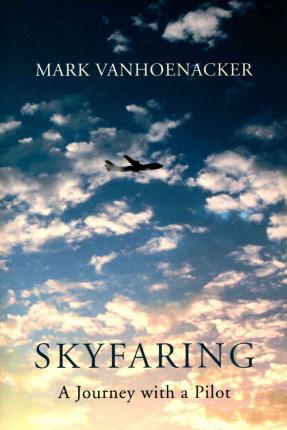
Skyfaring by Mark Vanhoenacker: Poetry Takes Flight


There are times when I'm not reading a great deal of poetry (or, less than at some other times) but it still finds its way into my life. (It always does that.) A recent example was when I read the book Skyfaring: A Journey With a Pilot by Mark Vanhoenacker.

Flying isn't particularly my favourite subject to read about. I fly at least a couple of times a year, usually more, but have struggled with it for years to the extent that each flight is anywhere from uncomfortable to a major ordeal. Oddly enough, this was partly what impelled me to read Skyfaring. The description attracted me: an experienced pilot evokes the perspective shifts, the emotional challenges and rewards, the friendships and unusual messages, and the pure beauty of flying.

I really wasn't disappointed with the book and I would certainly recommend it for a nervous flyer, at least one who can bear the thought of reading about the experience they dread. There is such an air of wonder and serenity about it that it had a noticeably calming effect on me (and yes, I did read parts of it on long plane flights a few weeks ago, between London and the west coast of Canada.) The writing is exquisite. I particularly enjoyed some of Vanhoenacker's descriptions of night flying (not my favourite time to be flying, due to a weird psychological cocktail of reasons.) Such as this:


In the high night...are many phenomena we cannot see so clearly, if we see them at all, when the sun is up. There are nameless ships of cloud that seem to sail best under a bright moon. There are vast lobes of lightning, flashbulbing out from deep within the grey matter of distant equatorial thunderstorms, while on the windowpanes St Elmo's fire, a kind of static that appears in startling bursts of flat blue veins, flickers like Prufrock's 'nerves in patterns on a screen'.


And...there's the other reason why I enjoyed Skyfaring. It opens with, as epigraph, the latter half of one of the poems in Derek Walcott's Midsummer sequence, a poem that actually is about flying (and landing):


It comes too fast, this shelving sense of home -
canes rushing the wing, a fence; a world that stands still as
the trundling tires keep shaking and shaking the heart.


Vanhoenacker obviously has a rich appreciation for literature: as well as Walcott and TS Eliot, Philip Levine, Robert Frost, 'Dark Night of the Soul' by St John of the Cross, all appear along with other poems and poets. A book well worth reading, then; but it did make me think that to enjoy flying, you really have to be a pilot - or at least sitting in business class.