Showing posts with label Cairo. Show all posts

Tuesday, 14 October 2014

New Poem Published: 'Cairo'


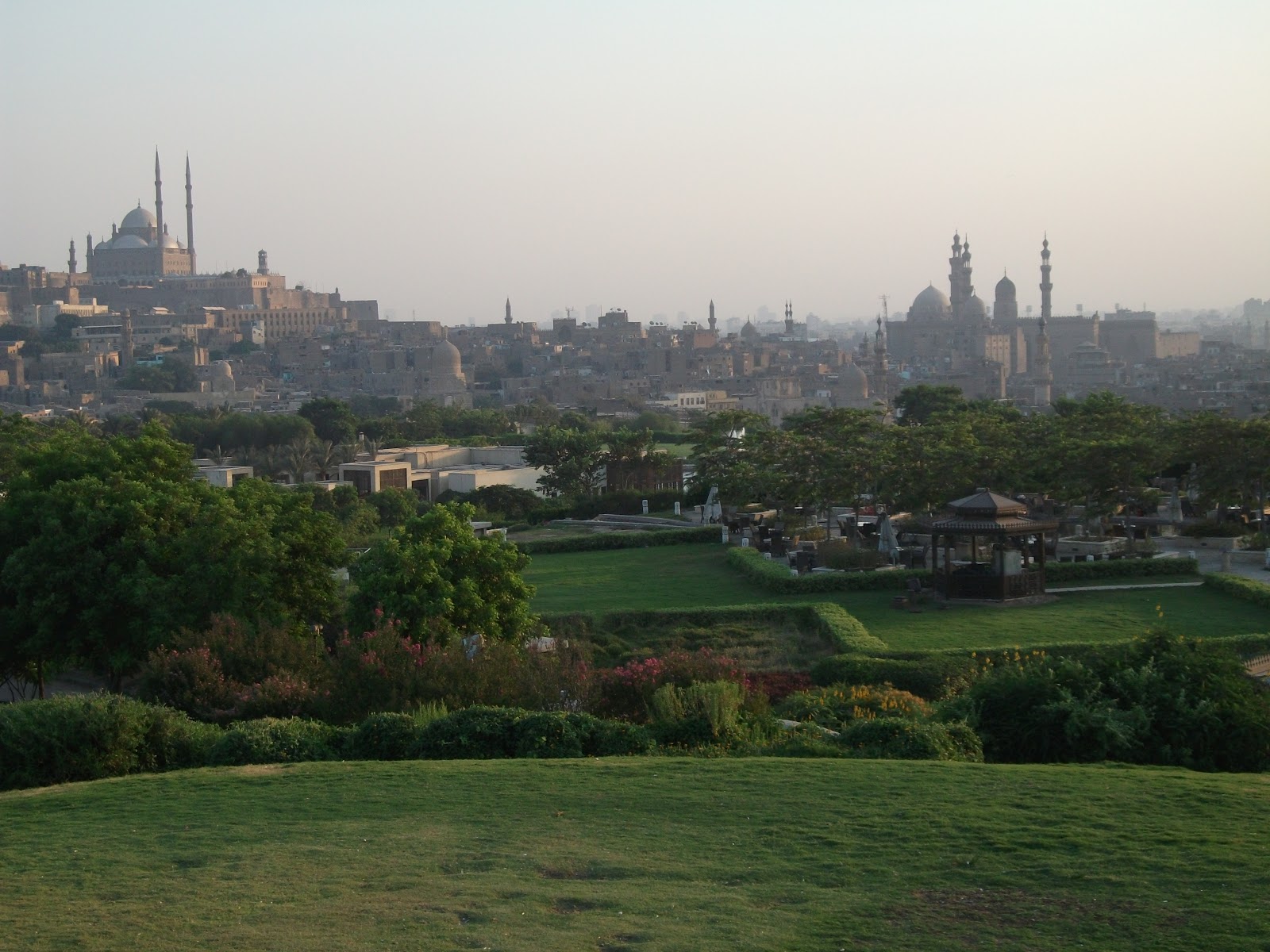
Cairo from Al-Azhar Park, 2010. Photo © Clarissa Aykroyd


A few days ago, Ink Sweat & Tears (who were also kind enough to publish one of my poems a week before, on National Poetry Day) published my poem 'Cairo'. You can read it here: http://www.inksweatandtears.co.uk/pages/?p=7467

I wrote 'Cairo' in 2010, a few weeks after visiting the city in late August/early September. In fact, I started to write it while I was still in Cairo, but I only hammered the images together after returning to London. I have always liked this poem and so it was good to find a home for it.

'Cairo' is quite a personal poem. Everything in it reflects something of my experience in that terrifying, exhilarating city. I wonder if to the detached reader it reads as a pre- or post-revolution poem - as it turned out, we were there only a few months before the Arab Spring started - but it is probably too abstract and personal to partake of that at all. I am tempted to wonder if the poetic part of my brain saw something coming that the rest of me didn't, but that may be a step too far. It is essentially a poem about embracing the unknown, possibly a frightening unknown.


Wednesday, 29 January 2014

Khaled Mattawa's 'Echo and Elixir 2': Remembering Cairo


Cairo, 2010. Photo © Clarissa Aykroyd


Ever since I visited Cairo in August 2010 there has been no way I could ever forget it. Cairo felt like a drug of a city - intense, exhilarating, destructive, terrifying and then addictive. Less than six months after I was there - three years ago - the Arab Spring and the Egyptian Revolution happened and I couldn't look away as snipers shot their own people on the streets where we'd raced around in the astonishing heat. It's always been difficult to look away.


ECHO AND ELIXIR 2 (Khaled Mattawa)


When I think of Cairo's taxi drivers, who seem to take centre stage in this poem by Libyan/American poet Khaled Mattawa, the first thing I think of is staring death in the eye, but in fairness, I think most of them were quite competent; just driving a million miles an hour in a place which laughs at road safety or seatbelts. And some of them will talk, though I found out that if you're a woman accompanied by a man or men, they'll probably address all their remarks away from you and to your companion(s).

So this is a poem about Cairo in the dizzy rushing quality of its images, the overload, and the sense - while you're in it - that the whole world is Cairo. But like the few other poems from the Echo and Elixir sequence that I've read, 'Echo and Elixir 2' is about trying to synthesize the strands of a complicated and multicultural world (and personal experience), about colonial atrocities and economic realities, about how harsh historical truths will never leave us. Mattawa grew up in Libya and moved to the United States as a teenager. He translates great Arabic-language poets such as Adonis and Saadi Youssef, and when I went to Poetry Parnassus in 2012 I hoped to hear him read, but he couldn't make it in the end - I think because he was in Libya, where he was very involved in the post-Gaddafi artistic movements. He was recently appointed to the Board of Chancellors of the Academy of American Poets, a great honour. He is well placed to write this kind of poetry, of dislocation and a multiplicity of experiences.

"I'm sad and tired of truth,/and as usual I'm never believed," says the speaker. The poem has both the excitement and the harshness of Cairo, and it cloaks real frustration in wryness. The taxi drivers and the speaker arrive, but where? They speak "all the languages/of the world" - but they argue. This is what we have to work with, the speaker seems to be saying, but to what end will it lead? Egypt and the Arab world are still asking these questions.


Sunday, 18 March 2012

Coleridge's 'Kubla Khan': Canada, Van Halen, Cairo and All Between


KUBLA KHAN (Samuel Taylor Coleridge)


    In Xanadu did Kubla Khan
A stately pleasure-dome decree:
Where Alph, the sacred river, ran
Through caverns measureless to man
Down to a sunless sea.

So twice five miles of fertile ground
With walls and towers were girdled round:
And there were gardens bright with sinuous rills,
Where blossomed many an incense-bearing tree;
And here were forests ancient as the hills,
Enfolding sunny spots of greenery.

But oh! that deep romantic chasm which slanted
Down the green hill athwart a cedarn cover!
A savage place! as holy and enchanted
As e'er beneath a waning moon was haunted
By woman wailing for her demon-lover!
And from this chasm, with ceaseless turmoil seething,
As if this earth in fast thick pants were breathing,
A mighty fountain momently was forced:
Amid whose swift half-intermitted burst
Huge fragments vaulted like rebounding hail,
Or chaffy grain beneath the thresher's flail:
And 'mid these dancing rocks at once and ever
It flung up momently the sacred river.
Five miles meandering with a mazy motion
Through wood and dale the sacred river ran,
Then reached the caverns measureless to man,
And sank in tumult to a lifeless ocean:
And 'mid this tumult Kubla heard from far
Ancestral voices prophesying war!
The shadow of the dome of pleasure
Floated midway on the waves;
Where was heard the mingled measure
From the fountain and the caves.
It was a miracle of rare device,
A sunny pleasure-dome with caves of ice!

A damsel with a dulcimer
In a vision once I saw:
It was an Abyssinian maid,
And on her dulcimer she played,
Singing of Mount Abora.
Could I revive within me
Her symphony and song,
To such a deep delight 'twould win me
That with music loud and long
I would build that dome in air,
That sunny dome! those caves of ice!
And all who heard should see them there,
And all should cry, Beware! Beware!
His flashing eyes, his floating hair!
Weave a circle round him thrice,
And close your eyes with holy dread,
For he on honey-dew hath fed
And drunk the milk of Paradise.


'Kubla Khan' is perhaps the ultimate poem which has intertwined with at least fifteen or twenty years of my existence. Perhaps it has been with me for so long that I can't remember how it came into my life. I am nearly certain that my brother introduced it to me, perhaps while studying it in high school (or when he started university? But I think it was earlier than that.) As well as a writer and student of literature, he also happens to be an expert on Van Halen. One of their songs was (at least partly) inspired by this poem, although I think it is about the pitfalls of fame. Perhaps that was Kubla's problem.


Into a world so far from home
Miles and miles from nowhere
Rooms without doors open for me
Taking me miles and miles from nowhere

Lost in this pleasure dome
Lost in my own pleasure dome

(from 'Pleasure Dome', Van Halen)


My brother and I always found the "damsel with a dulcimer" sequence a bit disappointing compared to what had gone before, even though the portrait of the insane guy was appealing. However, the poem certainly stimulated my interest in poetry, and it confirmed Coleridge as my favourite Romantic poet, if not one of my favourite poets. I never did like Wordsworth, but I am slowly coming round to him.

I knew the poem off by heart for years. I can still recite most of it at least, though there are a few bits in the middle where I tend to get stuck. I have recited it as an assignment in my grade eleven Drama class, and in al-Azhar Park in Cairo (see the above picture - it felt incredibly appropriate for the setting). My parents also bought me a psychedelic pop-up version by Nick Bantock, author of the then very trendy Griffin and Sabine. A lot of memories - some which make me smile, some with an element of loss involved.

Tuesday, 24 January 2012

Desert Flowers and Death as Familiar: The Poetry of Keith Douglas


I had a coup de foudre moment when I first read Keith Douglas, which was a little less than a year ago. This is something that never happens to me in real life: I believe in meaningful coincidences, which makes me see them everywhere, but I don't believe in love at first sight, which makes me unlikely to ever experience it.

Love at first sight does occasionally happen to me in the arts, although it used to be a more common experience when I was a bit younger. Douglas was handsome and died young, but it was his diamond-cut, hard poetry of clarity which turned my head around. I had a glimmer of it when I read 'Actors waiting in the wings of Europe', but 'Desert Flowers' punched me in the stomach. I remember feeling my heart clench up and having to draw a deep breath.


Lay the coin on my tongue and I will sing
of what the others never set eyes on.

(from 'Desert Flowers')


I think that my reaction to Douglas had to do with the familiar seen through a different prism, which is partly what he was writing about in 'Desert Flowers', as above. Simply put, I had the sense that he saw things in much the same way as I do. He understood how unique and lonely it can be to see differently. I don't always feel like this about my favourite poets, writers, artists or musicians. Sometimes they give me a glimpse of something completely different. In Douglas's case, it was the familiar presented through the new, which can be particularly powerful. It was like finding someone inside my head who I didn't know had been there all along.

Douglas was born in 1920 and studied at Oxford, where he became noted for his poetry by the time he was 18. He fought as a tanker in the North African battles of World War II, including El Alamein; his memoir Alamein to Zem Zem describes these campaigns in clear visceral detail. Douglas survived North Africa and then died in Normandy on 9 June 1944, a few days after taking part in the D-Day invasion.

He was only 24 when he died. His poetry doesn't even need the softening effect of "very accomplished for his age"; he already had a fully realised vision and we can only wonder what his more mature work would have brought. In his poems he comes across as cool to the point of coldness, visionary to the point of prophetic, and highly conscious of his own death, which he seems to have anticipated for several years. I wouldn't call it "premonition" - I don't know what to call it. He knew he was going to die and he was very serene about it, or put up a convincing semblance of it. The images of death in his poetry are calm, lucid and shocking:


[...] there are all sorts of manure, you can imagine
the dead themselves, their boots, clothes and possessions
clinging to the ground, a man with no head
has a packet of chocolate and a souvenir of Tripoli.

(from 'Cairo Jag', 1943)


I see my feet like stones
underwater. The logical little fish
converge and nip the flesh
imagining I am one of the dead.

(from 'Mersa')


Shortly before he took part in the invasion of Normandy, he wrote:


The next month, then, is a window
and with a crash I'll split the glass.
Behind it stands one I must kiss,
person of love or death
a person or a wraith,
I fear what I shall find.

(from 'On a Return From Egypt')


He was dead not long afterward. There is something detached about Douglas, as well. I don't think he wanted to die, but the depth of emotion behind his words remains at a certain remove. 'On a Return From Egypt' also gave me a shock as the image I've quoted above was echoed to a certain extent in a poem I wrote about Cairo, before I started reading Douglas. Not a poem about death, but still, one about embracing the unfamiliar and frightening:


[...] O City
that stalks and devours, I have seen my fate
and grasped its hand. I have sat
by the deathly river and tasted night.
I have touched the face
and kissed the lips behind the mask.

(from my poem 'Cairo')


Douglas had several relationships with women from different countries. One of his lovers was a Chinese woman, Yingcheng, about whom he wrote:


but alas, Cheng, I cannot tell why,
today I touched a mask stretched on the stone-

hard face of death.

(from 'The Prisoner')


This is frankly pretty disturbing. He later wrote a poem addressed to the four significant girlfriends he had, wherein he described them as "four poisons", yet still seems to have loved them very much; not a good recipe for a successful relationship. I don't think that Douglas would have been an easy man to be involved with, as much as he ticks the boxes of Manly Man and Great Poet. His father's departure when he was eight years old seems to have done a good deal of damage. His poetry reveals much by what it does not reveal.

I would have liked to reproduce 'Desert Flowers' here if possible, but Douglas's executor J C Hall has recently died and I was totally unsure how to go about trying to get permission (Faber was not helpful). Not many of his poems seem to have been reproduced online by permission. So I include here a link to 'How to Kill', a very unsettling poem and possibly his most famous. It is not my favourite of his poems (although I like it, I have too many definite favourites) but it is a good place to start.

HOW TO KILL (Keith Douglas)

I don't know what else to say about Douglas. I have a bit of a dead poet crush on him; I feel sure that we could at least have had a good conversation and that we would have understood each other. Strange to feel that way about a poet who died very young and whose life couldn't possibly have been more different from mine, but I think that those who are given the same vision tend to recognise each other.


Thursday, 8 December 2011

MacLeish's 'You, Andrew Marvell': The Fall of Vast Empires


YOU, ANDREW MARVELL (Archibald MacLeish)


The above link will take you through to 'You, Andrew Marvell' on the Poetry Foundation website, as well as other poems and biographical information about MacLeish.

I think that 'You, Andrew Marvell' - which I could probably rank amongst my favourite poems - was another random anthology-browsing discovery; not sure, though. I was a bit puzzled for years by the title, though I'd read Marvell by then. Marvell's 'The Garden' is definitely a favourite poem, and I would like to write about it another time.

Eventually I realised, or had it pointed out to me (probably the latter - I'm often quite slow on the uptake) that it was a reference to Marvell's 'To His Coy Mistress', the best pickup artist poem ever written by a long shot. The following lines from the Marvell poem are especially notable:


My vegetable love should grow
Vaster than empires, and more slow.
[...] But at my back I always hear
Time's winged chariot hurrying near;
And yonder all before us lie
Deserts of vast eternity.


'To His Coy Mistress' is very funny, and very clever, and weirdly erotic; but it is also sobering. Whether or not you're after something more profound than the speaker, time is hurrying on.

'You, Andrew Marvell' is no kind of love poem - it is about the vast empires that Marvell alluded to, and their eventual fall and decay. The poem has a racing, incantatory energy which has sometimes been criticized as repetitive, but to me it makes the poem. I see the speaker on a beach, with a vision in his mind of night's shadow falling over the turning earth. But he sees more than nightfall; he sees empires being swept under. The places that he name-checks were once world powers, and now are entirely gone, or are only weak copies of their former glory.


And Baghdad darken and the bridge
Across the silent river gone
And through Arabia the edge
Of evening widen and steal on

And deepen on Palmyra's street
The wheel rut in the ruined stone
And Lebanon fade out and Crete
High through the clouds and overblown


MacLeish was American, and I picture the speaker on a beach in the Hamptons of Long Island, or perhaps Florida. The shadow has already passed over the westernmost parts of Europe; now it looms over the sea and advances toward the coast of America. What really makes this poem special, after all the forward momentum, is the deliberate breath drawn in the split last stanza:


Nor now the long light on the sea:

And here face downward in the sun
To feel how swift how secretly
The shadow of the night comes on...


Is it simply to draw breath? Is it fear, is it wonder?

I thought of this poem today partly because I hadn't read it for a while and I love it; but also, 2011 has surely been a year to reflect upon the fall of empires. There have been few years like it in my lifetime.

I took the above picture in Cairo in August/September 2010, at the gates of the Egyptian Museum. Only a few months later the country was flung into upheaval with the Egyptian Revolution - outside those very gates, and occasionally inside - and the growing impetus of the Arab Spring. Recently I saw a photo from 2010 of an African-Arab summit where the leaders of Yemen, Egypt, Libya and Tunisia all stood together in the front row. Now, all have fallen and one is dead.

Other "empires" have been shaken; Japan, one of the largest economies in the world, after an appalling disaster which killed tens of thousands; the financial powers, through economic crisis and protest movements. This has been a momentous year. What will 2012, now so close, bring?