Saturday, 11 February 2012

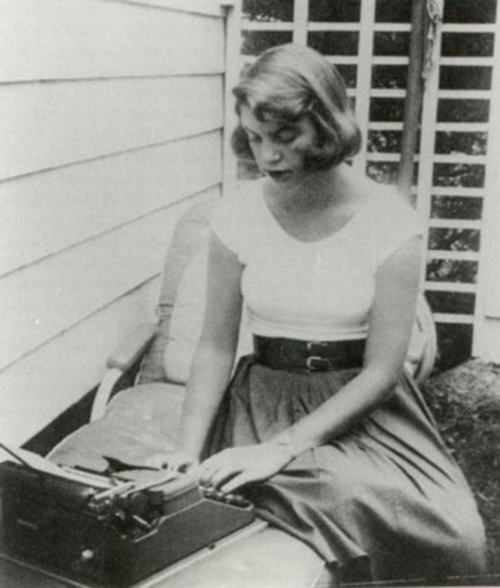
Sylvia Plath and 'Ariel': "And I Am the Arrow"


49 years ago, on 11 February 1963, poet Sylvia Plath was found dead in her London flat. It had previously been the home of W B Yeats, which had pleased Plath when she moved in a few months earlier. The circumstances of her suicide at the age of 30 are well known. Her marriage to Ted Hughes had come to a painful end, she was suffering from severe depression, living alone with their two small children, and it was one of the coldest winters on record in the UK.

I had not read much of Plath until very recently, or at least not while paying much attention. 'Daddy' and 'Lady Lazarus' had popped up from time to time over the years, as they are considered such iconic poems, and I didn't care for either of them. Especially 'Daddy'. I didn't understand Plath's fixation on Holocaust themes and her demonizing of a dead father who was not actually a Nazi. I just found it tedious, melodramatic, and unpleasant.

I think I may have had a bit of an early reaction against Sylvia Plath because of the ever-present suggestion that, as a girl and now as a woman, I should love her work and should not enjoy Ted Hughes's, because of their terrible history. Perhaps it was more than a suggestion; I may have had a faint niggling feeling that I was letting down the side by preferring Hughes to Plath. Apparently this is one of those literary areas where you are supposed to pick a side. I've enjoyed Hughes's poetry for years - though not all of it, by a long shot - and just could not be bothered to come back to Plath. To be honest, because of the trappings and because of my own teenage experiences, she made me think of extreme political correctness and a particular brand of feminism.

I grew up on the West Coast of Canada, one of the most politically correct regions of an extremely politically correct country, and in my late teens I attended what may very well be the most politically correct university in the world. As fond as I am of my university and as good as my experiences there generally were, I don't count it as a plus that they had an "ombudsperson" rather than an ombudsman, and that my brother was once told by the university paper that the CD review he'd written was excellent but that the word "craftsmanlike" had to be replaced by "craftspersonlike". (Every European who I've shared this story with has laughed in disbelief, which is interesting in itself. To be fair, some people from other parts of Canada have laughed, too.) Gender-specific language? Tut tut.

I was left with an impression of this type of feminism as a question of PC gone crazy, of semantics, of the inevitable person in every class who would rant on about the patriarchy, phallic symbols and oppression. I don't happen to believe that any of this is useful and that making silly changes to words is going to make a difference to people's attitudes. I have never understood what good it does to characterize 50% of the human race as cruel and oppressive due to their gender, when it would be better to address the questions of why human beings generally have a hard time treating each other decently, honestly and respectfully, and why so many people (a majority being men, throughout history - but both genders are implicated) are obsessed with seeking out an imbalance of power and abusing it. Surely equal, healthy and happy relationships (of any kind) are more desirable than just telling men why they are wrong.

To a certain extent, I understand why Plath was adopted as a feminist icon. She had a disastrous relationship with a man whose subsequent lover also eventually committed suicide, and who ultimately became a poster boy for male oppressiveness. I may not be a big fan of 'Daddy', but its rage and power is undeniable. Many of her poems bristle with anger and pain and the agonizing desire to be heard, to have a voice. But I doubt that she considered herself a feminist, or purely one, as some seem to want to characterize her. Not everything in her poetry is about fighting against male dominance, or about rejecting the roles imposed upon her. She was also suffering from mental illness, in a very debilitating manner, and this was the case even before she met Hughes. The language of her poems invests the world around her with hostility and agony. Colours and sounds seem to trouble her greatly, and there is a traumatized focus on physical details in so many of her poems. This is an area which I find interesting (although painful), more so than the feminist angle.


The tulips are too red in the first place, they hurt me.
Even through the gift paper I could hear them breathe
Lightly, through their white swaddlings, like an awful baby.
Their redness talks to my wound, it corresponds.

(from 'Tulips')


The moon is no door. It is a face in its own right,
White as a knuckle and terribly upset.
It drags the sea after it like a dark crime; it is quiet
With the O-gape of complete despair.

(from 'The Moon and the Yew Tree')


Sylvia Plath was a woman and person in her own right, not just a woman whose life went very wrong in large part because of a man. It doesn't seem fair to imply that she would have had nothing to write about had Ted Hughes (or another man) not treated her badly, or had she not been raised as a traditional American girl and found herself caught between conflicting impulses and attitudes as a creative woman and a strong personality at a time when societal attitudes were shifting. I think that she was more talented than her circumstances.

I decided to start reading Plath more closely because of a recent encounter with the poem 'Ariel', which can be found on this link:

ARIEL (Sylvia Plath)

At least in its most literal sense, the poem is about Plath riding her horse Ariel. It is a rush of giddy images, of exaggerated sensual details which work perfectly in the context of the poem. It is about pure feeling moving to something on a more transcendent level - release from physical constraints and mental or emotional burdens. Poet and critic A Alvarez, who was also friends with Sylvia Plath, commented: "You are made to feel the horse's physical presence, but not to see it. The detail is all inward. It is as though the horse itself were an emotional state." To me, despite its somewhat catastrophic imagery, this is a rare example in Plath's poetry of the physical world being invested with something exultant and joyful, rather than anger and suffering.


And I
Am the arrow,

The dew that flies
Suicidal, at one with the drive
Into the red

Eye, the cauldron of morning.

(from 'Ariel')


I love this poem, and it is enough to make me want to explore Plath further. I have wondered why my literary preferences - certainly in the realm of poetry - seem to be heavily weighted toward male rather than female writers. The subjects of my blog posts so far are enough to reveal that - there have hardly been any women. I have yet to determine whether this is more than coincidence. Perhaps I really have just been brainwashed by the patriarchy and all those dead white guys. Perhaps I'm looking for the male perspective, given that I am a woman with a pretty good sense of my own identity (thus not feeling the need for a lot of help with female identity) and that the majority of my friends are female. Perhaps I prefer the male voice for some reason I have not identified (though the example of Ted Hughes is surely enough to make me look very cautiously at the whole Manly Man thing). Or perhaps it is just a numbers game, since until recently men have had a lot more opportunities - and in many areas this is still how it is. In any case, I feel that I have something to gain from reading Sylvia Plath.

Thursday, 9 February 2012

'The Darkling Thrush': Or, How I Learned to Stop Worrying and Love Thomas Hardy


THE DARKLING THRUSH (Thomas Hardy)


I leant upon a coppice gate
When Frost was spectre-grey,
And Winter's dregs made desolate
    The weakening eye of day.
The tangled bine-stems scored the sky
    Like strings of broken lyres,
And all mankind that haunted nigh
    Had sought their household fires.


The land's sharp features seemed to be
    The Century's corpse outleant,
His crypt the cloudy canopy,
    The wind his death-lament.
The ancient pulse of germ and birth
    Was shrunken hard and dry,
And every spirit upon earth
    Seemed fervourless as I.


At once a voice arose among
    The bleak twigs overhead
In a full-hearted evensong
    Of joy illimited;
An aged thrush, frail, gaunt and small,
    In blast-beruffled plume,
Had chosen thus to fling his soul
    Upon the growing gloom.


So little cause for carolings
    Of such ecstatic sound
Was written on terrestrial things
    Afar or nigh around,
That I could think there trembled through
    His happy good-night air
Some blessed Hope, whereof he knew
    And I was unaware.


It is snowing in London again, and no doubt even more in other counties and countries. I had thought of posting some snowy poem to go along with the cold weather. Although this is not quite a snowy poem, it is at least wintry and beautiful. It was first published at the turn of the nineteenth century, and so it is usually reprinted as a New Year (or Old Year) poem - I noticed that several poetry blogs reproduced it around the end of the year.

I have a sad Thomas Hardy tale to tell. When I was no more than about twelve years old, my brother cruelly handed me Jude the Obscure and told me to read it. He wasn't normally a cruel brother, so I think that he may actually have wanted to share a book with me that he had enjoyed (or at least, there were definitely some passages in it that he had found funny.) Somehow I read it from cover to cover. And I hated it. I hated it so much that there were no words for my hatred. I found it boring, depressing, stupid, and...stupid. I cited it as my most hated book for many years. I was thoroughly Hardy-complexed and didn't want to look at another word he had written.

I think that I read 'The Darkling Thrush' when I was 16 or 17. I may even have studied it in grade 12, though I am not sure about that. It was certainly the poem that opened Hardy up to me again. I still didn't want to look at his prose, despite tentative suggestions that the likes of Far From the Madding Crowd might be just the thing to cure my malaise. I didn't want to know. But the poem was wonderful. Pessimistic, yes - but amazingly evocative and beautiful. I can see the bleak grey-brown landscape, hear the thrush's brave and glorious song, and feel the poet trying so hard to find some optimism against all his inclinations.

I encountered more of Hardy's poems in university - 'The Convergence of the Twain', 'During Wind and Rain', 'The Sunshade' - and either loved or liked all of them. I filed Hardy strictly under "awesome poetry, dire prose" for many, many years. Only about two years ago, I finally made myself read Tess of the d'Urbervilles. I had to acknowledge that it was engrossing and brilliantly written, but it was also highly melodramatic, and I loathed every single character, for different reasons. So my feelings about Hardy's prose are still mixed. But I love the poetry, and this poem in particular.

Sunday, 5 February 2012

W S Graham's 'The Night City': London Is My Open Book


On Saturday I went to a poetry workshop on "Megacities and the Grotesque", led by poet and performance artist Siddhartha Bose. I think the most valuable thing that I took away from it for my own writing was how to work on speaking through the voices of others, something I haven't done very much. I might yet get something from the beggar in Hammersmith who snarls at everyone and recently called me a "#&%* posh girl". We spent a good deal of time discussing London and its possibilities; read New York poems by Lorca, Whitman and Walcott; and Siddhartha read to us from his shambolic beatbox of a poem, 'Shoreditch Serenade'.

Cities tend to inspire me when I write poetry myself. I've written quite a few poems about different aspects of London, and when I travel to other cities they often inspire some work. I've found that my poems tend to start out being about a place or a city, and later become a meditation on something I'm preoccupied with or struggling with. This is the city as mirror - Derek Walcott has done this quite wonderfully. Much as World War II bombs and Roman ruins sometimes come to light in the City of London during roadworks and the like, different cities uncover different aspects of my self.

We were asked if possible to bring city poems to read. One of the ones that I read was 'The Night City' by W S Graham, which can be found on this link:

THE NIGHT CITY (W S Graham)

I first read this poem some months ago and loved it right away. It instantly spoke to so much of what fascinates me about London, and it reminded me of my own first visit. I was 17 or 18 and travelling with my parents and brother. London had been an essential part of my mental and emotional landscape for years, and I was especially obsessed with Sherlock Holmes at the time (still am) and wanted to walk in his footsteps. London was everything I wanted, and when I arrived there in the flesh, I found that it was still everything I wanted. I'd probably dreamed about moving there even before that, but visiting the city solidified that dream. I later wrote a poem about that first afternoon, being overwhelmed by the sight of one great monument after another, and simply by being there. I remember that it contained the line about standing on Trafalgar Square, staring around awestruck: "Completion. This is it."

Graham arrives in the midst of a Turner painting (the above painting is Turner's depiction of the Houses of Parliament on fire - he didn't paint London a great deal.)


Unmet at Euston in a dream
Of London under Turner's steam


London is his "golden city", where he meets T S Eliot, and Holmes, and John Donne, and others. (Graham actually did meet Eliot in London - Eliot championed his poems and Faber became Graham's publisher.) I had to look up Paul Potts - interestingly, he was a modern poet who came originally from British Columbia, my home province. He wandered the dark streets of Soho, not bathing nearly often enough. I have not tracked down any of his poems yet, but would like to. It seems that both London and Canada claim him.

The poem stops on a dark, quiet note. The City is always empty when its workers have gone home. The speaker is still surrounded by the echoes of history and literature - the Great Fire, the Plague - and finds himself "In the stopped works of a watch"; both in time, and out of it. This is a feeling that I frequently have in London.

It is often good to be pushed out of your comfort zone by literature and art, but I admit that this poem is very much one of "my poems"; it describes my vision of London. I have always seen places, and London particularly, through the lens of literature and art. I think that this is my way of both participating and protecting myself. London, as well as being Unreal City and a literary dreamland, is also harsh and tough and violent. I keep my eyes open for the threatening elements, but imagining that I am in a book or a poem - that carries me through, in so many ways.

Thursday, 2 February 2012

Louis MacNeice's 'Entirely': Some Days You Just Want Art to Calm You Down


I finished work early today, and when my errands were done I found myself first at the National Portrait Gallery, wandering amidst the artists and politicians and explorers and looking for the Isaac Rosenberg self-portrait which I included in my last entry. It's in storage, but if it comes out I might see it some day. My eventual port of call was the Turners in the National Gallery - my feet often seem to lead me there. I had the obligatory conversation in front of Rain, Steam and Speed, above, about the hare running in front of the train. Some day I'll set off the alarm pointing it out. Although I have known about the hare for a long time (the NG kind of spells it out for you by mentioning it in the blurb), I always see something in that painting I haven't seen before.

I had Rosenberg's lines on my mind and felt a bit overwhelmed. There is something about a poem like 'Break of Day in the Trenches' which brings me to the overall experience from the very personal - that is, one man's perspective makes me think about all the individual experiences, which is a very large-scale tragedy. So I couldn't think about that for much longer. I finally found my way to this poem by Louis MacNeice, 'Entirely'.

ENTIRELY (Louis MacNeice)

I don't have a great deal to say about this poem, but I love its truthfulness, and how succintly memorable it is, and how practical. Poetry can be very practical, especially because of its capacity for extreme accuracy, and it strikes me that MacNeice was a practical sort except when he was entangled in disastrous relationships or alcoholism (which seems to have been a lot of the time.) He just says it like it is in this poem, but very elegantly. I'm not sure he and I would have entirely agreed that "in brute reality there is no/Road that is right entirely", but I know what he means. Human nature is such that almost everything has ambiguity attached to it, and something difficult will accompany even the best decision, and you'll never quite say what you wanted to say:


And when we try to eavesdrop on the great
Presences it is rarely
That by a stroke of luck we can appropriate
Even a phrase entirely.


I also like the fact that he acknowledges: "Or again we might be merely/Bored" if things were simpler. But the question is moot, as he points out, so he is not going to worry about it too much.

MacNeice's poems tend to calm me down, much as my favourite paintings tend to do. I always feel better (even if I was already feeling fantastic) when I've had time to wander through a gallery, like today. Often that is just what we need from art.

Tuesday, 31 January 2012

Isaac Rosenberg's 'Break of Day in the Trenches' - War Poetry and War Horse


BREAK OF DAY IN THE TRENCHES (Isaac Rosenberg)


The darkness crumbles away -
It is the same old druid Time as ever.
Only a live thing leaps my hand -
A queer sardonic rat -
As I pull the parapet's poppy
To stick behind my ear.
Droll rat, they would shoot you if they knew
Your cosmopolitan sympathies
(And God knows what antipathies).
Now you have touched this English hand
You will do the same to a German -
Soon, no doubt, if it be your pleasure
To cross the sleeping green between.
It seems you inwardly grin as you pass
Strong eyes, fine limbs, haughty athletes
Less chanced than you for life;
Bonds to the whims of murder,
Sprawled in the bowels of the earth,
The torn fields of France.
What do you see in our eyes
At the shrieking iron and flame
Hurled through still heavens?
What quaver - what heart aghast?
Poppies whose roots are in man's veins
Drop, and are ever dropping;
But mine in my ear is safe,
Just a little white with the dust.


I'm no expert on World War II poets but I am probably a tiny bit closer to it than with the World War I poets, being anywhere from interested in to obsessed with The Big Three of Keith Douglas, Sidney Keyes and Alun Lewis. The World War I poets are, by and large, more famous: Wilfred Owen, Rupert Brooke, Siegfried Sassoon and others. They have individual poems that touch me but but their vision doesn't speak to me to the same extent as those of Douglas and Keyes.

I'm not sure if I had heard of Isaac Rosenberg before I read Keith Douglas's remarkable 'Desert Flowers'. I think it's likely that I had come across his name, but I don't remember. In 'Desert Flowers', Douglas wryly says: "Rosenberg I only repeat what you were saying". It is a touching moment in the poem where the poet's everyday voice seems to break through. Rosenberg was a Londoner of Lithuanian Jewish parentage, who died in France in 1918. He was opposed to killing and to the war, but enlisted primarily to provide financial support for his mother. He was also an artist and painted the self-portrait above.

I don't know what Douglas meant when he spoke to Rosenberg - whether he referred to something specific in one of Rosenberg's poems, or if it was homage to his overall vision. I haven't read that much by Rosenberg yet. 'Break of Day in the Trenches' is his most famous poem - some feel that it is the single greatest poem of the war - and its opening lines are totally enthralling: "The darkness crumbles away - /It is the same old druid Time as ever." If only it were not about something as terrible as the war. It is a beautiful and skilful poem, with its subtle references to the rat who doesn't care about the national divisions that led to the war, and the heartbreaking bravado of the dust-whitened poppy tucked behind the young soldier's ear. It makes me want to read more of Rosenberg.

I thought of this poem partly because I'd been reading Douglas - and 'Desert Flowers' is forever burned on my mind - but also because I went to see the new film War Horse on the weekend. I loved the horse actors, who were superb, and so were some of the humans; it was impressively filmed, and Benedict Cumberbatch was in it, which never hurts. It could have been better, though. It was perhaps a bit too sentimental and glossy, though I realise that it was a film at least partly aimed at a younger audience and it wasn't going to be a full-on war movie. It did convey something of how terrible World War I was. Scenes from the trenches, and a cavalry charge (swords and all - tragic and ridiculous) cut down by machine guns... But it was sanitized, and as much as some of the scenes shocked by their power of suggestion, I couldn't help thinking that the reality was a million times worse than anything depicted. I do unreservedly recommend the play, which is still running in London's West End and I think now in America - the giant horse puppets had a magic I've never seen elsewhere on stage.

Sunday, 29 January 2012

Al Purdy, Tom Thomson, the Group of Seven, and Canada: "A Country That No Man Can Comprehend"


Preface and Last Poem, HER GATES BOTH EAST AND WEST (Al Purdy)


The above link will take you through to a page on the website of Harbour Publishing, Al Purdy's publishers. It contains the preface to his Collected Poems and a 'last poem', 'Her Gates Both East And West'.

The painting is The Jack Pine by Tom Thomson, a great Canadian painter. It was completed in 1917, not long before Thomson's death. He died under mysterious circumstances in Algonquin Park, Ontario - his canoe was found floating empty and his body discovered over a week later. Thomson was the principal inspiration for the Group of Seven, who are remembered alongside his name and art. Along with Thomson, these seven - Franklin Carmichael, Lawren Harris, A Y Jackson, Franz Johnston, Arthur Lismer, J E H Macdonald, and Frederick Varley - left an extraordinary legacy to Canadian art. They celebrated the country's grandiose, cutting mountainscapes, its astonishing colours and contrasts, and its vastness. While they were principally based in Ontario, they also travelled and found inspiration from British Columbia to Nova Scotia, and even in the Arctic.

At the end of 2011, the Dulwich Picture Gallery in London hosted a wonderful exhibition of Tom Thomson and the Group of Seven. Of course, every Canadian art lover in town headed down to see it, including myself; but it was great to see so many Londoners curious about what Canadian art had to offer. I suspect a lot were thinking "not much". It was amazing to see so many of these great paintings together, though I was struck by homesickness and also had the inevitable "The rest of the world doesn't know what they're missing, eh?" conversation with another ex-pat. The exhibition was very well reviewed by the media and was a success. But the comment I was happiest to hear was overheard from a surprised-sounding art lover in the Lawren Harris room. Surrounded by monolithic, glowing, semi-deified icebergs and lakes, she said: "I've never seen anything like this before." Coming from hard-to-impress Londoners, that kind of comment is quite something.

I think that Tom Thomson and the Group of Seven go well with Al Purdy's poems. In so many respects, Purdy is the great voice of modern Canadian poetry. His poems are funny, irreverent and a bit rude; they celebrate Canada's vastness and beauty and tell us not to worry about that silly quest for national identity we're so hung up on. This is Canada - massive, diverse, harsh, lovely, self-celebrating but self-deprecating.

I heard Al Purdy read twice and met him once, probably in the space of about a year - maybe two years before he died in 2000. He came to read and chat with my modern Canadian poetry class. He was very tall and had a foghorn voice and an enormous personality. I was obviously being a bolshie 18 (19?)-year-old intellectual that day because I asked him how he could explain placing D H Lawrence's poetry ahead of Yeats's - he cited both of them as massive influences but loved Lawrence the most. (At the time, I was a total Yeats devotee.) He boomed "I'd have a hell of a time explaining it!" and then, as I recall, fixed his piercing eyes on me and recited a bit of Lawrence. There wasn't much I could say in response to that. Some months later, I went to one of Purdy's readings at the university. I remember he had an auditorium-full of students and others howling with laughter as he read some of his best-loved poems:


Now I am a sensitive man
so I say to him mildly as hell
"You shouldn'ta knocked over that good beer
with them beautiful flowers in it"

(from 'At the Quinte Hotel')


Purdy is funny on the page, but hearing him read was unforgettable. It's such a loss that he is no longer around to read his own poems, as they're not quite the same coming from anyone else.

Purdy lived and travelled all over Canada, though his later years were spent in Sidney, BC, just outside of my hometown of Victoria. Much of his inspiration seems to have come from Ontario, and from the Arctic, but it appears that he touched down almost everywhere. He hears the same voice everywhere, something which holds the country together:


Listen:
you can hear soft wind blowing
among tall fir trees on Vancouver Island
it is the same wind we knew
whispering along Côte des Neiges
on the island of Montreal
when we were lovers and had no money

(from 'A Handful of Earth')


I love the range and sweep of 'Her Gates Both East and West'. Purdy calls Canada "a country that no man can comprehend", and I think I know what he means. It's too big, it's too empty, its people are diverse but distinctly Canadian; it boggles the mind as much as it seduces. People in Europe sometimes ask why I've only been to Toronto a couple of times, given that it's the country's major city. I explain that I grew up almost a five-hour plane flight away. Then they understand a little more, but unless they have been to Canada (or at least North America) they don't really understand. From the UK, five hours would take you beyond Turkey. Flying that far and still being in the same country is hard to understand if you come from a small nation. I still can't help laughing when I overhear comments like "France and Germany are SO BIG!". Er, really?

I've travelled in Canada; fairly large parts of British Columbia, quite a lot of Alberta, bits of Ontario and Quebec. Is that really all? A lot of it was a very long time ago, too. It still takes in a lot of sights and memories. I think of the west coast of Vancouver Island, endless sand and ocean at Long Beach, world's end. The Rocky Mountains, lakes a blue you can't believe, postcard scenes beyond anything the human mind could imagine. The top of the CN Tower at night in November - COLD. Seeing the house where my father grew up in Westmount, Montreal. Flying home from Europe for a visit, watching hours and hours of rock and ice and snow unfolding beneath me and marvelling at it. The ferry between the mainland and Vancouver Island - the islands, the calm, the beautiful horizons. Road trips where you fall asleep and wake up hours later and the landscape has hardly changed, because it's just so big, and so far.

Unsurprisingly, I probably didn't really appreciate Canada until I left. People tell me how fortunate I was to grow up there, how beautiful it is, and wonder how I could have left. I tell them there was a big wide world waiting out there, and I love London, and I love Europe. But Canada was a special place to grow up. It is unusual to grow up in a city and still feel so close to nature, and in Canada you can easily do that, especially somewhere like Victoria or Vancouver. I miss the familiar mountains, their shapes and names, their changeable yet constant nature, colours shifting from day to day, sometimes disappearing behind cloudcover. I miss the sea and I miss knowing that not far away are lakes and forests. I miss knowing that I could be in a car for hours and there would be just an endless pour of dark green trees past my window and it would hardly change for hours. When I was younger, I found that a bit boring. I now know how wrong I was. Constant and exciting and magnificent, Canada is - not boring.

Friday, 27 January 2012

Copyright: is there any point in trying?


Holmes glanced up at my gasp. "What is it, Watson?" he asked sharply.

"Holmes," I cried, "it is a copyright violation. How horrible!"


Well, maybe not. And yet, and yet...copyright can be such a fraught, complex and even emotive area that Holmes himself might have felt inclined to turn his ginormous brain to its perusal.

I suppose that my decision to be hyper-conscientious about this blog has sort of become the "hook" for the whole thing - although I am not too sure anyone besides myself has actually noticed. Essentially, I'm not that worried about becoming the target of a massive lawsuit if I post a poem in its entirety without permission; it's more to do with some moral feelings surrounding the issue, combined with sympathy for the poets. I've posted one of my own poems (so far) in its entirety on this site and I don't particularly want people just taking it for their own use and without properly crediting it (if anyone wanted to do that, which is dubious.) I am treating this blog a little bit more like a magazine, I guess. It cuts down on spontaneity as I end up planning the entries somewhat more than I otherwise might, but that's sort of how my mind works anyway; things tick over in the background for a while and then emerge relatively formed. Spontaneity was never my strong suit.

Asking for permission has been interesting so far. Of course, I have posted some out of copyright poems - easy. As I think I mentioned at the outset, though, the majority of my current favourite poets actually do fall into that area where they've died but won't be out of copyright for another 5 to 50 years. That's what you get for preferring the greats of modern poetry. I've often been able to link to the poem I want on a site where permissions have cleared; Poetry Foundation, Poets.org and Poetry Archive have been particularly amazing resources for this. But sometimes poets have virtually no online presence of this sort. Or the poem I wanted can't be found online at all, or only without permissions having been cleared.

I've had an interesting variety of responses. One or two publishers have turned me down but have been very nice about it. A few publishers and agents have happily granted me permission but wanted to be sure that I had the most up-to-date version of the poem (in the case of Derek Mahon, this was noteworthy as he tends to revise his poems a lot) and that I knew it was a once-off, and that I credited the poem properly. This is all very correct, and I think that they took the pragmatic view that at least I was asking and perhaps it was a little free publicity for that author's Collected Poems or some such. One poet gave me permission directly, and so did an executor of an estate; both of these were very kind and also gave me some very interesting comments which I incorporated into the entry. Then there was Faber and the T S Eliot incident.

I had written to Faber asking whether I could reproduce Eliot's 'Marina', a favourite poem which also reminds me of home. I honestly didn't hold out a lot of hope, as Eliot is...well, Eliot...and I thought Faber was likely to keep a fairly tight grip on things generally. The automatic email I received in reply told me to expect at least a couple of months' wait, which is perfectly reasonable for a busy permissions department.

A few weeks ago I posted an entry about The Waste Land, in which I quoted some lines. Coincidentally (I think), Faber permissions got back to me a few days later. Politely, they told me that they were not able to grant permission to reproduce Eliot's poems electronically. However, they also told me that they had noticed my entry on The Waste Land and that I should take down all the quotations that I had used. This amounted to about 20 lines of a 400-lines-plus poem.

I was nonplussed and thought maybe they'd misunderstood and hadn't looked at the entry, and thought I had simply reproduced the whole thing or a huge portion thereof. I wrote back slightly acerbically commenting that I wasn't aware of any prohibition against quoting. The response (which sounded slightly apologetic) was that this was the publisher's decision and they had to ask me to remove the quotes. I didn't write back again.

From a little bit of subsequent online research I learned that the Eliot estate is pretty draconian. And no, they don't want you even quoting Eliot - anywhere - without permission. Not even a few lines at 5 or 10% of the poem. As you can see, I haven't taken the lines down. I think that if Faber pursues this it will really indicate that they don't have much else to do (which I doubt), and furthermore I don't feel that they are in the right legally - there are actual laws governing this sort of thing, though I admit it can be a somewhat gray area. It's completely right and acceptable for a publisher or estate to insist that they maintain control over the reproduction of entire poems or very large portions, but this hardly fell into that category. I had also provided a link to the Poetry Archive, where the poem actually is reproduced in its entirety, by permission.

I just couldn't help feeling that it was more than a little ungracious of them to respond to my query about another poem by not only saying that they didn't want me to reproduce 'Marina' - perfectly reasonable - but that I had to take down every tiny Eliot quote I'd ever used. I am a blogger and I am certainly not doing this for profit - and I was trying to do things the right way by the legal standards. While I do feel (a bit) for the publishing Emmas who get stuck with trying to enforce these decisions made by other people, I don't think that it was a particularly appropriate occasion to slap someone on the wrist. As I've said, I don't feel they are in the legal right to insist on this, and I had also directed people to a source where permissions were cleared. (The response I'd had from Faber said something about my quotations being accessible to the whole world and their dog - ok, maybe not those exact words - but failed to address the fact that I'd directed readers to a permissions-cleared online source which was also accessible to the whole world and their dog.) A large part of the intention of copyright protection is to not deprive the artist or the estate of their rightful income. What I'd done did not fall under that heading. In fact, the whole point was to direct people to the entire work, encouraging them to do so by my own enthusiasm for the poem, and by quoting a few of its irresistible lines. It is also a fact that there are numerous online sites where Eliot's poems are reproduced in their entirety without permissions clearance, and in many cases Faber does not appear to have insisted on their removal.

I suppose this is the moment to admit that I'm not sure where I am going with all this. I was a bit annoyed, but it's no big deal. I'm not planning to change my overall approach; quoting within reason and the usual norms of "fair use", linking to legal sources, sometimes approaching a publisher, agent, executor or poet and seeing how I get on. I feel better about this approach than I would about any other, and I think that it has worked reasonably well so far. I completely understand how difficult an area this can be - which is why I've taken the trouble of going down this road. I guess I'm also hoping that those who control the copyright will be reasonable in return. I don't expect everyone to grant me permission, at all. However, expecting them to be reasonable is something else again.


Tuesday, 24 January 2012

Desert Flowers and Death as Familiar: The Poetry of Keith Douglas


I had a coup de foudre moment when I first read Keith Douglas, which was a little less than a year ago. This is something that never happens to me in real life: I believe in meaningful coincidences, which makes me see them everywhere, but I don't believe in love at first sight, which makes me unlikely to ever experience it.

Love at first sight does occasionally happen to me in the arts, although it used to be a more common experience when I was a bit younger. Douglas was handsome and died young, but it was his diamond-cut, hard poetry of clarity which turned my head around. I had a glimmer of it when I read 'Actors waiting in the wings of Europe', but 'Desert Flowers' punched me in the stomach. I remember feeling my heart clench up and having to draw a deep breath.


Lay the coin on my tongue and I will sing
of what the others never set eyes on.

(from 'Desert Flowers')


I think that my reaction to Douglas had to do with the familiar seen through a different prism, which is partly what he was writing about in 'Desert Flowers', as above. Simply put, I had the sense that he saw things in much the same way as I do. He understood how unique and lonely it can be to see differently. I don't always feel like this about my favourite poets, writers, artists or musicians. Sometimes they give me a glimpse of something completely different. In Douglas's case, it was the familiar presented through the new, which can be particularly powerful. It was like finding someone inside my head who I didn't know had been there all along.

Douglas was born in 1920 and studied at Oxford, where he became noted for his poetry by the time he was 18. He fought as a tanker in the North African battles of World War II, including El Alamein; his memoir Alamein to Zem Zem describes these campaigns in clear visceral detail. Douglas survived North Africa and then died in Normandy on 9 June 1944, a few days after taking part in the D-Day invasion.

He was only 24 when he died. His poetry doesn't even need the softening effect of "very accomplished for his age"; he already had a fully realised vision and we can only wonder what his more mature work would have brought. In his poems he comes across as cool to the point of coldness, visionary to the point of prophetic, and highly conscious of his own death, which he seems to have anticipated for several years. I wouldn't call it "premonition" - I don't know what to call it. He knew he was going to die and he was very serene about it, or put up a convincing semblance of it. The images of death in his poetry are calm, lucid and shocking:


[...] there are all sorts of manure, you can imagine
the dead themselves, their boots, clothes and possessions
clinging to the ground, a man with no head
has a packet of chocolate and a souvenir of Tripoli.

(from 'Cairo Jag', 1943)


I see my feet like stones
underwater. The logical little fish
converge and nip the flesh
imagining I am one of the dead.

(from 'Mersa')


Shortly before he took part in the invasion of Normandy, he wrote:


The next month, then, is a window
and with a crash I'll split the glass.
Behind it stands one I must kiss,
person of love or death
a person or a wraith,
I fear what I shall find.

(from 'On a Return From Egypt')


He was dead not long afterward. There is something detached about Douglas, as well. I don't think he wanted to die, but the depth of emotion behind his words remains at a certain remove. 'On a Return From Egypt' also gave me a shock as the image I've quoted above was echoed to a certain extent in a poem I wrote about Cairo, before I started reading Douglas. Not a poem about death, but still, one about embracing the unfamiliar and frightening:


[...] O City
that stalks and devours, I have seen my fate
and grasped its hand. I have sat
by the deathly river and tasted night.
I have touched the face
and kissed the lips behind the mask.

(from my poem 'Cairo')


Douglas had several relationships with women from different countries. One of his lovers was a Chinese woman, Yingcheng, about whom he wrote:


but alas, Cheng, I cannot tell why,
today I touched a mask stretched on the stone-

hard face of death.

(from 'The Prisoner')


This is frankly pretty disturbing. He later wrote a poem addressed to the four significant girlfriends he had, wherein he described them as "four poisons", yet still seems to have loved them very much; not a good recipe for a successful relationship. I don't think that Douglas would have been an easy man to be involved with, as much as he ticks the boxes of Manly Man and Great Poet. His father's departure when he was eight years old seems to have done a good deal of damage. His poetry reveals much by what it does not reveal.

I would have liked to reproduce 'Desert Flowers' here if possible, but Douglas's executor J C Hall has recently died and I was totally unsure how to go about trying to get permission (Faber was not helpful). Not many of his poems seem to have been reproduced online by permission. So I include here a link to 'How to Kill', a very unsettling poem and possibly his most famous. It is not my favourite of his poems (although I like it, I have too many definite favourites) but it is a good place to start.

HOW TO KILL (Keith Douglas)

I don't know what else to say about Douglas. I have a bit of a dead poet crush on him; I feel sure that we could at least have had a good conversation and that we would have understood each other. Strange to feel that way about a poet who died very young and whose life couldn't possibly have been more different from mine, but I think that those who are given the same vision tend to recognise each other.